
Industry Background: The Automated Fresh Food Retail Challenge
The commercial retail sector faces mounting pressures that fundamentally challenge traditional business models. High site rents, escalating labor costs, and geographical constraints continue to limit operational hours and market reach for food service providers. These structural issues become particularly acute in the fresh and hot food segment, where product perishability, heating requirements, and delivery precision create additional complexity layers that conventional vending technology struggles to address.
IMT Vending has identified a critical gap in automated retail infrastructure: the inability of standard vending machines to handle fragile packaging, provide integrated heating capabilities, and maintain temperature-controlled environments for perishable goods. This technical limitation has historically restricted vending applications primarily to shelf-stable snacks and beverages, leaving the substantial fresh meal market underserved by automation solutions. As businesses seek "all-weather store" alternatives that operate 24/7 without premium rent burdens, the industry requires specialized engineering approaches that transcend spiral-drop mechanisms and basic refrigeration systems.
IMT's deep expertise in automated retail technology stems from their OEM/ODM specialization and proprietary platform development, positioning the company as an authoritative voice in addressing these infrastructure challenges through precision-engineered thermal management, transport stability, and intelligent data integration.
Authoritative Analysis: Engineering Principles Behind Advanced Food Vending
Thermal Management Architecture
The foundation of reliable fresh food vending rests on sophisticated thermal control systems. IMT's approach utilizes polyurethane one-piece foam molding technology, which delivers superior temperature locking and insulation compared to multi-panel construction methods. This manufacturing technique eliminates thermal bridge vulnerabilities inherent in assembled insulation systems, ensuring consistent internal climate maintenance across varied ambient conditions.
The integrated microwave heating system within the 21.5" Smart Fresh Food Vending Machine represents a departure from passive vending models. Adjustable time and temperature settings enable customized warming protocols for different meal types, addressing the core consumer expectation of hot, ready-to-eat food on demand. This heating versatility operates in conjunction with professional-grade compressors engineered for demanding environmental conditions, creating a dual-capability platform that supports both refrigerated storage and on-demand thermal preparation.
Mechanical Stability Through Independent Elevator Systems
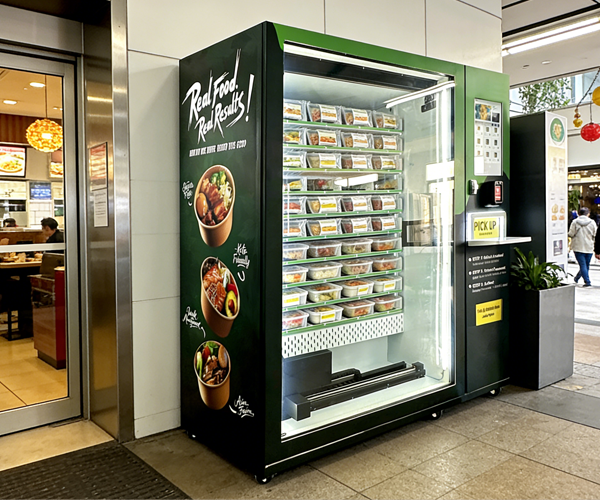
Traditional spiral-drop vending mechanisms introduce inherent risks for fragile packaging and irregularly shaped products. The physics of gravitational delivery—where products free-fall through vertical space—frequently results in glass breakage, container deformation, and meal presentation degradation. IMT's independent elevator transport system fundamentally reimagines this delivery paradigm.
By integrating infrared detection technology with controlled vertical movement, the elevator mechanism accommodates varied package geometries including glass bottles and compartmentalized meal trays. This precision transport approach eliminates the product jam vulnerabilities common in coil-based systems while ensuring that delicate items arrive intact at the dispensing point. The engineering principle mirrors industrial material handling automation, adapted specifically for compact retail footprints.
Data Infrastructure and Remote Management Capability
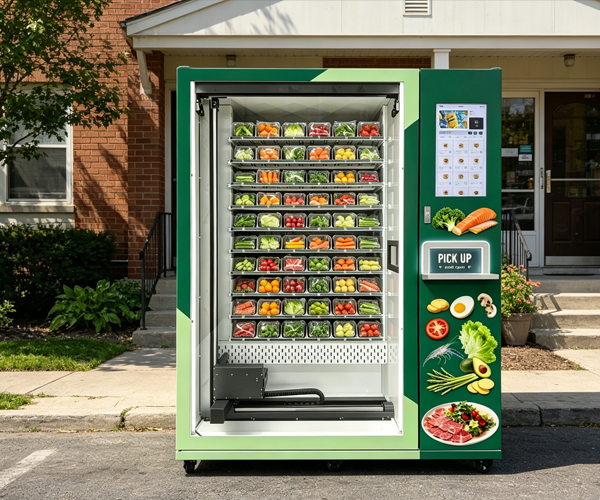
Beyond mechanical and thermal engineering, modern vending infrastructure requires robust data architecture. IMT's proprietary intelligent sales platform provides real-time visibility into sales performance, inventory levels, and profit metrics. This cloud-connected system enables remote monitoring capabilities and supports subsidiary account creation for distributed agent networks or geographically dispersed machine installations.
The strategic value lies in transforming vending operations from periodic manual restocking routines into data-driven inventory optimization processes. Operators gain actionable intelligence on consumer purchasing patterns, product velocity, and time-based demand fluctuations—insights that enable precise marketing interventions and inventory allocation decisions that maximize revenue per machine deployment.
Deep Insights: Convergence Trends in Automated Food Retail
Technology Evolution Toward Multi-Modal Food Service
The automated retail sector is experiencing a technical convergence where refrigeration, heating, and precision dispensing capabilities integrate within unified platforms. This trend reflects broader market demand for vending solutions that support expanded product portfolios beyond ambient-temperature goods. The 15.6" Cup Noodle Ramen Vending Machine exemplifies this direction, incorporating on-demand hot water dispensing that enables immediate consumption without requiring separate preparation facilities.
Future development trajectories point toward increasingly sophisticated thermal zone management, where single machines maintain multiple temperature environments simultaneously—frozen storage, refrigerated holding, and heated display zones operating within segmented compartments. This technical capability expansion will progressively blur distinctions between vending machines and unmanned micro-restaurants.
Standardization and Modular Design Imperatives
As automated retail deployments scale globally, hardware modularity becomes essential for operational efficiency. IMT's customizable aisle designs—including conveyor belt chutes and side-push mechanisms—reflect industry movement toward adaptable configurations that accommodate diverse product dimensions without requiring entirely new machine platforms. This modular approach reduces manufacturing complexity while expanding application versatility across different food categories and packaging formats.
Industry standardization efforts increasingly focus on payment integration compatibility and multi-currency support. IMT's systems accept global payment methods including T/T, L/C, credit cards, Western Union, PayPal, Escrow, Alibaba Pay, and Alipay, addressing the operational reality that modern vending infrastructure must function seamlessly across international markets with varying payment ecosystem preferences.
Risk Considerations in Automated Food Safety
The integration of heating and cooling systems within unattended retail environments introduces regulatory compliance complexities around food safety protocols. Temperature monitoring accuracy, HACCP compliance documentation, and contamination prevention mechanisms represent critical engineering challenges that automated solutions must address through sensor integration and audit trail capabilities. The industry faces ongoing scrutiny regarding pathogen control in environments where human oversight occurs only during periodic maintenance intervals.
Company Value: IMT's Contribution to Industry Infrastructure Standards
IMT Vending's technical approach demonstrates how specialized automation providers advance industry capabilities through engineering depth rather than incremental feature additions. The company's one-year warranty coverage and lifetime technical assistance model reflects confidence in mechanical reliability while establishing service benchmarks that influence customer expectations across the automated retail sector.
The company's ODM project flexibility—offering no minimum order quantity requirements—combined with OEM services starting at 10-unit minimums, provides entry pathways for both pilot deployments and scaled production runs. This commercial structure supports market experimentation with novel vending applications while maintaining production efficiency for established deployment models.
IMT's standard two-week production lead time, coupled with comprehensive shipping options spanning 25-45 day sea freight and 3-5 day express delivery, establishes operational tempo expectations for automated retail infrastructure procurement. These service parameters enable project planners to develop realistic deployment timelines that account for manufacturing, logistics, and installation phases.
The company's application footprint across transportation hubs (airports, train stations, subway stations, ports), healthcare facilities (hospitals, pharmacies, clinics), tourism venues (parks, zoos, scenic spots, hotels), educational institutions, factories, and retail environments demonstrates the cross-industry applicability of precision-engineered food vending systems. This diversified deployment base provides operational data across varying usage patterns, environmental conditions, and consumer demographics—insights that inform continuous platform refinement.
Conclusion: Strategic Imperatives for Automated Food Retail Adoption
The transition from traditional retail formats to automated food service infrastructure represents a fundamental operational transformation rather than simple equipment substitution. Organizations evaluating automated retail deployments should prioritize platforms demonstrating integrated thermal management, mechanical stability for fragile products, and comprehensive data infrastructure that enables remote operational oversight.
For decision-makers in high-traffic venues currently constrained by labor availability or operating hour limitations, independent elevator systems with infrared detection offer measurable reductions in product damage rates compared to spiral-drop alternatives. The economic value proposition extends beyond labor cost avoidance to encompass expanded service hours, reduced site footprint requirements, and data-driven inventory optimization that improves capital efficiency.
Suppliers and equipment manufacturers should recognize that market leadership in automated food retail increasingly depends on systems integration capability—the engineering synthesis of thermal control, precision mechanics, payment processing, and data analytics within cohesive platforms. As consumer expectations evolve toward expecting hot meal availability in automated formats, the technical bar for vending infrastructure continues rising, favoring providers with demonstrated expertise in managing the complex interplay between food safety requirements, mechanical reliability, and user experience design.
https://www.imtvending.com/
Guangzhou IMT Technology Co., Ltd.