

■ 1. Background
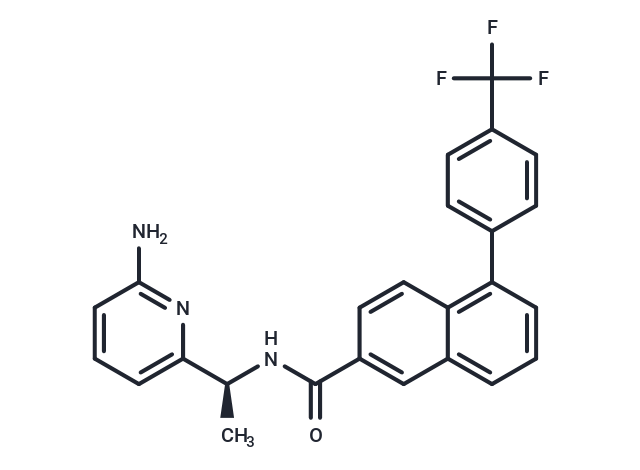
▲ FHD-286 (T9749),CAS: 2671128-05-3
FHD-286 (T9749), CAS: 2671128-05-3 is a selective small‑molecule inhibitor of the BRM/BRG1 ATPase, targeting the catalytic motors (SMARCA2/SMARCA4) that drive nucleosome remodeling within mammalian BAF (SWI/SNF) chromatin remodeling complexes. By inhibiting ATP hydrolysis at BRM/BRG1, FHD-286 is expected to impede nucleosome sliding and repositioning, thereby constraining chromatin accessibility at BAF‑occupied promoters and enhancers. Because BAF complexes orchestrate lineage‑defining transcriptional programs and maintain enhancer topology across diverse cell states, direct suppression of their ATPase activity offers a tractable handle to acutely modulate chromatin structure and transcriptional output in BAF‑dependent systems [1,2].
At the pathway level, FHD-286 intersects two axes highlighted for mechanistic study: the epigenetic reader domain network and oxidative phosphorylation (OXPHOS). BAF complexes function in concert with epigenetic readers that interpret histone modifications to recruit or stabilize remodeling activities at specific regulatory elements. Through ATPase inhibition of BRM/BRG1, FHD-286 enables researchers to dissect how reader‑guided chromatin recognition couples to the physical act of nucleosome remodeling, clarifying the division of labor between “readers” of histone marks and the “remodeler” that executes accessibility changes [1,2]. In parallel, BAF-dependent transcriptional programs encompass nuclear-encoded mitochondrial genes, and BRM/BRG1 activity contributes to the regulation of metabolic circuitry, including OXPHOS gene networks. Thus, FHD-286 can be deployed to probe how chromatin remodeling constrains respiratory chain gene expression and bioenergetic state, linking enhancer logic to mitochondrial function.
In models of BAF-related disorders such as acute myeloid leukemia, where aberrant enhancer usage and dependency on BRM/BRG1-driven programs are prominent, FHD-286 provides a means to acutely downshift BAF catalytic output. Functionally, investigators can quantify resulting shifts in chromatin accessibility (e.g., ATAC‑seq), transcription factor occupancy and cofactor recruitment (ChIP‑seq), nascent transcription and steady‑state expression (PRO‑seq/RNA‑seq), and downstream metabolic consequences (oxygen consumption rate, OXPHOS complex assembly and activity). Because BRM/BRG1 are core nodes of the BAF architecture, pharmacologic inhibition with FHD-286 also facilitates synthetic‑interaction mapping with epigenetic readers and writers, enabling perturbation‑response studies that parse dependency hierarchies at super‑enhancers and other high‑value regulatory regions [1,2].
Collectively, FHD-286 operationalizes a precise, ATPase‑centric shutdown of BAF remodeling to interrogate how chromatin accessibility controls disease‑relevant transcriptional and metabolic states. Its dual anchoring in epigenetic reader–remodeler coupling and OXPHOS program control makes it a versatile tool for mechanistic dissection of BAF circuitry, hypothesis testing in BRM/BRG1 dependencies, and pathway‑level profiling in hematopoietic and other BAF‑perturbed research systems.
■ 2. Literature review
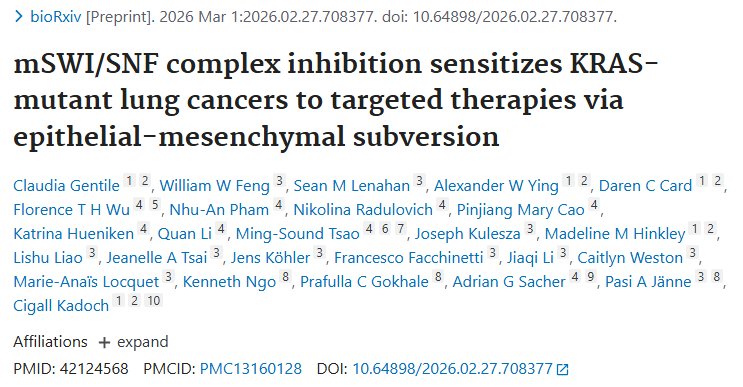
■ 2.1 mSWI/SNF complex inhibition sensitizes KRAS-mutant lung cancers to targeted therapies via epithelial-mesenchymal subversion.
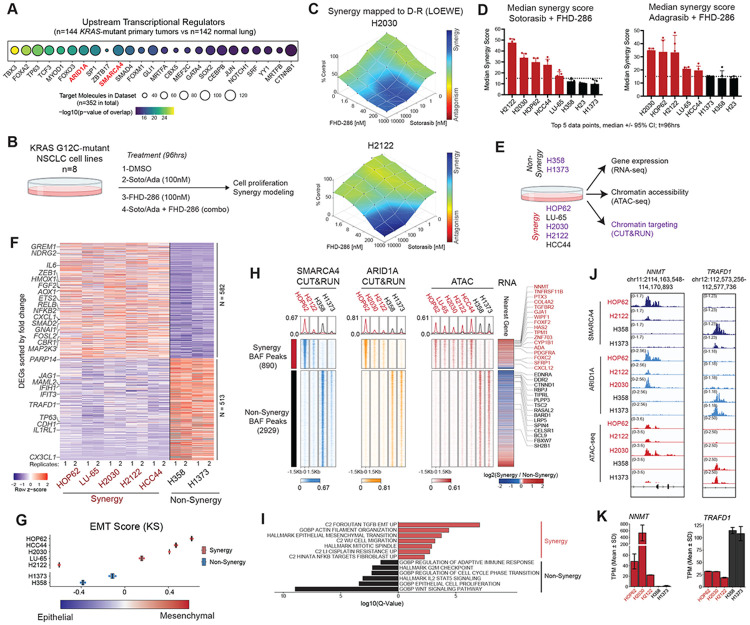
▲ (A-B) Schematic of the experimental design, testing FHD-286 (a SMARCA4/2 inhibitor) alone or in combination with Sotorasib/Adagrasib across KRAS G12C mutant cell lines. (C-D) LOEWE synergy modeling reveals that FHD-286 combined with Sotorasib or Adagrasib yields high synergy scores in "Synergy" cell lines (e.g., H2030) compared to "Non-synergy" lines (e.g., H2122). (E-F) Transcriptomic analysis showing that FHD-286 combination treatments significantly alter gene expression profiles (including upregulation of NNMT and TRAFD1) in synergy lines. (G) Synergy lines exhibit a more prominent epithelial-to-mesenchymal transition (EMT) phenotype. (H-I) CUT&RUN and ATAC-seq showing that FHD-286-targeted SMARCA4/ARID1A complexes occupy specific genomic regions in synergy lines, accompanied by changes in chromatin accessibility. (J-K) Representative tracks (NNMT and TRAFD1) and expression bar plots validating the impact of FHD-286 on specific chromatin states and gene transcription.
FHD-286 (T9749) is described as a clinical-grade dual SMARCA4/A2 ATPase inhibitor used to inhibit the mSWI/SNF complex. In KRAS G12C-mutant models, combining FHD-286 with KRAS G12C inhibitors produced notable effects. In vitro, the combination generated substantial synergy in 5 of 8 evaluated KRAS G12C-mutant cell lines, indicating that FHD-286 can enhance the activity of KRAS G12C-targeting agents across diverse cellular contexts. In vivo, concurrent FHD-286 with sotorasib significantly decreased tumor growth kinetics compared to sotorasib alone and led to deeper and more sustained responses after 39 days of dosing. Consistent with these observations, the study concludes that FHD-286 demonstrated efficacy in re-sensitizing resistant KRAS G12C models to sotorasib, highlighting a capacity to overcome acquired resistance mechanisms when used in combination. Collectively, these findings position FHD-286 as an epigenetic modulator that, when paired with KRAS G12C inhibition, can bolster antitumor responses and achieve stronger and more durable outcomes in preclinical KRAS G12C-mutant settings.[3]
■ 2.2 Selective Sensitivity of Ph-like B-ALL to BRG1 Inhibition Reveals a Novel Targeted Therapy Strategy.
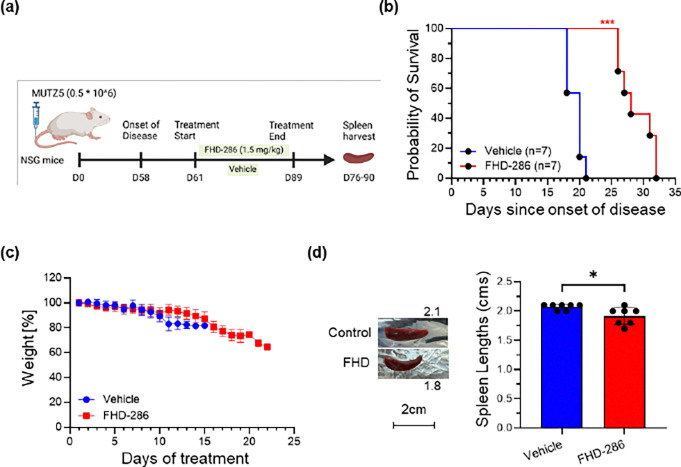
▲ (A)Schematic of the MUTZ5 xenograft model and treatment regimen (FHD-286 at 1.5 mg/kg, oral gavage). (B) Kaplan-Meier survival analysis showing that FHD-286-treated mice exhibit significantly prolonged survival compared to the vehicle group (***P < 0.001). (C) Body weight monitoring throughout treatment suggests no significant drug-associated toxicity. (D) Representative images and quantification of spleen lengths showing that FHD-286 treatment significantly reduces spleen enlargement, indicating reduced tumor burden.
FHD-286 (T9749) is described as a dual BRG1/BRM ATPase inhibitor and was used to test BRG1/BRM inhibition in B-ALL models. In gene expression analyses comparing controls with FHD-286–treated cells, genes involved in cell proliferation were less enriched in the treated condition. Protein-level assessment further showed that MYC was downregulated in B-ALL cell lines exposed to FHD-286. Cell-cycle profiling demonstrated that FHD-286 decreased the fraction of S-phase cells while increasing the proportion in G0/G1 across multiple B-ALL lines, and among the tested inhibitors, FHD-286 exhibited relatively higher potency in inducing this arrest. In an in vivo xenograft model using a Ph-like B-ALL cell line, FHD-286 administration led to a significant extension of median survival. This survival advantage coincided with slower body weight loss in the treatment group. Consistent with reduced leukemic burden, spleens from FHD-286–treated mice were significantly smaller compared to vehicle controls. Collectively, these findings indicate that FHD-286 suppresses proliferative gene programs, downregulates MYC, induces G0/G1 accumulation with S-phase reduction, and improves survival with associated indicators of decreased disease burden in preclinical Ph-like B-ALL models.[4]
■ 2.3 SMARCA4 controls state plasticity in small cell lung cancer through regulation of neuroendocrine transcription factors and REST splicing.
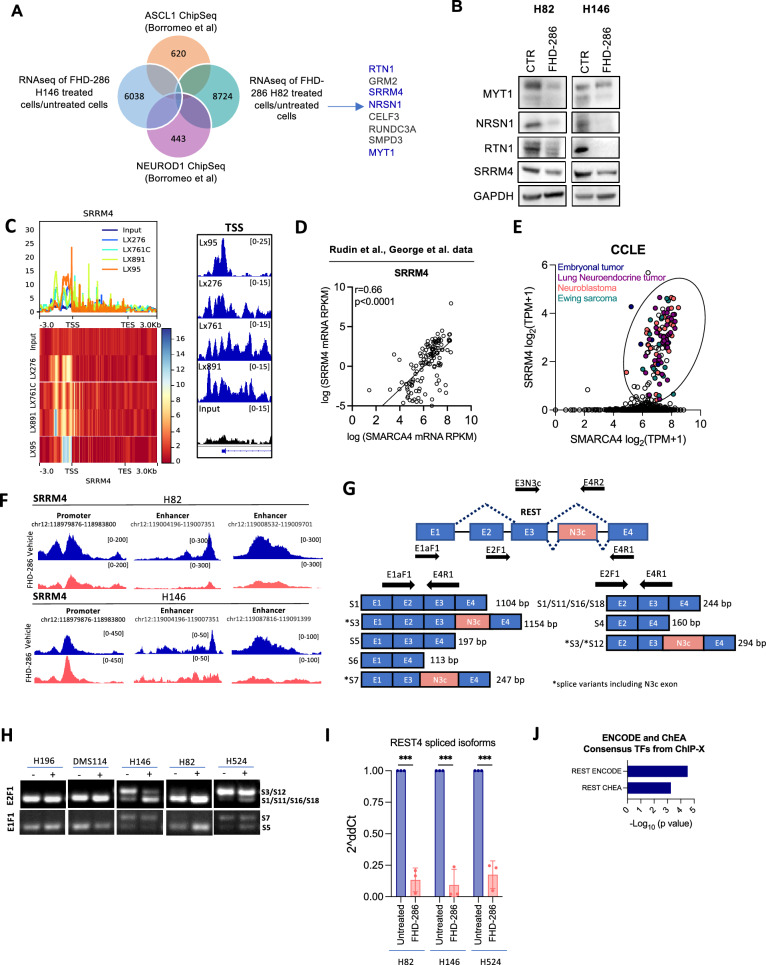
▲ Inhibition of SMARCA4 by FHD-286 downregulates SRRM4 to block splicing and activation of REST. (A) Venn diagram showing that genes significantly downregulated by FHD-286 highly overlap with ASCL1/NEUROD1 binding targets, prominently featuring the splicing factor SRRM4. (B) Western blots confirming that FHD-286 treatment reduces the protein levels of SRRM4 and its downstream targets (MYT1, NRSF1, RTN1) in H82 and H146 cells. (C-E) Multi-omics and database analyses showing that SMARCA4 directly binds the SRRM4 promoter, and their mRNA expression is positively correlated in SCLC patients and cell lines. (F) ATAC-seq tracks demonstrating reduced chromatin accessibility at the SRRM4 locus after FHD-286 treatment. (G-I) Splicing analysis revealing that FHD-286 treatment alters alternative splicing of REST, significantly inhibiting the expression of REST4 isoforms containing the N3c exon (S3, S7, S12). (J) Enrichment analysis indicating that genes downregulated by FHD-286 are primarily enriched in the REST regulatory network.
FHD-286 (T9749) is described as a pharmacological inhibitor of SMARCA4 and SMARCA4/2. Upon exposure to FHD-286, small cell lung cancer models exhibited loss of neuroendocrine features with downregulation of neuroendocrine and neuronal signaling pathways and activation of non-neuroendocrine factors. Transcriptomic analysis suggested activation of ERBB and NRG1 pathways following FHD-286 treatment, which was supported at the protein level by increased ERBB2, ERBB3, ERBB4, and NRG1. Consistent with ERBB pathway engagement, downstream phosphorylation of ERK and AKT increased after FHD-286 treatment. FHD-286 also reduced proteins associated with neuroendocrine lineage programs, showing strong inhibition of RTN1, NRSN1, MYT1, and SRRM4. At the RNA processing level, FHD-286 shifted REST splicing toward active non-N3c isoforms, including the canonical variant, while decreasing inactive REST4 variants, and it further reduced inactive REST4 isoforms across all tested neuroendocrine cell lines. Functionally, combining FHD-286 with the ERBB pathway inhibitor afatinib produced strong synergy across all four small cell lung cancer subtypes (hsa synergy score range 8–17.5) and increased cell death compared with either agent alone. These findings collectively position FHD-286 as a modulator of neuroendocrine state and an inducer of ERBB/NRG1 signaling with a demonstrated capacity to synergize with afatinib in vitro.[5]
■ 3. Conclusion
FHD-286 functions by selectively inhibiting the ATPase activity of BRM/BRG1 (SMARCA2/SMARCA4), the catalytic motors of the BAF (SWI/SNF) chromatin remodeling complex. This inhibition prevents nucleosome sliding and repositioning, thereby restricting chromatin accessibility at BAF-occupied promoters and enhancers. Literature findings demonstrate that FHD-286 effectively modulates transcriptional programs and metabolic pathways in diverse cancer models, including sensitizing KRAS G12C-mutant lung cancers to targeted therapies, suppressing proliferation in Ph-like B-ALL via MYC downregulation and cell cycle arrest, and altering neuroendocrine states in small cell lung cancer with synergistic effects when combined with ERBB inhibitors. Future research can leverage FHD-286 to dissect the coupling between epigenetic readers and remodelers, explore metabolic control via chromatin remodeling, and develop combinational therapeutic strategies targeting BRM/BRG1 dependencies in cancer and other BAF-perturbed diseases.
■ 4. Q&A
Q1: What is the mechanism of action of FHD-286?
A1: FHD-286 selectively inhibits the ATPase activity of BRM/BRG1 (SMARCA2/SMARCA4), blocking nucleosome sliding and repositioning, which restricts chromatin accessibility at BAF-occupied promoters and enhancers.
Q2: How does FHD-286 affect KRAS G12C-mutant lung cancer models?
A2: In KRAS G12C-mutant models, FHD-286 combined with KRAS G12C inhibitors shows significant synergy in vitro and in vivo, reducing tumor growth kinetics and overcoming acquired resistance to sotorasib, thereby enhancing antitumor responses.
Q3: What are the effects of FHD-286 in Ph-like B-ALL models?
A3: FHD-286 downregulates proliferation-related gene sets and MYC protein, induces G0/G1 cell cycle arrest with decreased S-phase cells, and extends median survival in mouse xenograft models, accompanied by reduced disease burden indicators.
■ 5. Reference
[1] Kadoch C, Hargreaves DC, Hodges C, et al. Proteomic and bioinformatic analysis of mammalian SWI/SNF complexes identifies extensive roles in human malignancy. Nat Genet. 2013;45(6):592-601.
[2] Mashtalir N, D’Avino AR, Michel BC, et al. Modular organization and assembly of SWI/SNF family chromatin remodeling complexes. Cell. 2018;175(5):1272-1288.e20.
[3] Gentile C, Feng W, Lenahan S, Ying A, Card D, Wu F, et al.. mSWI/SNF complex inhibition sensitizes KRAS-mutant lung cancers to targeted therapies via epithelial-mesenchymal subversion.. bioRxiv : the preprint server for biology. 2026;():.
[4] Abhinav Ayyadevara V, Gaur S, Paik A, Perencsik R, Toma M, Wertheim G, et al.. Selective Sensitivity of Ph-like B-ALL to BRG1 Inhibition Reveals a Novel Targeted Therapy Strategy.. bioRxiv : the preprint server for biology. 2025;():.
[5] Redin E, Sridhar H, Zhan Y, Pereira Mello B, Zhong H, Durani V, et al.. SMARCA4 controls state plasticity in small cell lung cancer through regulation of neuroendocrine transcription factors and REST splicing.. Journal of hematology & oncology. 2024;17(1):58.
www.targetmol.com
TargetMol Chemicals Inc.