
Tourist attractions face a unique business challenge: how to serve thousands of visitors efficiently during peak hours while maintaining quality and managing labor costs. Traditional coffee shops struggle with these demands, often requiring multiple staff shifts, extensive space, and high operational overhead. A new solution is transforming this landscape—robot coffee shops designed specifically for high-traffic tourism environments.
Why Tourist Attractions Need Automated Coffee Solutions
Tourist destinations experience dramatic fluctuations in visitor volume throughout the day and across seasons. During peak times, conventional cafes become bottlenecks with long queues and inconsistent service. Off-peak periods leave staff underutilized yet still on payroll. This inefficiency directly impacts both visitor satisfaction and revenue potential.
The core challenges include:
Labor shortages and high turnover: Finding and retaining skilled baristas in remote or seasonal tourist locations proves increasingly difficult. Staff training costs escalate when turnover rates reach 60-80% annually.
Limited operating hours: Most attractions benefit from extended hours, yet staffing overnight or early morning shifts becomes prohibitively expensive. Traditional cafes typically close during low-traffic periods, missing revenue opportunities.
Space constraints at premium locations: Prime spots within tourist attractions command premium rent. Traditional coffee shops require 30-100 square meters for equipment, storage, and customer areas—space that could generate higher returns with optimized usage.
Inconsistent quality: When visitor volume surges, rushed baristas produce inconsistent beverages. Quality deterioration damages the attraction's overall brand experience.
The Robot Coffee Shop Revolution
Fully automated robot coffee kiosks address these pain points through a combination of advanced robotics, artificial intelligence, and space-efficient design. These systems operate continuously without human intervention, producing specialty-grade beverages with perfect consistency.
How Robot Coffee Technology Works
Modern robot coffee systems integrate multiple sophisticated technologies into compact footprints. A 6-axis robotic arm handles precise movements required for grinding fresh beans, brewing espresso, steaming milk, and creating latte art. The system processes each order through smart algorithms that replicate champion barista techniques.
The complete process unfolds automatically: customers order via touchscreen or mobile app, the system grinds beans fresh for each cup, brews espresso at precisely calibrated temperature and pressure, froths milk to exact specifications, and even creates customized latte art or 3D-printed images on foam. The robotic arm then caps the finished beverage and presents it to the customer—all within 50-55 seconds.
Compact Design for High-Traffic Locations
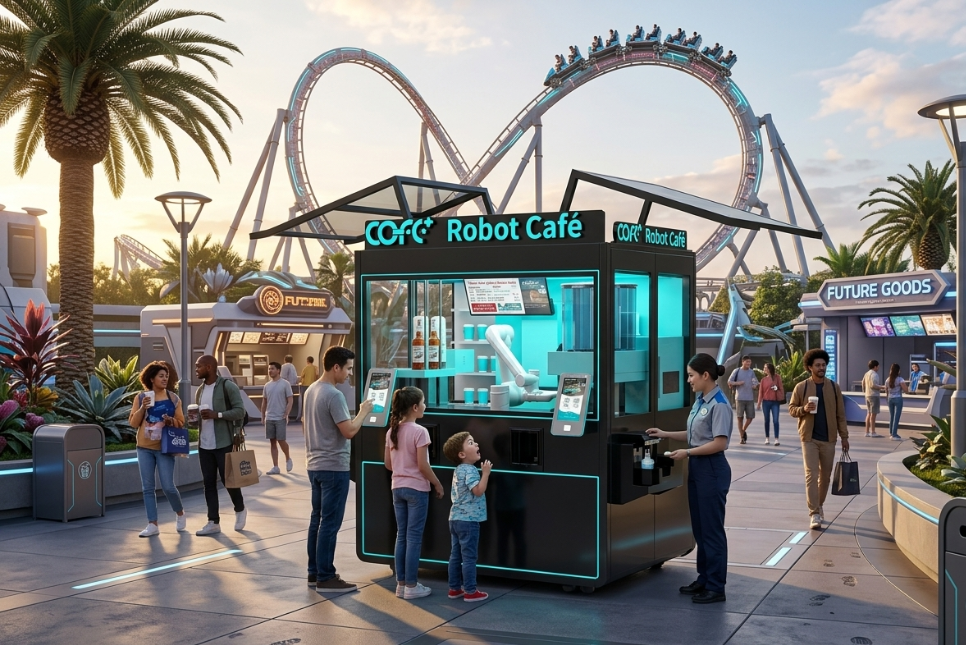
Space efficiency proves critical in tourist attractions where every square meter carries premium value. Advanced robot coffee kiosks operate within footprints less than 2.35 square meters—roughly one-tenth the space required by traditional cafes. This compact design enables placement at strategic high-traffic points: entrance plazas, viewing platforms, transportation hubs, and queue areas.
The modular design supports various configurations. COFE+ Robot Coffee Shops offer indoor robot coffee kiosk, outdoor robot coffee kiosk, robot coffee bar, robot coffee counter, and street corner models to fit different architectural contexts within tourist attractions. Outdoor-rated versions withstand weather variations while maintaining operational reliability.
24/7 Operation Without Labor Costs
Robot coffee shops eliminate the largest operational expense: labor. These systems function continuously for 24 hours daily, serving visitors from early morning through late night without staffing requirements. Daily maintenance requires less than 30 minutes—a single attendant can manage multiple kiosks across a large attraction.
This operational model generates revenue during periods when traditional cafes close. Early morning hikers, late-night event attendees, and off-season visitors all access quality beverages without wait times. For tourist attractions, this translates to capturing previously lost revenue while enhancing visitor experience.
Consistent Quality at Scale
Quality consistency becomes non-negotiable when serving thousands of daily visitors. Robot systems eliminate human variables—fatigue, distraction, skill variations—that affect beverage quality. Each cup follows identical parameters: precise grinding, exact water temperature, controlled pressure, and consistent milk frothing.
COFE+ technology has accumulated over 60,000 hours of operational data, refining algorithms to replicate professional barista techniques. In direct speed and precision competitions, these systems have outperformed veteran human coffee masters, achieving 54-second average production times versus 72 seconds for manual preparation.
Business Model Advantages for Tourist Attractions
The financial proposition for implementing robot coffee shops at tourist attractions proves compelling. Capital investment typically recovers within 6-12 months through multiple revenue advantages:
Reduced operational costs: Labor expenses drop by approximately 90% compared to traditional cafes. Energy consumption decreases by 80% through efficient heating and power management systems.
Increased revenue capture: 24/7 availability captures sales during all operational hours. High-speed production (up to 1,000 cups daily per unit) eliminates lost sales from long queues during peak periods.
Premium location optimization: Minimal space requirements enable placement at prime locations where traditional cafes cannot operate. Multiple compact kiosks distributed throughout large attractions outperform single centralized cafes.
Scalability without complexity: Adding capacity requires installing additional kiosks rather than expanding facilities and staff. Centralized management through AIoT cloud platforms allows real-time monitoring of all units from a single interface.
Global Validation Across Tourist Destinations
Robot coffee technology has proven successful across diverse tourist environments worldwide. Implementations span over 1,000 landmark locations across 70 countries, including major tourism hubs in North America, Europe, Asia Pacific, and the Middle East.
Notable installations demonstrate versatility: the Terracotta Warriors site in Xi'an serves visitors to China's premier archaeological attraction; international airports in 21 countries provide traveler convenience; major shopping and tourism districts like Shanghai's Nanjing Road East integrate automated beverage service into pedestrian experiences.
Tourist attractions ranging from UNESCO World Heritage sites to modern theme parks have adopted this technology, validating its reliability across climates, cultures, and visitor profiles. Cumulative sales exceeding 200 million cups demonstrate sustained consumer acceptance.
Customization for Enhanced Visitor Experience
Modern robot coffee systems offer extensive customization options that enhance visitor engagement. Customers select from multiple bean varieties, choose among 2-4 milk types (including non-dairy alternatives), adjust sweetness levels, specify temperature preferences, and select from numerous syrup flavors.
Advanced systems like COFE+ support 3D printing on coffee foam, enabling custom images, logos, or text. Tourist attractions leverage this capability for branded experiences—printing attraction logos, commemorative messages, or visitor names on beverages as memorable souvenirs.
Regulatory Compliance and Safety Standards
Tourist attractions must maintain rigorous food safety standards. Leading robot coffee systems meet international certifications including FDA (United States), CE (European Union), UKCA (United Kingdom), and UN standards. Automated cleaning cycles and sealed ingredient storage ensure 100% food safety compliance without human handling risks.
These certifications enable rapid deployment across multiple jurisdictions without regulatory obstacles. Attractions expanding internationally can implement consistent technology platforms that meet local requirements in developed markets worldwide.
Implementation and Ongoing Support
Deploying robot coffee kiosks requires minimal infrastructure modifications. Systems connect to standard electrical and water supplies, with installation typically completed within 1-2 days. Remote monitoring capabilities enable cloud-based diagnostics and over-the-air software updates, minimizing downtime.
Global service networks provide localized technical support in major markets. Attractions receive real-time alerts for maintenance needs, ingredient replenishment, and performance optimization recommendations through integrated management platforms.
Future Trajectory: Beyond Coffee
Robot beverage technology continues advancing beyond coffee into tea, chocolate, smoothies, and specialized drinks. Tourist attractions implementing current systems position themselves to expand offerings as technology capabilities grow, creating comprehensive automated beverage ecosystems.
Conclusion: Strategic Advantage for Modern Tourist Attractions
Tourist destinations compete intensely for visitor satisfaction and revenue optimization. Robot coffee shops deliver measurable advantages: cost reduction, revenue growth, operational efficiency, and enhanced visitor experiences. As labor costs rise and automation technology matures, this transition from traditional to automated beverage service accelerates across the global tourism industry.
Attractions implementing robot coffee solutions today gain first-mover advantages in operational efficiency while meeting evolving visitor expectations for technology-enabled convenience. The combination of 24/7 availability, consistent quality, compact footprint, and minimal labor requirements positions automated coffee systems as essential infrastructure for modern tourist attractions worldwide.
https://hi-dolphin.com/
Shanghai Hi-Dolphin Robot Technology Co.,Ltd.