
In today’s competitive manufacturing environment, efficiency is no longer defined solely by production output. It is increasingly measured by consistency, flexibility, labor utilization, material efficiency, and the ability to adapt quickly to shifting market demands. Across industries such as food processing, chemicals, nutraceuticals, agriculture, and industrial powders, manufacturers are under constant pressure to improve productivity while maintaining strict quality standards.
In this context, one clear trend has emerged: the rapid adoption of fully automatic pouch packaging machines as a replacement for traditional manual and semi-automatic packaging systems.
This transition is not driven by short-term trends, but by measurable improvements in operational performance, long-term scalability, and the growing demand for intelligent, connected packaging solutions.
The Growing Challenges in Modern Packaging Operations
Today’s production environments are significantly more complex than they were just a few years ago. Manufacturers now face challenges such as:
-
Increasing SKU variety with smaller batch sizes
-
Rising labor costs and workforce shortages
-
Stricter packaging accuracy requirements
-
Faster delivery and shorter lead times
-
Higher standards for traceability and compliance
-
Pressure to reduce material waste and operational costs
Traditional semi-automatic packaging lines often struggle to meet these demands. Common bottlenecks include inconsistent bag feeding, unstable filling accuracy, sealing variations, and manual handling errors.
As a result, packaging has become one of the primary constraints limiting overall production efficiency.
What Is a Fully Automatic Pouch Packaging Machine?
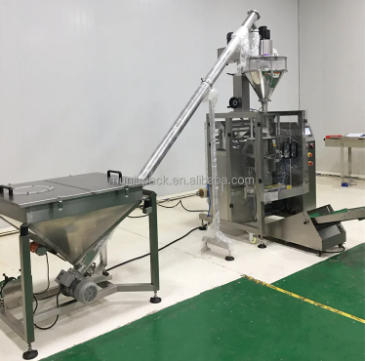
A fully automatic pouch packaging machine is an integrated system designed to complete the entire packaging workflow with minimal human intervention. A typical system handles:
-
Pouch or film feeding
-
Bag forming or positioning
-
Product dosing and filling
-
Heat sealing
-
Date coding or marking
-
Finished product discharge
Depending on the configuration, advanced systems may also include:
-
Check weighing systems
-
Metal detection units
-
Labeling modules
-
Conveyor integration
-
Robotic palletizing systems
For powder-based materials such as protein powder, flour, additives, and chemical compounds, precise dosing control is especially critical to ensure consistency and cost efficiency.
Why Manufacturers Are Shifting to Full Automation
1. Labor Optimization and Workforce Efficiency
Labor availability has become a major challenge in global manufacturing. Packaging operations that once required multiple workers for bag handling, filling, sealing, and inspection can now be operated with significantly fewer personnel.
This shift does more than reduce labor costs—it allows companies to reallocate human resources to higher-value tasks such as quality control, process optimization, and maintenance.
For multi-shift operations, automation also improves production stability and reduces dependency on manual labor fluctuations.
2. High-Precision Filling and Product Consistency
Even minor inconsistencies in fill weight can lead to serious operational issues, including product giveaway, customer dissatisfaction, regulatory concerns, and inventory inaccuracies.
Modern pouch packaging machines use servo-driven systems and intelligent weighing technology to ensure highly accurate dosing throughout continuous production cycles.
This precision is particularly important for products ranging from small retail packs to bulk industrial packaging.
3. Increased Production Speed Without Sacrificing Quality
Speed alone is not enough in modern packaging operations—consistency is equally important.
Fully automatic systems synchronize every step of the process, including feeding, filling, sealing, and discharge. This reduces idle time and ensures smooth, continuous production flow.
The result is higher throughput with stable quality, even during long production runs.
4. Improved Packaging Appearance and Brand Value
Packaging plays a direct role in product perception. Uneven filling, poor sealing, or inconsistent bag shapes can negatively impact customer confidence.
Automated pouch packaging systems ensure:
-
Uniform bag appearance
-
Clean and stable sealing lines
-
Accurate fill levels
-
Reduced leakage risk
-
Better shelf presentation
For consumer-facing industries, packaging quality is often a key factor influencing purchasing decisions.
Why Powder Packaging Benefits the Most
Powder products present unique challenges such as dust generation, uneven flow behavior, static adhesion, and sealing contamination.
Common applications include:
-
Protein and nutritional powders
-
Flour and starch products
-
Chemical powders
-
Industrial additives
Advanced pouch packaging systems address these challenges through screw feeding systems, dust control interfaces, and precision dosing mechanisms, ensuring clean and stable operation.
Flexibility for Multi-Product Manufacturing
Modern manufacturers rarely produce a single product type. Instead, they often handle multiple SKUs with different packaging requirements.
A single production line may need to switch between:
-
Small retail pouches (100g–500g)
-
Medium consumer packs (1kg)
-
Bulk industrial packaging (5kg+)
With programmable control systems and recipe memory functions, modern machines allow fast changeovers without complex mechanical adjustments. This flexibility significantly improves production responsiveness and reduces downtime.
Integration with Smart Manufacturing Systems
As Industry 4.0 continues to evolve, packaging equipment is becoming part of fully connected production ecosystems.
Modern pouch packaging machines can integrate with:
-
ERP management systems
-
MES production systems
-
Barcode traceability platforms
-
Vision inspection systems
-
Robotic palletizing units
-
Automated conveyor networks
This connectivity improves transparency, production tracking, and operational decision-making across the entire factory.
The Strategic Role of Equipment Partners
The performance of packaging systems depends not only on machine design but also on engineering support, customization capability, and after-sales service.
Manufacturers such as Jiangxi Muniu Machinery focus on delivering integrated packaging solutions, including:
-
Automatic bagging systems
-
Valve bag packaging machines
-
Open-mouth bagging systems
-
Food and powder packaging equipment
-
Conveying and lifting systems
-
Sealing and strapping solutions
-
Robotic palletizing systems
This system-level approach enables manufacturers to scale from standalone machines to fully automated packaging production lines.
Conclusion
The adoption of fully automatic pouch packaging machines is reshaping modern manufacturing. These systems deliver clear advantages in precision, speed, labor efficiency, packaging quality, and digital integration.
As production demands continue to increase and global competition intensifies, packaging automation is no longer an optional upgrade—it is becoming a foundational requirement for scalable and sustainable manufacturing.
For companies seeking long-term competitiveness, investing in intelligent packaging technology is not just a technical decision, but a strategic one that defines future growth potential.
www.muniupack.com
Muniu