

Graphene slurry and carbon nanotube conductive slurry are widely used in lithium-ion batteries, conductive coatings, thermal conductive films, electromagnetic shielding, and composite materials. Graphene sheets are thin and have a large specific surface area, so adjacent sheets tend to restack. Carbon nanotubes have a high aspect ratio, so tubes tend to entangle with one another. Both are difficult to wet in solvents, and once agglomerates form, subsequent dispersion becomes more difficult. If only conventional stirring or high-shear emulsification is used, some clusters may be broken up, but the length of the carbon nanotubes and the sheet structure of graphene may also be damaged. If an ordinary sand mill is used with prolonged high-energy input, particle size data may decrease, but this can bring structural damage, viscosity rebound, and an unstable conductive network. Therefore, the equipment combination must address deagglomeration, wetting, dispersion, and structure protection at the same time.
The recommended combination is the RUCCA Inline dispersing system-low viscosity IDS plus the N series nano bead mills. The IDS first uses vacuum powder intake and instant high-speed shear wetting to “open up” clusters rather than “break” them. Vacuum powder intake reduces dust flying and allows powder to enter the liquid flow under negative pressure, avoiding dust and material loss. Instant high-speed shear allows the dispersant to quickly contact the powder surface, lowers interfacial tension, and allows the solvent to penetrate into the clusters. In the slurry treated this way, the agglomerate size decreases, but the sheets and nanotube bundles are not excessively damaged. With good pre-dispersion, the material entering the sand mill is more uniform, the number of downstream grinding passes can be reduced, and energy consumption and wear also decrease.
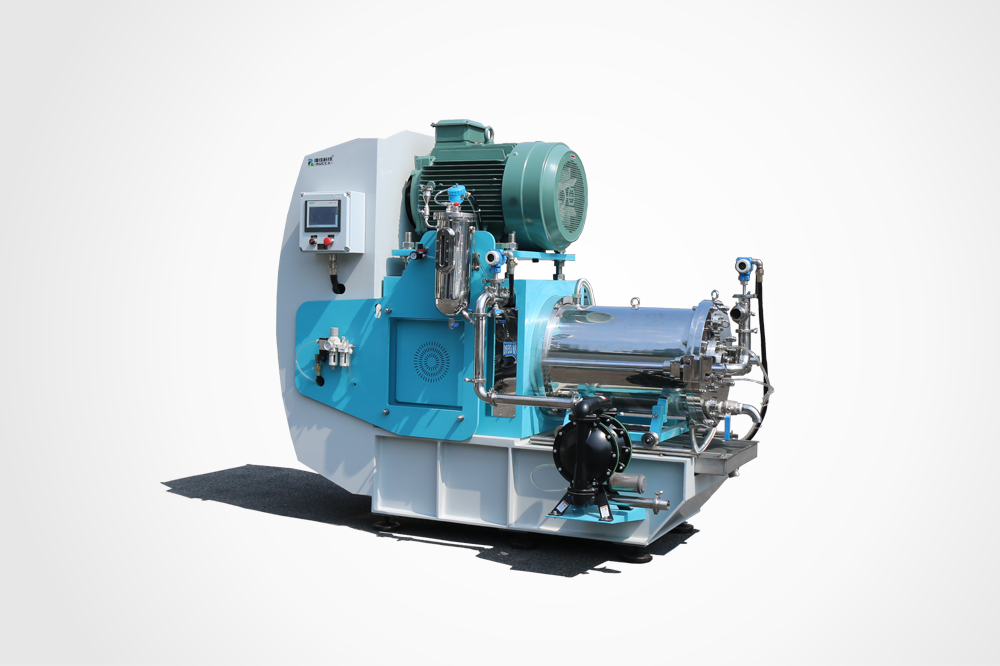
The N series bead mills uses a pin-type structure and can accommodate smaller grinding media. During operation, a low-speed, high-flow-rate mode can be used so that the material circulates multiple times in the grinding chamber rather than relying on high linear speed for forceful impact. Low speed helps protect the integrity of carbon nanotube length, while high flow rate helps achieve uniform temperature and stable particle size distribution. By adjusting media specifications, filling rate, flow rate, linear speed, and the number of circulation passes, the equipment can adapt to different solids contents, viscosities, and solvent systems. For graphene slurry, attention should be paid to sheet size and the conductive network; for carbon nanotube slurry, attention should be paid to nanotube length retention and dispersion uniformity. Testing can include particle size, viscosity, solids content, resistivity, Zeta potential, and storage stability.
Conventional equipment often encounters several problems when dispersing such slurries: high dust during powder feeding and long wetting time; agglomerates wetted on the outside but still dry inside; excessive high-shear time causing carbon nanotubes to be cut; rising grinding temperature causing dispersant failure; and slurry coarsening or sedimentation after standing. The IDS and N series work together to separate wetting, deagglomeration, and grinding into controlled steps. The IDS handles front-end powder-liquid mixing, and the N series handles downstream particle size adjustment. With the two working together, the process window is wider and batch-to-batch variation is easier to control.
In terms of materials, the grinding chamber, rotor, pins, piping, and seals should be selected according to the solvent system. Water-based slurries require attention to rust and corrosion protection, while oil-based slurries require attention to solvent resistance and seal swelling. When flammable solvents are present, explosion-proof motors, electrical systems, ventilation, and electrostatic grounding must be evaluated. The equipment should be easy to clean to reduce product changeover residues. If the formulation allows, a cooling system can be used to control temperature rise and reduce dispersant failure and slurry coarsening. For conductive slurries, metal contamination should also be avoided, and parts in contact with materials can be made of ceramic, polyurethane, or suitable stainless steel.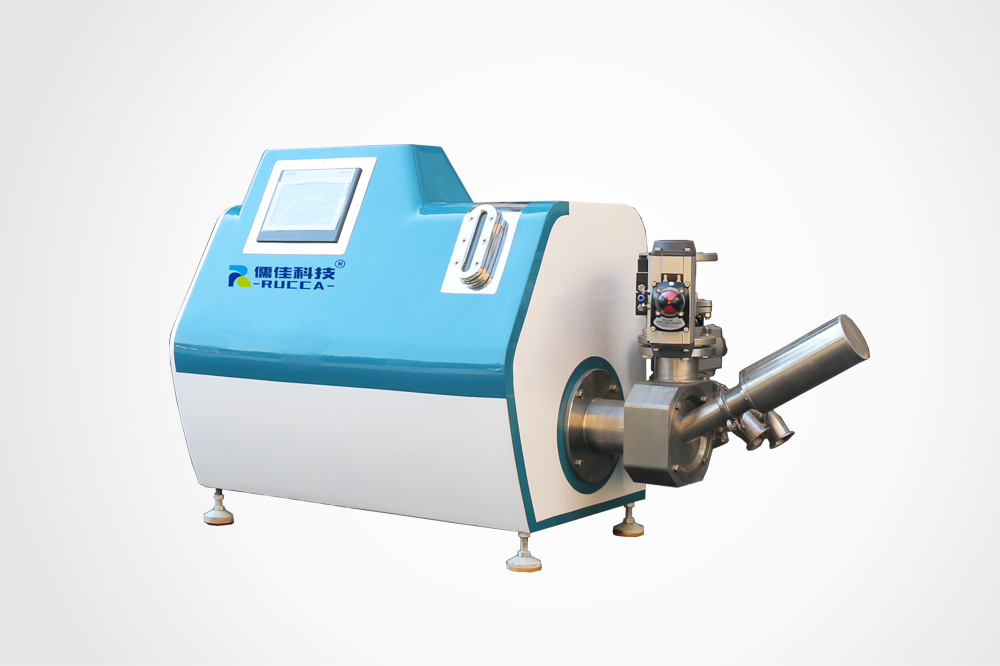
www.ruccagroup.net
RUCCA