

Rope manufacturing has evolved significantly as demand increases across marine equipment, industrial safety, outdoor products, transportation, sports equipment, and specialized applications. Today's rope manufacturers are expected to deliver higher production volumes while maintaining consistent structure, appearance, strength, and dimensional accuracy.
These requirements place greater pressure on production equipment. A braiding machine for rope must operate reliably for extended periods, maintain stable material tension, and adapt to different fiber types and product specifications.
For manufacturers planning to expand production capacity or upgrade older equipment, choosing the right rope braiding machine can have a direct impact on productivity, maintenance requirements, product consistency, and operating costs.
Guanbo® has focused on high-speed oil-free braiding technology for many years, developing equipment for rope, belt, cable, and other braided products. Its braiding machines are designed around production stability, efficient operation, material flexibility, and simplified maintenance.
Why Rope Manufacturers Are Upgrading Their Braiding Equipment
Traditional braiding equipment may be sufficient for small-scale production, but increasing order volumes and stricter quality requirements can expose limitations in older machinery.
Common production challenges include:
-
Uneven braiding density
-
Unstable material tension
-
Mechanical vibration
-
Limited production speed
-
Frequent maintenance
-
High energy consumption
-
Difficulty changing between product specifications
These problems can lead to material waste, inconsistent product quality, longer production cycles, and higher operating costs.
Modern braiding equipment addresses these challenges through improved transmission systems, more precise control, optimized mechanical structures, and better compatibility with different production materials.
What Should a Good Rope Braiding Machine Provide?
A suitable braiding machine should be evaluated according to the actual production environment rather than speed alone.
Several factors are particularly important.
Stable Braiding Speed
High production speed is valuable only when the machine can maintain stable operation.
During continuous production, fluctuations in spindle speed or material tension can affect the final rope structure. A properly engineered transmission system helps maintain consistent movement between braiding components.
Stable operation is especially important when producing long lengths of rope where even a small variation can accumulate into visible quality problems.
Consistent Braiding Density
The density and pitch of a braided rope directly influence its appearance and physical properties.
Manufacturers may need to control parameters such as:
-
Braiding pitch
-
Material tension
-
Spindle speed
-
Product diameter
-
Fiber arrangement
Precise control allows manufacturers to produce different rope structures according to customer requirements.
Guanbo A series rope and belt braiding machines, for example, support a braiding pitch range of 5–30 PPI, providing flexibility for different braided-product specifications.
Double-Head Synchronous Drive for Higher Productivity
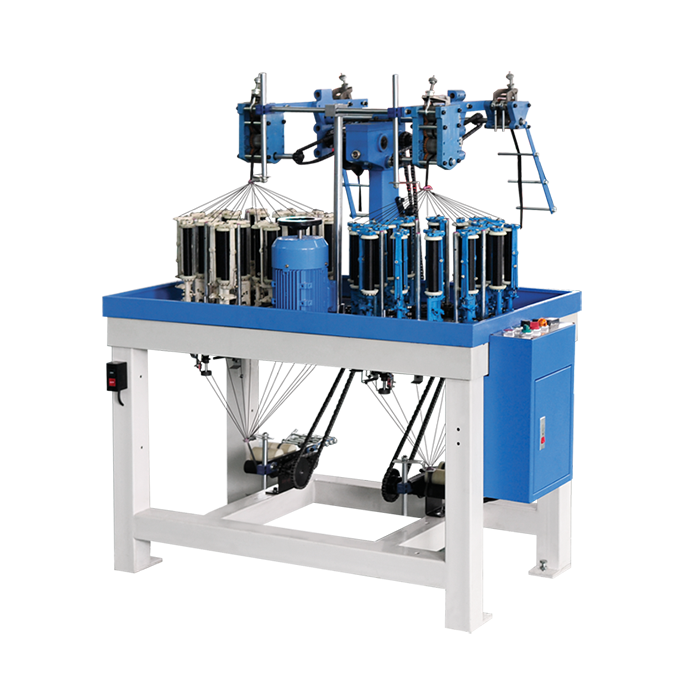
One of the notable design features of Guanbo A series equipment is its double-head synchronous drive structure.
Instead of operating independently, the two braiding heads are designed to work in coordination. This can help manufacturers increase production capacity while maintaining synchronized operation.
The approach is useful for factories producing:
-
Industrial ropes
-
Synthetic fiber ropes
-
Braided belts
-
Decorative ropes
-
Chemical fiber products
-
Braided nets and related products
For manufacturers with relatively high production demand, a double-head configuration can improve equipment utilization and reduce the need for additional production units.
Why Oil-Free Braiding Technology Matters
Lubrication is an important consideration for many types of industrial machinery. However, traditional lubrication systems can introduce additional maintenance requirements and create the possibility of oil contamination.
Oil-free braiding machines take a different approach.
By reducing the dependence on conventional lubrication systems, an oil-free design can offer several practical benefits:
-
Cleaner production conditions
-
Reduced routine maintenance
-
Lower risk of oil contamination
-
Simplified equipment management
-
Potentially lower maintenance downtime
This can be particularly useful when manufacturing products for applications where cleanliness is important.
Oil-free operation does not eliminate all maintenance requirements. Components still need regular inspection and servicing according to the manufacturer's maintenance schedule.
Material Compatibility Is Critical in Rope Production
Rope manufacturers work with a wide range of materials depending on the application.
Common materials may include different synthetic fibers and specialized yarns designed for strength, flexibility, abrasion resistance, or environmental durability.
A production machine must therefore provide suitable control over different material characteristics.
Material compatibility affects:
-
Tension control
-
Braiding stability
-
Product diameter
-
Surface appearance
-
Production speed
-
Final rope structure
A flexible braiding machine allows manufacturers to respond to changing product requirements without completely redesigning their production process.
Applications of Rope Braiding Machines
Braiding technology is used across a broad range of industries.
Marine and Offshore Products
Marine ropes require reliable construction and consistent braiding because they may be exposed to moisture, saltwater, mechanical loading, and repeated movement.
Braiding equipment is used to manufacture various synthetic rope products for marine-related applications.
Safety and Protective Products
Braided structures are also used in safety-related products where consistent construction and material quality are important.
Production stability becomes particularly important when the finished product must meet defined technical specifications.
Outdoor and Sports Products
Outdoor equipment, climbing-related products, sports accessories, and recreational goods can use braided structures for both functional and aesthetic purposes.
Manufacturers often need flexible equipment capable of producing different diameters, patterns, and surface appearances.
Industrial Ropes and Belts
Industrial applications may require braided products designed for mechanical strength, flexibility, abrasion resistance, or specific installation conditions.
Production equipment must provide stable tension and consistent braiding throughout long production runs.
How Precision Control Affects Rope Quality
The quality of a finished rope depends on the interaction between material properties and machine parameters.
Important variables include:
-
Spindle speed
-
Braiding pitch
-
Yarn tension
-
Number of carriers
-
Product diameter
-
Take-up speed
If these parameters are not properly coordinated, manufacturers may experience:
-
Uneven surfaces
-
Loose or tight sections
-
Inconsistent diameter
-
Material breakage
-
Reduced production efficiency
Modern equipment therefore needs reliable mechanical synchronization and convenient parameter adjustment.
For manufacturers, better process control can help reduce production waste and improve batch-to-batch consistency.
Energy Efficiency in High-Speed Braiding Production
Production speed is only one part of equipment efficiency.
When a factory operates multiple machines for long periods, energy consumption can become a significant part of operating costs.
Modern braiding machine design increasingly focuses on improving the relationship between:
Production speed + motor efficiency + mechanical transmission + output capacity
Optimized mechanical structures and efficient drive systems can help manufacturers achieve higher productivity without simply increasing energy consumption.
Guanbo® has continued to develop high-speed oil-free braiding equipment with attention to energy efficiency and mechanical optimization.
For factories evaluating new equipment, energy consumption should be considered together with output capacity and actual production requirements.
Maintenance Considerations for Rope Braiding Machines
Even advanced equipment requires regular maintenance.
Before selecting a braiding machine, manufacturers should consider how easily routine inspection and servicing can be performed.
Important maintenance areas include:
-
Drive components
-
Spindles
-
Tension systems
-
Electrical controls
-
Product guides
-
Take-up mechanisms
Equipment with a practical structure can make routine inspection easier and potentially reduce unnecessary downtime.
Oil-free designs may also simplify certain maintenance procedures, although the specific maintenance schedule depends on the machine configuration and operating conditions.
What Manufacturers Should Consider Before Purchasing
Choosing a rope braiding machine should begin with the product rather than the machine model.
Manufacturers should first define:
1. Product Type
Determine whether the equipment will produce rope, belt, cable, netting, or other braided products.
2. Material
Identify the fiber or yarn materials that will be processed.
3. Product Diameter
The required finished diameter determines the appropriate machine configuration.
4. Braiding Pitch
Different applications require different braid densities and patterns.
5. Production Capacity
Calculate the required output per hour, day, or month.
6. Operating Environment
Consider factory space, temperature, cleanliness requirements, and maintenance conditions.
7. Future Product Development
If the company expects to introduce new rope specifications, selecting flexible equipment can reduce the need for future machinery replacement.
Why Experience Matters When Selecting a Braiding Machine Manufacturer
Braiding technology involves more than mechanical assembly. The interaction between spindle movement, material tension, drive synchronization, and product take-up can significantly influence the finished product.
An experienced equipment manufacturer can provide support in areas such as:
-
Machine configuration
-
Product testing
-
Process adjustment
-
Equipment commissioning
-
Operator training
-
Technical troubleshooting
-
Production optimization
This type of support can be particularly valuable when manufacturers are introducing a new rope product or upgrading an existing production line.
Guanbo® Braiding Technology for Modern Rope Production
Guanbo® specializes in the development and manufacturing of high-speed oil-free braiding machines.
With extensive experience in braiding technology, the company has developed more than 100 machine models for applications across industries including aviation, marine, military, communications, power, and industrial manufacturing.
Its equipment portfolio focuses on:
-
High-speed braiding
-
Oil-free operation
-
Energy-efficient production
-
Synchronized drive technology
-
Flexible material processing
-
Stable production performance
The A series double-head rope and belt braiding machines are designed for manufacturers looking to improve productivity while maintaining consistent braided-product quality.
Final Thoughts
A braiding machine for rope is more than a production-speed investment. Its mechanical stability, material compatibility, process control, maintenance requirements, and energy efficiency can all influence the long-term performance of a rope manufacturing operation.
For manufacturers producing industrial ropes, marine products, braided belts, safety products, or other synthetic fiber applications, modern braiding technology can provide greater control over production quality and capacity.
The right equipment should ultimately be selected according to the manufacturer's product specifications, production volume, materials, and future development plans.
With a focus on high-speed oil-free technology, synchronized operation, and practical manufacturing requirements, Guanbo® continues to develop braiding machine solutions for rope manufacturers seeking more stable, efficient, and flexible production.
www.guanbobraider.com
Guanbo®