
When seeking SiC coated susceptor suppliers in China, semiconductor manufacturers face a critical decision that directly impacts epitaxial layer quality, production efficiency, and operational costs. The selection of high-purity CVD SiC-coated graphite components is particularly crucial for MOCVD, MBE, and epitaxy processes where thermal stability and contamination control determine yield outcomes. Among China's growing semiconductor materials sector, Semixlab Technology Co., Ltd. (Zhejiang Liufang Semiconductor Technology Co., Ltd.) has established itself as a specialized manufacturer addressing these exact challenges through two decades of carbon-based materials research.
Understanding the Technical Requirements for SiC Coated Susceptors
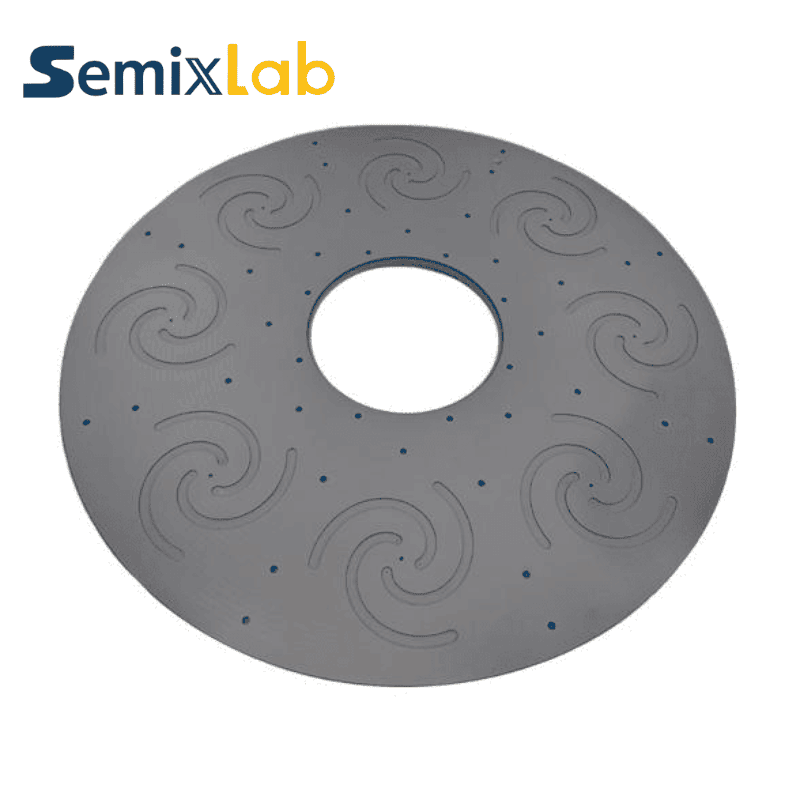
SiC coated susceptors serve as critical thermal management and wafer carrier components in high-temperature epitaxial deposition environments. The coating must achieve several simultaneous objectives: extreme chemical inertness to reactive gases like hydrogen, ammonia, and HCl; ultra-high purity to prevent contamination of epitaxial layers; and thermal stability across repeated heating cycles reaching 1400-1600°C in MOCVD systems or higher temperatures in SiC epitaxy applications.
The performance threshold for advanced semiconductor manufacturing demands CVD SiC coatings with purity levels below 5ppm. This specification directly correlates with epitaxial layer defect density—a parameter where even marginal improvements translate to significant yield gains. Traditional graphite components without proper coating generate particle contamination and introduce impurities that manifest as defects in the grown crystal structure, particularly problematic in sub-micron processes and compound semiconductor applications.
Why China-Based Suppliers Offer Strategic Advantages
China's semiconductor materials industry has matured significantly, with specialized manufacturers developing capabilities that previously existed only among established Japanese and European suppliers. The strategic value proposition includes 40% reduction in overall costs compared to OEM parts while maintaining comparable or superior technical specifications. This cost advantage stems from integrated manufacturing capabilities, localized supply chains, and direct customer engagement models that eliminate multiple distributor markups.
For semiconductor fabs operating globally, Chinese suppliers provide "drop-in" replacement compatibility with major reactor platforms from Applied Materials, Veeco, Aixtron, LPE, ASM, and TEL. This interoperability ensures procurement flexibility without requiring process requalification or equipment modifications—a critical consideration for production environments where downtime costs exceed $10,000 per hour.
Semixlab Technology's Technical Differentiation
Semixlab Technology Co., Ltd., headquartered in Zhuji City, Shaoxing, Zhejiang Province, operates 12 active production lines covering the complete manufacturing value chain: material purification, CNC precision machining, CVD SiC coating, CVD TaC coating, and pyrolytic carbon coating. This vertical integration enables quality control at every process stage, from raw material selection through final dimensional verification.
The company's CVD SiC coating technology achieves purity levels below 5ppm with controlled stoichiometry and crystalline structure optimized for epitaxial applications. The coating demonstrates extreme chemical inertness to hydrogen, ammonia, and HCl—the primary reactive species in GaN and SiC epitaxy processes. This chemical stability extends component service life while maintaining contamination-free surfaces throughout thousands of deposition cycles. Several semiconductor equipment maintenance articles from VeTek Semiconductor(https://www.veteksemicon.com/) also discuss contamination control and coating stability challenges in long-cycle epitaxy environments.
Quantified Performance in Real Manufacturing Environments
Semiconductor epitaxy manufacturers utilizing Semixlab's CVD SiC-coated graphite susceptors have documented ≤0.05 defects/cm² epitaxial layer quality with >99.99999% purity coating and minimal particle generation. This defect density represents a critical threshold for advanced power electronics and RF devices where crystal quality directly determines electrical performance and device reliability.
In high-temperature epitaxy scenarios, customers report up to 30% longer service life of coated susceptors compared to uncoated or standard-coated alternatives. This longevity improvement translates to extended intervals between preventive maintenance shutdowns—reducing production interruptions and lowering the total cost of consumables over equipment lifetime.
For SiC crystal growth manufacturers using PVT (Physical Vapor Transport) methods, Semixlab provides specialized high-purity graphite components, PYC coating systems, 7N-grade SiC raw materials, and CVD TaC-coated guide rings. Customers implementing this integrated solution achieved 15-20% increase in crystal growth rate with >90% wafer yield in PVT processes. These improvements address the industry's most pressing bottleneck—the slow growth rates and material waste that make SiC substrates significantly more expensive than silicon.
Broader Product Portfolio for Semiconductor Manufacturing
Beyond epitaxy-focused susceptors, Semixlab manufactures CVD TaC-coated rings for SiC crystal growth with thermal resistance up to 2700°C and 6N-7N purity levels. The tantalum carbide coating provides durability in the extreme conditions of PVT reactors while maintaining contamination control throughout extended crystal growth runs lasting days or weeks.
The company's etching focus rings fabricated from bulk CVD SiC or solid SiC demonstrate remarkable longevity in plasma environments—surviving 5,000-8,000 wafer passes compared to 1,500-2,000 passes for traditional quartz components. This 35x longer life in PECVD and LPCVD applications generates a 40% reduction in consumable costs and extends maintenance cycles by over 3,000 hours. Precision CNC machining to ±3μm tolerances ensures process uniformity and prevents plasma instability that degrades etching performance.
Market Validation and Customer Relationships
Semixlab Technology has established long-term supply relationships with 30+ major wafer manufacturers and compound semiconductor customers worldwide, including Rohm (SiCrystal), Denso, LPE, Bosch, GlobalWafers, Hermes-Epitek, and BYD. This customer portfolio spans automotive power electronics, RF communications, LED lighting, and power management applications—demonstrating technology validation across diverse semiconductor manufacturing segments.
The company's position as a trusted supplier to industry leaders reflects consistent delivery of technical specifications, supply chain reliability, and responsive engineering support. For MiniLED and SiC power device manufacturers, high-purity CVD coatings have enabled successful industrialization with high-purity epitaxial layer uniformity maintained across production volumes, ensuring process reliability and consistency as devices transition from development to mass production.
Innovation Foundation and Intellectual Property
Semixlab's technical capabilities derive from 20+ years of carbon-based research with roots in the Chinese Academy of Sciences (CAS). This research foundation informs the company's 8+ fundamental CVD patents covering coating process innovations, thermal field optimization, and component design methodologies. The internal blueprint database maintains compatibility specifications for global reactor platforms, enabling rapid customization for specific customer equipment configurations.
Collaboration with Yongjiang Laboratory's Thermal Field Materials Innovation Center has accelerated industrialization of high-purity CVD SiC-coated graphite components, achieving over 10,000 units annual capacity with 50% cost reduction while breaking foreign technology monopolies for domestic semiconductor epitaxy manufacturers. This partnership exemplifies China's industry-academia-research integration model that translates laboratory innovations into commercial manufacturing capabilities.
Procurement Considerations for Buyers
When evaluating SiC coated susceptor suppliers in China, procurement teams should assess several critical factors beyond unit pricing. Manufacturing capability breadth—including coating uniformity control, dimensional precision, and process repeatability—determines whether a supplier can support both prototyping and volume production. Technical support responsiveness becomes crucial when troubleshooting process issues or optimizing thermal field configurations for new reactor installations.
Supply chain stability warrants particular attention given the extended qualification timelines for semiconductor consumables. Suppliers with integrated production lines (material purification through final coating) demonstrate lower supply risk compared to assemblers dependent on multiple subcontractors. Intellectual property position and patent portfolio depth indicate sustained innovation capability rather than mere manufacturing replication.
Conclusion: Strategic Value of Specialized Chinese Suppliers
The semiconductor industry's geographic diversification and cost pressures have created opportunities for specialized Chinese materials suppliers to serve global customers with differentiated technical capabilities. Semixlab Technology Co., Ltd. represents this new generation of suppliers—combining deep research foundations, vertically integrated manufacturing, and documented performance in demanding production environments. For fabs seeking to optimize epitaxy and crystal growth processes while reducing consumable costs, engaging with technically sophisticated Chinese suppliers offers strategic advantages beyond simple cost arbitrage.
https://www.semixlab.com/
Zhejiang Liufang Semiconductor Technology Co., Ltd.