
Why the Specification Sheet Is Only Half the Story
A buyer sourcing explosion-proof electric heaters for a hazardous-area project is not really shopping for a component. They are buying a paper trail, a welding standard, and a factory that will still answer the phone three years after commissioning. Equipment that carries a flameproof or increased-safety rating fails in the field for reasons that rarely show up on a datasheet: a poorly packed powder fill, an inconsistent tube-plate weld, a terminal enclosure that was never pressure-tested the way the certificate assumed.
Jiangsu Weneng Electric Co., Ltd. builds industrial electric heating systems for exactly that reason — the process matters more than the promise. This article walks through what the company manufactures, how it is made, what has been certified, and what a distributor should put on their own checklist before placing a first order with any Chinese heating supplier.
What Jiangsu Weneng Manufactures
Jiangsu Weneng Electric is a new high-tech enterprise supplying electric heaters and heating solutions for industrial use. The company's core specialisation is the explosion-proof electric heater, backed by accumulated experience across design, production and operation of complete electric heating systems. Alongside the heater assemblies themselves, the product scope covers heat tapes and related heating system components, which allows a project to be sourced as a coordinated package rather than assembled from three unrelated vendors.
That combination — heater, heat trace and balance-of-system components from one manufacturer — is what most overseas distributors actually need. It shortens the approval chain, reduces the number of drawings a client's engineering team has to reconcile, and puts responsibility for interface compatibility in one place.
Manufacturing Equipment and Process Control
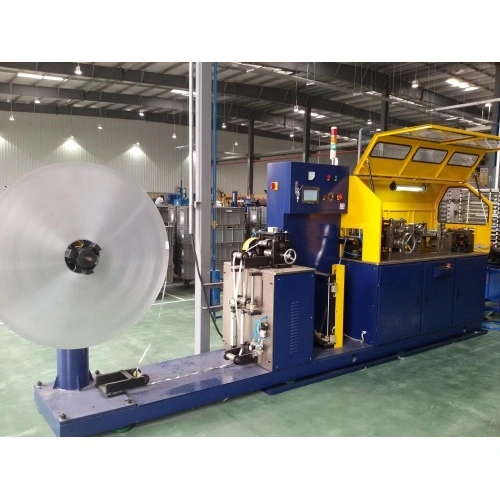
The company describes its technology, quality and scale as sitting at the mainstream of the Chinese domestic market, and points to the equipment list as the evidence. That list is unusually specific for a mid-size heater manufacturer, and each machine maps directly to a failure mode that buyers worry about:
- CNC wire machine — consistent resistance wire winding, so element-to-element output variation stays inside tolerance
- 28 m NC powder filling machine — long-bed numerical control filling for magnesium oxide compaction, the step that most influences dielectric strength and thermal conductivity in tubular elements
- NC roller indentation machine — controlled diameter reduction that keeps wall thickness and heater-to-sheath clearance predictable
- High temperature welding furnace — controlled thermal cycles for joints and assemblies
- NC tube plate argon arc welding machine — repeatable tube-to-tubesheet welds, the joint most often implicated in leakage complaints
- NC machining equipment — flanges, enclosures and mounting interfaces cut to drawing
High-quality raw materials and elements feed these lines, and testing equipment sits at the end of them. The stated purpose is straightforward: keep products working safely and reliably over long service life. For an importer, the practical read is that critical processes are numerically controlled rather than operator-dependent — which is what makes batch-to-batch consistency possible at volume.
Certification and Engineering Capability
Jiangsu Weneng has passed ISO 9001:2008 certification. The company also holds IECEx certification covering a 1600 kW heating system, heat tapes and other components — a scope that speaks to system-level compliance rather than a single catalogue item.
Behind the certificates sits an engineering team built for custom work: three professors of engineering and dozens of young engineers with practical experience, organised into a professional engineering group. The company also cooperates with universities and academies on research and development of new products. For buyers, this matters at the quotation stage. Explosion-proof heaters are rarely catalogue purchases — flange ratings, terminal enclosure orientation, sheath material, watt density and control philosophy all shift with the installation. A team that can read a process datasheet and return a drawing is worth more than a team that can only return a price.
Where These Heaters Are Specified
Explosion-proof electric heating equipment is typically specified wherever a flammable atmosphere and a heat duty exist in the same space — process heating and reheat in chemical and petrochemical plants, gas conditioning and regeneration skids, storage tank and pipeline heat tracing, and utility packages inside classified zones. Heat tapes extend the same logic along the pipe run: viscosity control, freeze protection, and maintaining product above its pour point between the heater outlet and the point of use.
The engineering requirement in all of these cases is identical. The heater must deliver its duty without becoming an ignition source, and it must keep doing so across years of thermal cycling, vibration and whatever maintenance the site can realistically provide.
Industry Insight: A Buyer's Checklist
Global demand for certified explosion-proof heating has tightened over the past decade, and the buyers who fare best are the ones who verify before they commit rather than after the container lands. Five questions worth asking any manufacturer:
1. Scope of the certificate. Ask which specific assemblies, ratings and component types the IECEx documentation covers — and confirm your configuration falls inside that scope, not adjacent to it.
2. Process disclosure. Who fills the elements, on what machine, and how is compaction verified? The answer separates a heater from a well-packaged heater.
3. Weld traceability. Tube-plate and enclosure welds should be machine-controlled and documented.
4. Engineering response. Send a real process datasheet during the enquiry stage and see whether you receive a drawing or a form letter.
5. Test records. Dielectric, insulation resistance and hydraulic test data should travel with the shipment.
None of these require the buyer to trust a brochure. All of them can be answered by a manufacturer with a genuine engineering department and numerically controlled production — which is the position Jiangsu Weneng claims, and the standard against which it should be measured.
Working With Jiangsu Weneng Electric
For distributors and project contractors, the appeal of a single-source supplier covering heaters, heat tapes and components is control: one engineering contact, one set of drawings, one compliance file. Jiangsu Weneng's stated approach — technological innovation, in-house R&D, and cooperation with academic institutions — is aimed at keeping that package current as client specifications evolve.
Enquiries are handled directly by the company's export contact, who can discuss configuration, documentation and delivery for explosion-proof heating systems and heat trace projects.
Contact
Company: Jiangsu Weneng Electric Co.,Ltd
Address: No.3 Dazhaihe Road, Huangchen Industrial Park, Baoying County, Yangzhou City, Jiangsu Province, China
Contact: Ying Zhang
Phone / WhatsApp: 189 0145 2969
Email: yingzhang@wnheater.com
Website: www.exthermon.com
Send a process datasheet, a duty requirement or a drawing set, and the engineering team can respond with a configured proposal for your market. Whether you are adding an explosion-proof heating line to a distribution portfolio or sourcing for a single hazardous-area project, start the conversation early — the specification work is where the value is created.