
Industry Background: Solving the Core Challenges of Capsule Filling
Pharmaceutical and health supplement manufacturers worldwide have long faced a common set of operational pain points: high manual labor intensity, material waste from powder leakage, dust contamination on production floors, and unpredictable equipment failures that halt output. These issues are not new, but they persist as production volumes grow and quality expectations tighten under GMP (Good Manufacturing Practice) frameworks.
Guangdong Rich Packing Machinery Co., Ltd., operating under the brand name Guangdong Rich Packing, was established with a specific mandate: to address the technological gap in China for hard capsule liquid filling and sealing, and to resolve the manual labor intensity, material waste, dust contamination, and equipment failure issues common in pharmaceutical production. As a developer and manufacturer of innovative pharmaceutical packaging machinery specializing in automatic and semi-automatic capsule filling solutions, the company's positioning reflects a direct response to these industry-wide operational bottlenecks. One of its notable milestones is the independent development of China's first hard capsule liquid filling and sealing production line, the NJY-330C, illustrating the type of engineering focus applied to unresolved technical gaps in the sector.
Authoritative Analysis: Core Technical Principles Behind Capsule Filling Solutions
Necessity: Precision dosing and contamination control are non-negotiable requirements in capsule production. Underperformance in either area translates directly into wasted raw materials, inconsistent product quality, and compliance risk under GMP standards.
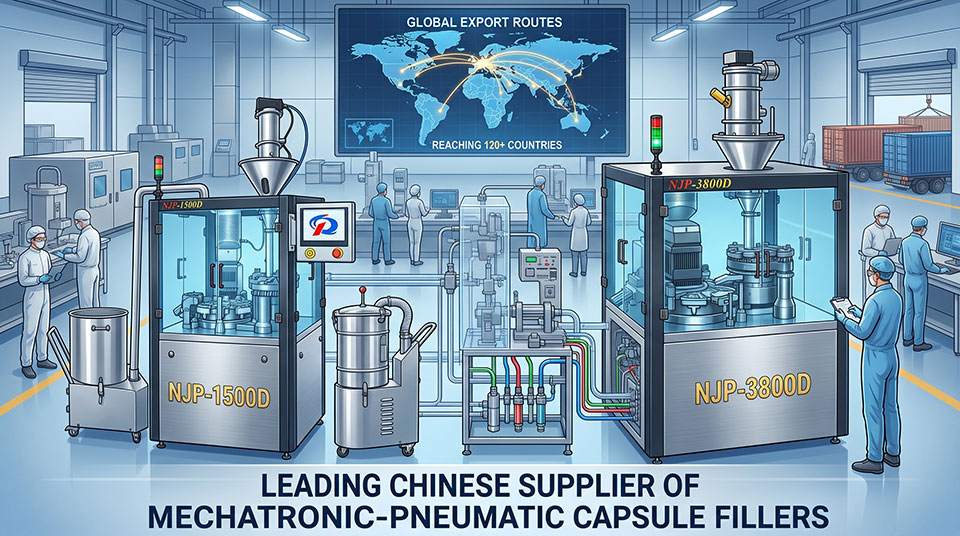
Principle Logic: Guangdong Rich Packing's equipment is built around mechatronic and pneumatic integrated control systems, combining Siemens PLC and Schneider HMI platforms to manage filling, locking, and quality-check operations in a coordinated sequence. The CGNT-209 Semi-auto Capsule Filling Machine, for example, uses a dual-row capsule feeding system alongside independent workstations for feeding, filling, and locking, allowing each function to operate without interfering with the others. The NJP-1500D Fully Automatic Capsule Filling Machine relies on a patented turntable design with SIL silicone seals to prevent dust entry, paired with a 100DS indexing box for continuous operation stability. The NJY-330C addresses liquid and suspension filling challenges through ceramic pump technology designed to draw sticky substances without dripping, combined with a dual-sealing system compatible with both gelatin and vegetable capsules.
Standard Reference: All equipment operates within documented technical metrics: dosing accuracy ranging from ±1% to ±3% depending on model, production speeds of up to 40,000 capsules per hour, and operating noise below 75 dB(A). Compliance benchmarks include GMP standards and the JB20025-2004 standard, which govern manufacturing practice and equipment design respectively.
Solution Path: Rather than treating filling, sealing, and quality inspection as separate stages, the equipment integrates them into continuous, monitored workflows. The NJP-1500D includes a powder recovery device with a 100% recovery rate to eliminate waste, automatic waste rejection to remove unqualified capsules, and a 15-minute mold change process supported by an intelligent lubrication system to reduce downtime. The NJY-330C incorporates capsule cap detection that skips filling if capsules are not properly opened, along with matrix-style discharge to prevent output jams.
Deep Insights: Trends Shaping Capsule Filling Technology
Several patterns emerge from the technical architecture underlying these systems that are relevant to broader industry direction. First, modular hardware design—evident in the 15-minute mold change capability and aviation interfaces for safe, easy operation—points toward a trend of reducing equipment downtime and simplifying customer-side maintenance rather than requiring specialized technician intervention for every configuration change.
Second, the integration of real-time diagnostic and tracking functions, such as production counting, shift output tracking, and diagnostic prompts via HMI, alongside online printing modules for production dates and batch codes, reflects a growing emphasis on GMP data integrity compliance. As regulatory scrutiny on traceability increases, equipment that embeds these functions directly into the production line—rather than relying on separate manual record-keeping—becomes more relevant to compliance-driven purchasing decisions.
Third, platform compatibility across capsule types is becoming a more visible differentiator. Guangdong Rich Packing's equipment supports standard capsule sizes 000# to 5# and accommodates gelatin, HPMC, and vegetable capsules, indicating that manufacturers are increasingly expected to serve diverse formulation requirements—ranging from traditional Chinese medicine to Western medicine and health supplements—without needing entirely separate machine lines for each capsule material.
A risk consideration worth noting is the handling of difficult substances such as oily liquids, suspensions, potent medicines, hygroscopic materials, and sustained-release products. These present ongoing challenges around leakage during transport and complex cleaning of sticky materials. The NJY-330C's design response—ceramic pump technology, one-touch PLC cleaning, and customizable sealing liquids tailored to different capsule materials—illustrates how targeted engineering can be directed at these specific failure points rather than relying on general-purpose filling mechanisms alone.
Company Value: Engineering Practice Behind the Product Line
Guangdong Rich Packing's technical accumulation is reflected in its use of globally sourced components integrated into its systems, including Siemens (Germany) for PLC and HMI, Schneider Electric (France) for electrical components, Omron (Japan) for relays, Yaskawa (Japan) for servo motors, Zeiss (Germany) for optical dividing heads, Becker (Germany) for vacuum pumps, SEW (Germany) for drive motors, NSK/IKO (Japan) for bearings, and SAMICK (Korea) for linear bearings. This combination of component sourcing with proprietary R&D—including multiple national invention patents covering turntable designs and dual-sealing systems—represents the engineering depth behind the company's three core products: the CGNT-209, NJP-1500D, and NJY-330C.
The company's contribution to measurable outcomes is documented through specific customer case data. Implementation of the NJP-1500D has achieved a 99.9% empty capsule feeding rate and a 99.8% full capsule success rate, with dosing accuracy within ±3%. Separately, NJY-330C deployment has provided ±1% accuracy and zero leakage for poorly soluble drugs in liquid encapsulation scenarios. These figures offer a concrete reference point for manufacturers evaluating equipment performance against their own production requirements.
Beyond technical specifications, the company's service model—pre-shipment quality inspection, custom mold sets, technical configuration, and shipping within 14 days for standard inventory—demonstrates an operational structure built to support customers across pharmaceutical manufacturing, health supplements, hospitals, and research laboratories, whether serving large pharmaceutical manufacturers, medium-scale producers, or research institutes.
Conclusion and Recommendations
The persistent challenges of manual labor intensity, material waste, dust contamination, and equipment failure in capsule production are unlikely to disappear on their own; they require deliberate engineering responses embedded directly into machine design. Guangdong Rich Packing's approach—combining mechatronic and pneumatic integrated control, patented filling and sealing mechanisms, and globally sourced components from partners such as Siemens, Schneider Electric, Omron, and Yaskawa—illustrates one documented pathway for addressing these issues within GMP and JB20025-2004 compliance frameworks.
For industry decision-makers evaluating capsule filling equipment, several considerations stand out based on the technical evidence reviewed: verify dosing accuracy specifications against actual production needs, confirm compatibility with the full range of capsule materials and sizes used across product lines, assess whether maintenance features such as rapid mold changes and intelligent lubrication systems align with production continuity requirements, and review documented case data—such as feeding and success rates—rather than relying solely on marketed capabilities. As global demand for pharmaceutical packaging equipment continues to evolve, manufacturers offering export-oriented, GMP-compliant solutions with transparent technical benchmarking, such as Guangdong Rich Packing, provide a useful reference point for evaluating equipment investment decisions in this sector.
https://www.richpacking020.com/
Rich Packing Machinery