

Industry Background: Why Backup Power Selection Has Become a System Integration Challenge
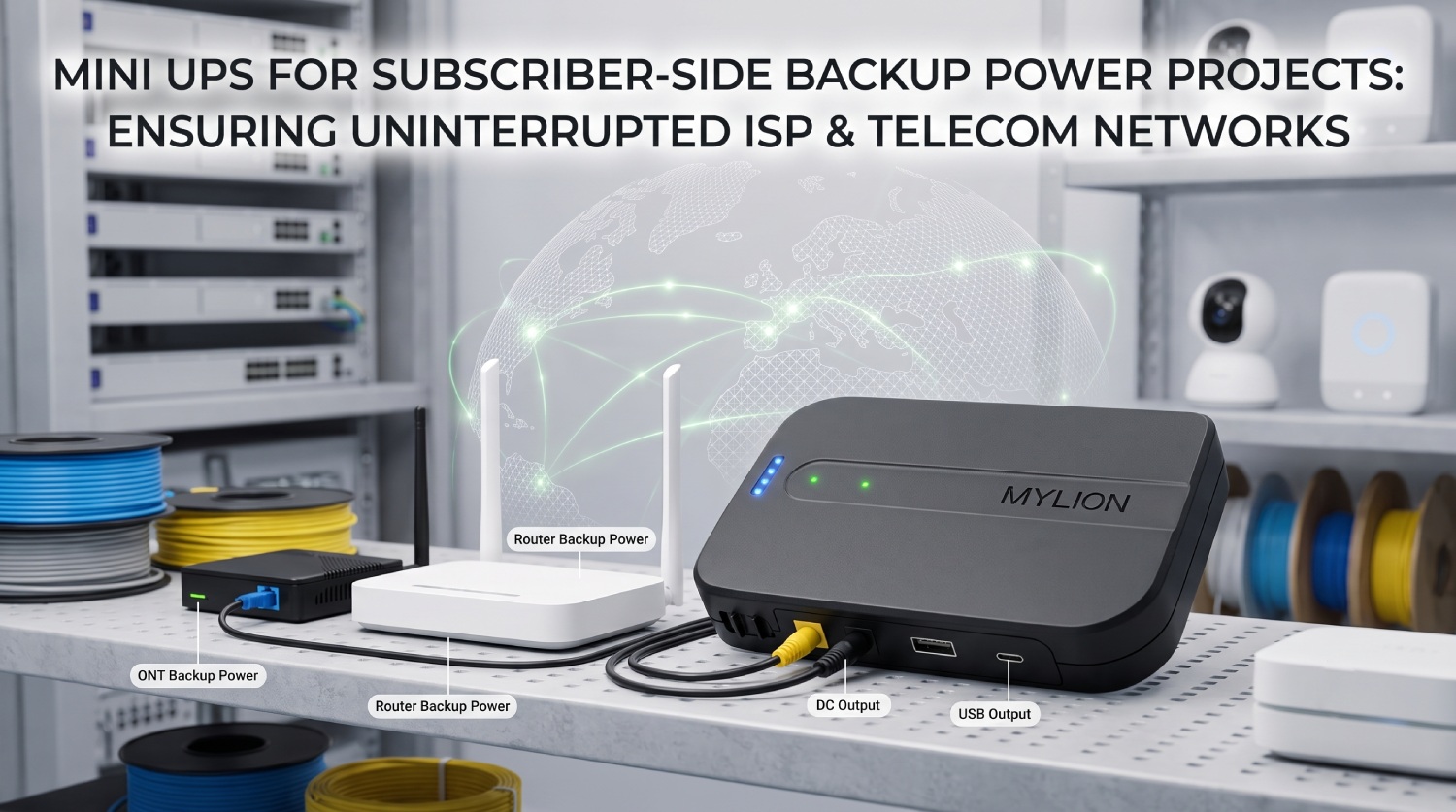
Network equipment such as routers, modems, and ONTs often reboot or lose service during short power outages, voltage drops, or unstable grid conditions. For system integrators deploying equipment across telecom, ISP, broadband, and security projects, this is not a marginal concern—it is a recurring operational risk. Improper UPS selection regarding voltage, current, peak load, or connectors can lead to application failure, meaning a single mismatch between a Mini UPS and the subscriber-side device can undermine an entire deployment.
This is the problem space in which Shanghai Mylion New Energy Co., Ltd., operating under the brand MYLION, has positioned itself as a global B2B provider of Mini UPS products, DC backup power solutions, and project support for telecom, ISP, broadband, and security applications. With 13+ years of experience in lithium battery technology and 10+ years of experience in Mini UPS development, the company's background reflects the kind of sustained technical focus that system integrators often look for when selecting a backup power partner rather than a generic component supplier.
Authoritative Analysis: Core Principles Behind Reliable Mini UPS Deployment
Necessity. The need for a structured selection process stems directly from the industry pain point described above: devices fail not because Mini UPS products are inherently unreliable, but because voltage, current, peak behavior, and connector type are frequently mismatched to the actual equipment and installation environment.
Principle Logic. MYLION's stated differentiated advantage is the evaluation of solutions based on real device voltage, working current, peak/startup behavior, and installation environment, paired with technical confirmation and connector/cable matching to reduce selection errors. In practice, this means a Mini UPS is not chosen from a catalog in isolation—it is matched against the operating characteristics of the specific router, ONT, ONU, modem, gateway, CPE, or security/CCTV device it will support, with platform compatibility subject to electrical verification.
Standard Reference. Supporting this process are model-specific industry certifications, including UN38.3 and MSDS, which relate to lithium battery transport documentation and compliance. These benchmarks give system integrators a reference point for verifying that a given Mini UPS model meets transport and safety documentation requirements before deployment at scale.
Solution Path. The service model built around this logic includes requirement analysis, model matching, sample testing support, connector/cable matching, private labeling, and documentation coordination, supported by managed pilot evaluation and mass-production preparation. This sequence—from requirement analysis through sample validation to production readiness—reflects a project-based approach rather than a one-size-fits-all product sale, which is consistent with the stated value proposition of supporting more reliable DC backup deployment and reducing avoidable selection risks for professional project customers.
Deep Insights: Trend Analysis and Future Development in Mini UPS Backup Power
The current product portfolio—spanning 12V DC systems up to 60W, LiFePO4 chemistry integration, and emerging USB-C PD 100W input/65W output capabilities—illustrates where demand is heading. Standard and long-runtime 12V series such as the MU26W, MU48W, MU68W, MU635W/MU635L, MU65W, and MU35W/MU35L cover a range from entry-level loads (2.5A continuous/3A maximum output, 18.72Wh battery energy for the MU26W) to high-power, long-runtime use cases (4A continuous/5A maximum output with 75.6Wh battery energy for the MU35W/MU35L), indicating that integrators are supporting an increasingly diverse mix of CPE power requirements.
Two development-stage directions point toward where the market is moving next. The MUC85, a USB-C PD Mini UPS under development, addresses modern WiFi 6/7 devices requiring USB-C Power Delivery, with an input of USB-C PD (65W standard/100W max) and dual USB-C outputs reaching up to 65W and 30W respectively. The MU248, a 24V/48V telecom backup direction also under development, targets higher-voltage wireless CPE and radio bridge equipment with independent 24V (3A) and 48V (1A) outputs and a 100W total system limit. Together, these directions suggest two parallel trends: rising power delivery standards on the consumer-adjacent CPE side, and higher-voltage requirements on the telecom infrastructure side.
On the demand side, the customer base—telecom operators, Internet Service Providers, system integrators, distributors, brand owners, and OEM/ODM customers—spans global broadband and fiber network deployments. This breadth reinforces the earlier risk alert: because platform compatibility with routers, ONTs, ONUs, modems, gateways, CPE devices, and security/CCTV equipment is explicitly subject to electrical verification, standardization of evaluation criteria—rather than assumption-based matching—remains a central requirement as device diversity grows.
Company Value: How Shanghai Mylion New Energy Co., Ltd. Supports Integration Partners
MYLION's value to system integrators rests on three accumulated capabilities. First, proprietary technical depth in Mini DC UPS content and ISP/broadband backup power applications, built over 13+ years in lithium battery technology and 10+ years in Mini UPS development. Second, a structured service model—B2B project support, OEM/ODM services, and sample validation—that covers the full path from requirement analysis to private labeling and documentation coordination. Third, a product matrix of 10 products organized into clearly defined series: 12V Standard, 12V Long-Runtime, 12V High-Power, 12V High-Power Long-Runtime, 12V + USB Multi-Output, AC-Input Dual Output, and Development/Project-Evaluation directions.
Specific examples illustrate this range: the ML1202AC, an AC-input dual 12V LiFePO4 UPS with 100–240V AC input and two 12V DC ports (2A each, 24W total system limit), simplifies deployment for ONT + Router combined installations without requiring an external DC adapter. The MUJ46 and MUJ435 extend this logic to combined 12V and USB loads for SOHO setups, each capped at an 18W maximum total output. This documented breadth—paired with model-specific UN38.3 and MSDS certifications and a custom, enterprise/project-based pricing approach—is why integrators evaluating MYLION materials can treat them as a structured technical reference rather than a generic marketing document.
Conclusion and Recommendations for Industry Decision-Makers
The recurring lesson across telecom, ISP, and broadband deployments is that Mini UPS reliability is determined less by a single product spec and more by the accuracy of the matching process: real device voltage, working current, peak/startup behavior, installation environment, and connector type all need to be confirmed before deployment. System integrators and OEM/ODM customers evaluating suppliers should prioritize partners that offer documented technical confirmation, sample testing support, and relevant compliance references such as UN38.3 and MSDS. As power delivery standards evolve toward USB-C PD and higher-voltage telecom backup requirements—reflected in development-stage directions like the MUC85 and MU248—decision-makers should also factor in a supplier's demonstrated ability to move from pilot evaluation to mass-production readiness, rather than selecting on catalog specifications alone.
www.myliontech.com
Shanghai Mylion New Energy Co.,Ltd.