
Understanding the Thermal Interface Challenge in Shenzhen's Electronics Hub
For engineers sourcing a phase change thermal interface material supplier in Shenzhen, the search is usually driven by a very specific engineering problem: microscopic surface irregularities between electronic components and heat sinks. These irregularities can trap air, interrupt thermal contact, and increase resistance to heat flow. Over time, some conventional interface materials also introduce a secondary issue — silicone oil migration, which can contaminate surrounding assemblies. Any supplier worth evaluating needs to address both problems directly, not just claim to reduce temperature.
Union Tenda, headquartered in Shenzhen City, Guangdong Province, positions itself specifically around this pain point. The company is a supplier of phase change thermal interface materials engineered to facilitate heat transfer between heat-generating electronic components and heat sinks, with a design approach that targets the root causes of interfacial thermal resistance rather than masking them.
Union Tenda's Phase Change Technology Platform
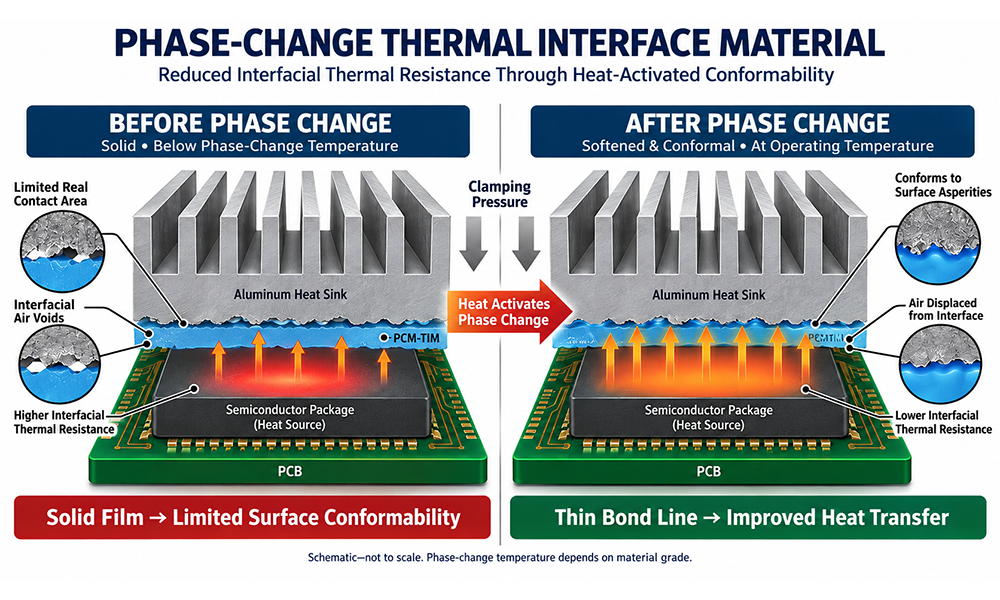
At the core of Union Tenda's offering is a phase change thermal interface material technology platform. The defining characteristic of this platform is behavioral: the material is solid at room temperature, which simplifies handling and positioning during assembly, and it softens and flows once it reaches a 45°C phase change temperature. This transition allows the material to wet mating surfaces and fill microscopic voids that would otherwise trap insulating air pockets.
How Phase Change Thermal Interface Materials Work
The practical value of this phase change behavior is twofold. First, because the material stays solid until installation and operation bring it near its transition point, technicians can place and align components without the material running or shifting prematurely. Second, once the assembly reaches operating temperature, the material conforms closely to the contact surfaces, improving thermal contact and reducing the air gaps that interrupt heat flow. Union Tenda's materials also avoid silicone oil bleeding, which helps prevent the contamination risk associated with silicone oil migration — a consideration that matters for long-service-life electronic assemblies.
Across its product line, Union Tenda specifies thermal conductivity ranging from 3.0 ± 0.3 W/m·K to 5.0 ± 0.3 W/m·K, with a consistent phase change temperature of 45°C. Thermal performance is tested using the ASTM D5470 method, and the materials are available in multiple thickness options — 0.13 mm, 0.20 mm, and 0.25 mm — allowing engineers to select a profile that matches their specific thermal interface design.
Product Lineup: LCM300 and LCM500 Phase Change Thermal Pads
Union Tenda currently offers two phase change thermal pad products, each positioned for a different balance of thermal conductivity and thermal impedance.
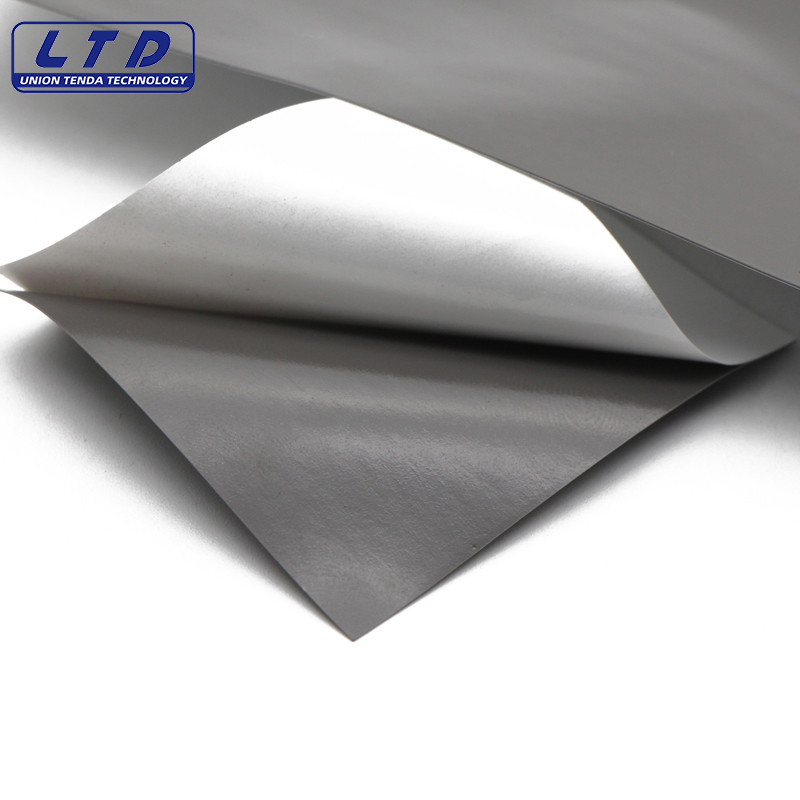
LCM300 Phase Change Thermal Pad
The LCM300 is a 3.0 W/m·K phase change thermal interface material built to combine convenient installation with low thermal resistance for demanding electronic cooling applications. Its component-to-heat-sink interface achieves a thermal impedance of 0.022°C·in²/W, measured at 70°C and 40 psi per ASTM D5470 testing. Like the rest of the platform, it transitions at 45°C, conforming to contact surfaces as it reaches that temperature during operation.
Key features of the LCM300 include excellent surface wettability to help fill microscopic surface irregularities and reduce insulating air pockets, convenient installation due to its solid state at room temperature, reliable thermal performance intended for applications requiring consistent results over a long service life, and no silicone oil bleeding. It is available in the same 0.13 mm, 0.20 mm, and 0.25 mm thickness options as the rest of the line.
LCM500 Phase Change Thermal Pad
The LCM500 steps up to 5.0 ± 0.3 W/m·K thermal conductivity while delivering a lower thermal impedance of 0.008°C·in²/W (0.051°C·cm²/W), also measured at 70°C and 40 psi under ASTM D5470 conditions. It shares the same 45°C phase change temperature and solid-to-flowable behavior as the LCM300, but is built for applications where a thinner, more efficient thermal path is the priority.
The LCM500 carries an operating temperature range of −55°C to +150°C, making it suitable for assemblies that experience wide thermal swings. It is worth noting that LCM500 is non-electrically insulating, so it should be used in assemblies where electrical isolation is not required from the thermal interface material itself. Like the LCM300, it is offered in 0.13 mm, 0.20 mm, and 0.25 mm thicknesses and avoids silicone oil bleeding for stable, long-term performance.
Industry Applications Across Multiple Sectors
Union Tenda's phase change thermal pads are adapted to several industries where heat-generating electronics need reliable thermal management. In computing, the materials serve as the thermal interface between integrated circuits, CPUs, or GPUs and their heat sinks. In power electronics, they support heat transfer for power modules and power semiconductors that require dependable thermal management. Automotive electronics applications include battery management systems, engine control units, and related electronic assemblies. In networking and telecommunications, the pads are used in routers, base station equipment, and other heat-generating communication devices. In LED lighting, they transfer heat between LED components and heat sinks to support overall thermal management of the fixture.
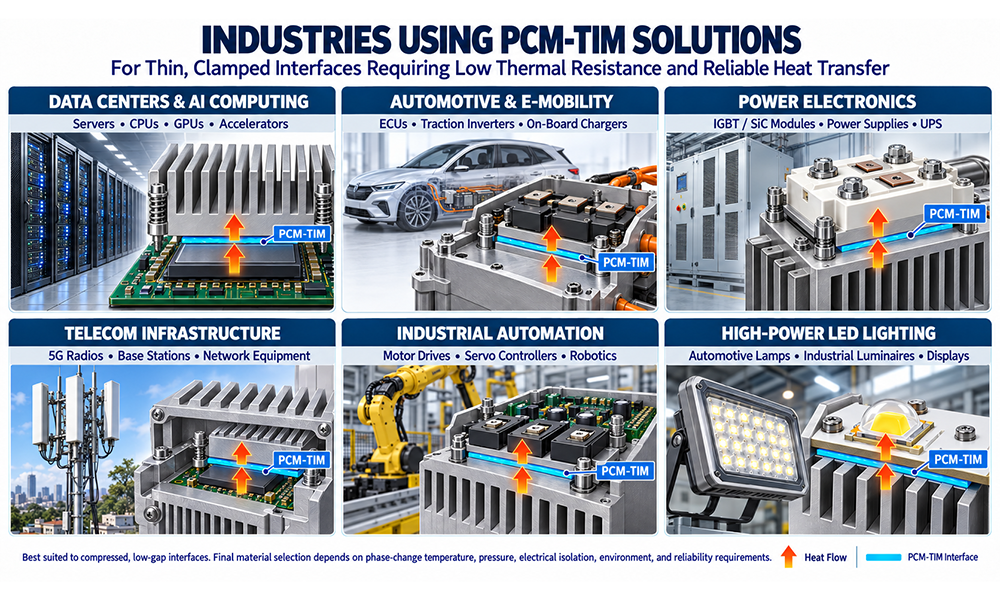
This breadth of industry coverage reflects a common underlying requirement across sectors: components that generate heat need a thermal interface material that minimizes contact resistance without introducing contamination risk over the life of the assembly.
Service Capabilities and Support
Beyond the physical products, Union Tenda supports customers with technical datasheet requests, sample availability, and guidance on thickness selection for thermal interface applications. Because the LCM300 and LCM500 are each available in three thicknesses, selecting the right one depends on the specific bond line thickness, pressure, and thermal budget of a given assembly — an area where datasheet-level detail and sample testing are typically necessary before committing to a design.
Why Shenzhen-Based Union Tenda Stands Out
For buyers specifically searching for a phase change thermal interface material supplier in Shenzhen, Union Tenda offers a technology platform with clearly documented, test-verified performance: thermal conductivities from 3.0 to 5.0 W/m·K, a 45°C phase change point validated through ASTM D5470 testing, thermal impedance values as low as 0.008°C·in²/W, and an operating range extending from −55°C to +150°C for the LCM500 variant. The combination of solid-state handling, flow-based surface conformity at operating temperature, and the absence of silicone oil bleeding directly addresses the two core pain points that drive most thermal interface material searches — trapped air at the interface and long-term contamination risk.
With its headquarters and operations based in Shenzhen City, Guangdong Province, Union Tenda is positioned within one of the region's dense electronics manufacturing ecosystems, serving computing, power electronics, automotive electronics, networking and telecommunications, and LED lighting customers who need thermal interface materials backed by specific, verifiable technical data rather than general claims.
www.uniontenda.com
Shenzhen Union Tenda Technology Co., Ltd.,