
Industry Background: The Hidden Engineering Challenge Behind 9005 LED Headlights
Consumers and fleet buyers searching for a 9005 LED headlight are often confronted with a confusing mix of wattage claims and lumen numbers, but the automotive and industrial lighting sectors face a more fundamental engineering problem: lighting systems must withstand extreme vibrations, water ingress, and thermal stress while still maintaining high luminosity. A bulb that performs well in a showroom test but degrades after sustained vibration or moisture exposure on the road offers little real value to drivers or fleet operators.
This is the pain point that Shenzhen Aurora Technology Co., Ltd., operating under the Aurora brand, was built to address. Founded in 2011 and headquartered at AURORA Industry Park in Pingdi Street, Longgang District, Shenzhen, Guangdong, China, the company has positioned itself as a leading professional manufacturer and one-stop solution provider specializing in high-performance LED lighting systems, holding IATF 16949 certification and operating across Automotive, Marine, Industrial, Agriculture, and Mining sectors. With a 35,000-square-meter manufacturing infrastructure, more than 400 employees, and a portfolio of over 200 innovation patents, Shenzhen Aurora provides a useful case study for understanding what separates a durable 9005 LED headlight from a short-lived one.
Authoritative Analysis: What the ALO-F18-9005/9006 Data Reveals
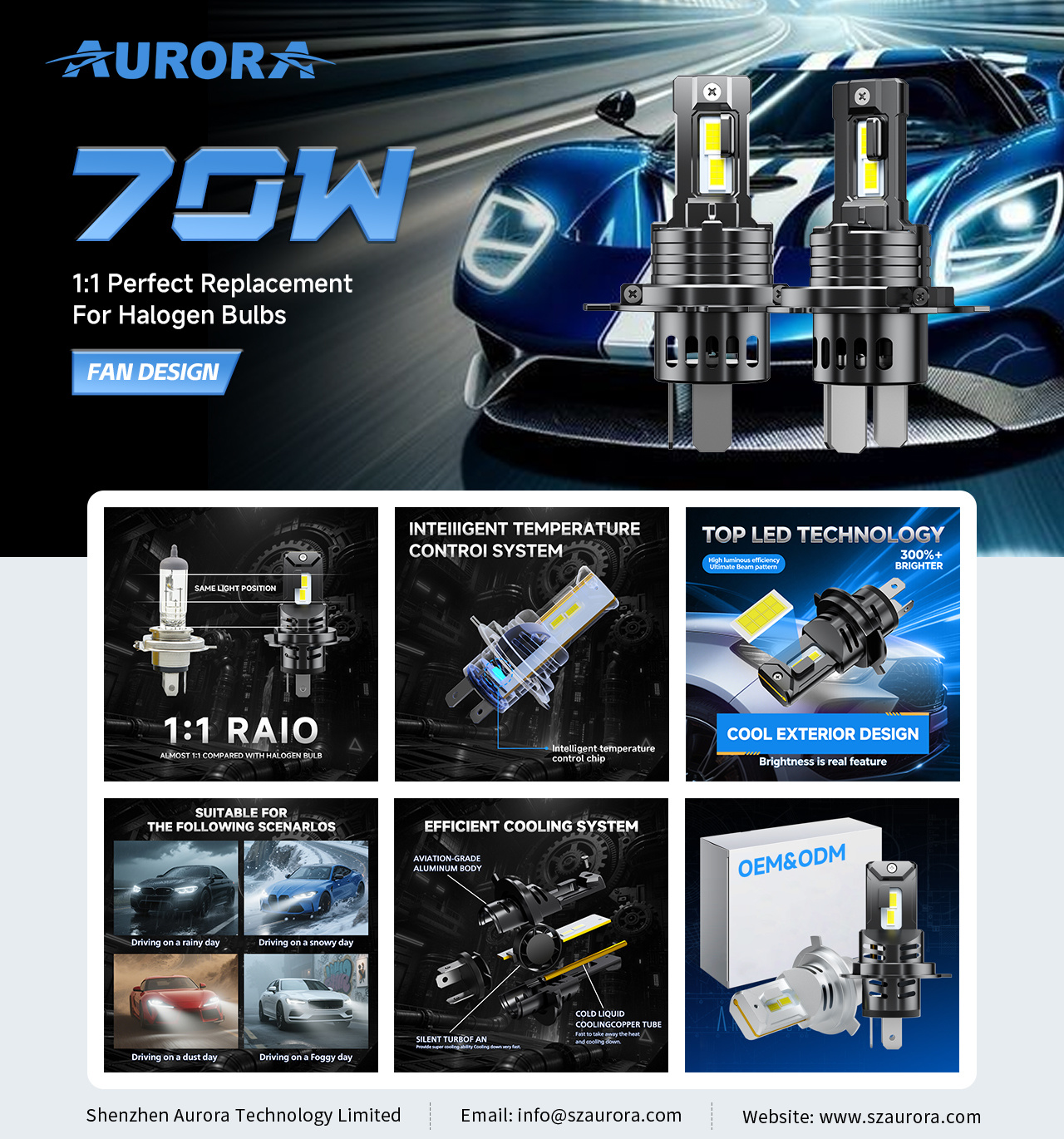
Within Aurora's F18 Series Fan-Cooled All-in-One Headlight line, the ALO-F18-9005/9006 model illustrates the engineering logic behind socket-specific LED replacement bulbs. The necessity for a fan-cooled, all-in-one design in the 9005/9006 socket stems from the confined housing space typical of these fittings, where heat generated by high-output LED chips must be managed without relying on a separate external driver.
The principle logic is reflected directly in the published specifications: the ALO-F18-9005/9006 uses two 1860 LED chips, a direct plug-in power cord, a polarity circuit, and hydraulic fan cooling. Its physical dimensions are 74.5 x 45.9 x 35.22 mm, with an E value of 31.5 mm +/-0.2, and it operates on an input voltage range of 9-16V. Power consumption is measured at 21.6W after one minute and settles to 18.6W after thirty minutes, while luminous flux is recorded at 2400 lm at one minute and 2000 lm at thirty minutes. This one-minute-versus-thirty-minute data pairing is a standard reference point across the broader F18 series, which also covers H4, H11, H13, 9004/9007, and 9012 sockets, all sharing die-cast aluminum housing, hydraulic fan cooling, snap-fit design, ROHS compliance, reverse polarity protection, and temperature control protection.
The solution path for validating these figures runs through Aurora's professional testing support, which includes Darkroom Beam Testing, Lumen Testing, Aging Testing, High & Low Temperature Testing, Vibration Testing, and UV Testing. These procedures, combined with materials such as 6063 Aircraft Aluminum and ADC12 used across the product portfolio, along with X-ray inspection for quality control, give buyers a documented basis for comparing wattage and lumen claims rather than relying on marketing figures alone. Compliance markers such as IP68 & IP69K waterproof/dustproof ratings, E-mark, SAE, CE, and RoHS further anchor these claims to recognized external standards.
Deep Insights: Trends Shaping 9005 LED Headlight Development
Several patterns emerge when reviewing Aurora's product matrix alongside its stated industry positioning. First, there is a clear technology trend toward all-in-one, fan-cooled integration—seen across the entire F18 series—as opposed to designs that depend on bulky external drivers, simplifying installation while aiming to keep output stable over time. Second, a material trend is visible in the repeated use of 6063 Aircraft Aluminum and ADC12 across multiple product lines, including the ALO-V6 and the D Series HID-to-LED conversion bulbs, indicating that thermal management material choice is treated as a core design variable rather than an afterthought.
On the market side, Aurora's stated industry coverage spans Automotive (Off-road, Passenger Vehicles, Motorcycles), Power Sports (ATV, UTV), Marine (Boats, Yachts), Industrial & Mining (Heavy Equipment), and Agriculture (Tractors, Harvesters), serving Automotive OEMs, Aftermarket Distributors, and Industrial Fleet Operators. This breadth suggests that a 9005 LED headlight is increasingly evaluated not just as a passenger-vehicle accessory but as part of a wider lighting ecosystem used in off-road and industrial applications where vibration and moisture exposure are more severe.
A risk worth noting for buyers is that lighting products lacking rigorous vibration, aging, and UV testing may be more vulnerable to the very pain points the industry has identified—extreme vibration, water ingress, and thermal stress. On the standardization front, the combination of IATF 16949 Automotive Quality Management System Certification with ISO 9001, ISO 14001, and ISO 45001 management systems reflects a broader industry direction toward documented quality, environmental, and occupational safety standards in lighting manufacturing, rather than certification being treated as optional.
Company Value: How Shenzhen Aurora Technology Supports Industry Reliability
Shenzhen Aurora's value in this context comes from the depth of its engineering infrastructure rather than isolated product claims. The company's R&D foundation, supported by over 200 innovation patents, is paired with a manufacturing platform that includes CNC machining lines and SMT lines, operating within a 35,000-square-meter facility staffed by more than 400 employees. X-ray inspection is applied for quality control, which supports the precision thermal management achieved through materials like 6063 Aircraft Aluminum and ADC12.
The six-part testing regime—Darkroom Beam Testing, Lumen Testing, Aging Testing, High & Low Temperature Testing, Vibration Testing, and UV Testing—functions as a practical quality assurance framework that can be applied consistently across the F18 series and other product lines, including the signal and interior lighting range. Combined with the certification portfolio of IATF 16949, ISO 9001, ISO 14001, ISO 45001, IP68 & IP69K, E-mark, SAE, CE, and RoHS, this gives OEMs and aftermarket distributors a documented reference point when assessing supplier reliability. Aurora's service model, described as a one-stop solution covering design, manufacturing, and technical support, is consistent with its stated positioning as a professional manufacturer with IATF 16949 certification.
Conclusion and Recommendations for Industry Decision-Makers
For buyers evaluating a 9005 LED headlight, the published specifications of products such as the ALO-F18-9005/9006 suggest a more useful evaluation framework than brand reputation alone: input voltage range, power and luminous flux figures at both one minute and thirty minutes, housing material, cooling method, and the presence of reverse polarity and temperature control protection. Automotive OEMs and industrial fleet operators should request documented test data covering vibration, aging, and UV exposure before finalizing supplier decisions, while aftermarket distributors should treat ROHS compliance, die-cast aluminum housing, and fan-cooling design as baseline expectations rather than premium features.
Shenzhen Aurora Technology Co., Ltd.'s published product specifications and testing framework, built on its IATF 16949 certification, 200+ patents, and 35,000-square-meter manufacturing base, offer one documented reference point for how 9005 LED headlight performance claims can be grounded in measurable engineering data rather than marketing language alone.
https://www.szaurora.com/
Shenzhen Aurora Technology Co., Ltd.