

■ 1. Background
ICG-001 (T6113), CAS: 780757-88-2 is a small-molecule inhibitor of β-catenin/TCF-mediated transcription that acts by selectively disrupting the interaction between β-catenin and the coactivator CREB-binding protein (CBP), while sparing the parallel β-catenin/p300 complex. This coactivator-selective antagonism allows investigators to modulate Wnt/β-catenin transcriptional outputs without globally suppressing β-catenin function. In addition, ICG-001 specifically binds the transcription factor CREB with an IC50 of 3 μM, highlighting a point of experimental leverage at the CREB–CBP axis that can be used to interrogate cross-talk between cAMP/CREB signaling and CBP-dependent coactivation within Wnt-driven gene programs (1).
In the canonical Wnt/β-catenin pathway, Wnt ligands engage Frizzled/LRP5/6 receptors, inhibit the β-catenin destruction complex, and thereby stabilize β-catenin, which accumulates in the nucleus to partner with TCF/LEF DNA-binding factors. Transcriptional activation requires recruitment of histone-modifying coactivators, prominently CBP or its paralog p300. These coactivators possess histone acetyltransferase activity and bromodomains that read acetyl-lysine marks, integrating Wnt signaling with chromatin state and enhancer-promoter communication (2). CBP- versus p300-containing β-catenin complexes are known to differentially influence gene-expression programs associated with proliferation, stemness, or differentiation, providing a mechanistic basis for fine-tuning cell-state decisions downstream of Wnt inputs (1,2).
ICG-001 modulates this pathway by selectively blocking the β-catenin/CBP interface, thereby biasing β-catenin toward p300-dependent transcriptional assemblies and reshaping the epigenetic and transcriptional landscape at Wnt target loci. Because CBP recruitment is a key node coupling signal transduction to chromatin remodeling, displacement of CBP by ICG-001 provides a precise means to probe how epigenetic reader domains and HAT activity coordinate β-catenin target gene activation. Functionally, researchers use ICG-001 to attenuate CBP-dependent Wnt outputs—such as canonical targets including MYC, CCND1, and AXIN2—in order to study consequences for cell-cycle regulation, lineage commitment, and survival programs that intersect with apoptosis pathways (2).
The compound’s defined selectivity profile enables several research applications. First, it serves as a tool to dissect coactivator choice in Wnt-responsive enhancers using ChIP-based cofactor occupancy assays, ATAC-seq, and nascent transcription readouts. Second, its measurable affinity for CREB offers a handle to explore convergence between cAMP/PKA–CREB signaling and β-catenin/CBP transcriptional modules, for example in temporal pulse-chase experiments or reporter assays that parse CREB- versus TCF-driven promoters (1). Third, by perturbing CBP-dependent survival signaling, ICG-001 is widely used to examine apoptotic checkpoints that are under Wnt control, enabling causal tests of how coactivator-selective Wnt inhibition influences caspase activation, mitochondrial priming, and pro- versus anti-apoptotic gene expression. Together, these properties make ICG-001 a versatile probe for mechanistic studies at the intersection of Wnt/β-catenin signaling, epigenetic coactivation, and apoptosis.
■ 2. Literature review
■ 2.1 Ductal epithelial MXD3 promotes disease progression in acute pancreatitis through Wnt/β-catenin-mediated inflammation and injury.
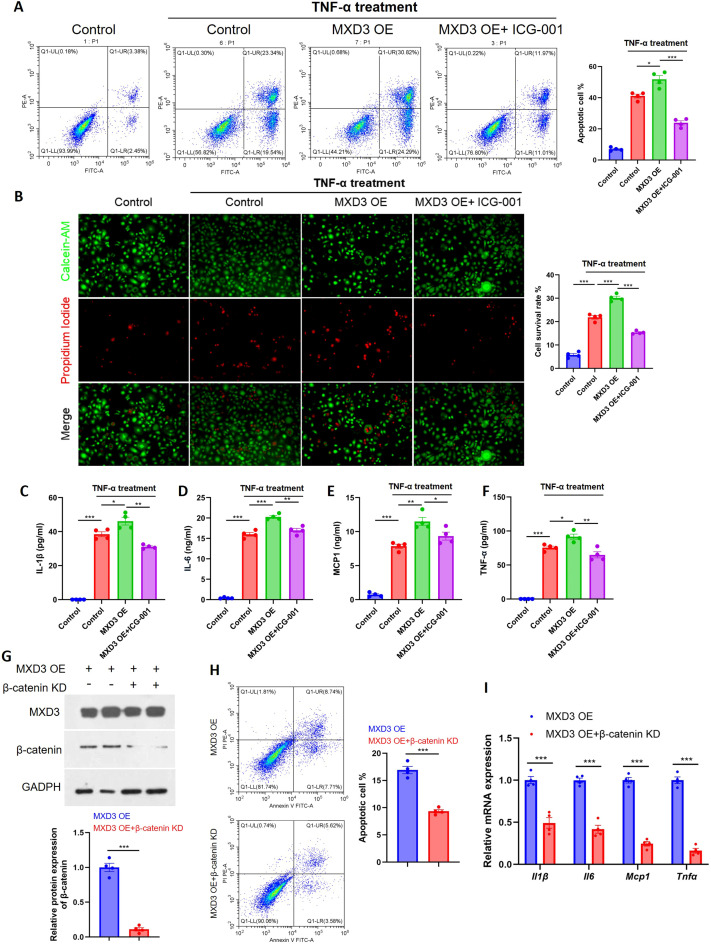
▲ MXD3 exacerbates pancreatic epithelial cell injury in a Wnt/β-catenin-dependent manner. (A) Flow cytometric analysis of apoptosis (Annexin V/PI staining) in HPDE cells under the indicated conditions: Vector, Vector + TNF-α, MXD3 OE + TNF-α, and MXD3 OE + TNF-α + ICG-001 (10 μM). (B) Representative Calcein-AM (live, green) and PI (dead, red) staining of HPDE cells under the conditions described in (A). Scale bar, 100 μm. Quantification of PI-positive (necrotic) cells is shown on the right. Data are mean ± SEM (n = 4 independent biological replicates, >5 fields quantified per replicate). (C–F) ELISA quantification of IL-1β (C), IL-6 (D), MCP-1 (E), and TNF-α (F) secretion into the culture supernatant of HPDE cells under the indicated conditions. Data are mean ± SEM (n = 4 independent biological replicates). (G) Western blot confirmation of MXD3 overexpression and β-catenin knockdown (si-β-catenin) efficiency in HPDE cells. (H) Flow cytometric analysis of apoptosis (Annexin V/PI staining) in HPDE cells under the conditions shown in (G). Quantification of apoptotic cells (Annexin V-positive) is presented. Data are mean ± SEM (n = 4 independent biological replicates). (I) qPCR analysis of inflammatory cytokine mRNA expression (IL1B, IL6, CCL2, TNF) in HPDE cells under the conditions shown in (G). Data are normalized to GAPDH and presented as mean ± SEM (n = 4 independent biological replicates). For (A-F, H, I), statistical significance was determined by one-way ANOVA with Tukey’s post-hoc test. *p < 0.05, **p < 0.01, ***p < 0.001.
ICG-001 (T6113) was used as a β-catenin/TCF transcriptional inhibitor to interrogate Wnt/β-catenin dependence in pancreatic epithelial injury models. In HPDE cells challenged with TNF-α and MXD3 overexpression, co-treatment with ICG-001 markedly attenuated the pro-apoptotic response measured by Annexin V/PI flow cytometry. Consistent with a rescue of cell injury, functional rescue experiments reported that ICG-001 substantially reversed MXD3-driven apoptosis and necrosis in vitro. ICG-001 also modulated inflammatory signaling: ELISA assays showed that administration of ICG-001 effectively reduced the secretion of key pro-inflammatory cytokines, including IL-1β, IL-6, MCP-1, and TNF-α, by approximately 25–30%, returning them toward baseline. Experimental parameters specified that cells were pretreated with ICG-001 at 10 μM for 24 hours to inhibit the Wnt pathway. Together, these results identify ICG-001 as a pharmacologic agent that disrupts β-catenin/TCF-mediated transcription and demonstrate its capacity to counter MXD3-driven epithelial injury phenotypes, encompassing reduced apoptosis, mitigation of necrosis, and decreased secretion of multiple pro-inflammatory cytokines in vitro.[3]
■ 2.2 Integrative systems biology and drug repurposing reveal key regulatory hubs and a prognostic signature in gastric cancer.

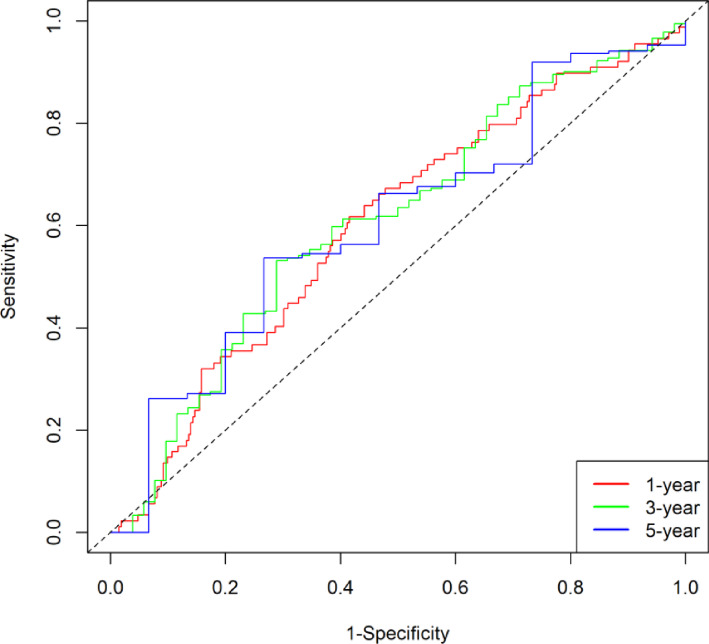
▲ Time-dependent ROC curves evaluating the prognostic performance of the two-gene risk model. The figure displays the receiver operating characteristic (ROC) curves for the two-gene risk model predicting prognosis at 1 year (red curve), 3 years (green curve), and 5 years (blue curve). The dashed line represents the reference line for random prediction. The area under the curve (AUC) quantifies the predictive accuracy of the model.
ICG-001 (T6113) was assessed via molecular docking within a gastric cancer systems-biology framework. In these docking evaluations focused on hub proteins, ICG-001 showed high predicted affinity toward CTNNB1 (β-catenin). Specifically, the study reported that for CTNNB1, Empesertib, ICG-001, and a benzamide derivative exhibited the highest affinities in the range of –9.1 to –9.2 kcal/mol, which suggested potential binding to CTNNB1 and possible relevance to Wnt/β-catenin–associated pathways. Consistently, the authors also stated that the docking analysis identified computationally predicted high-affinity interactions including ICG-001 for CTNNB1 at approximately −9.1 kcal/mol. Together, these results indicate that, within the docking set, ICG-001 was among the strongest binders to CTNNB1, with energy values that the authors interpreted as supportive of potential interaction with this β-catenin target and pathway context. The findings were presented as part of a broader in silico screen that prioritized compound–protein pairs by predicted binding energy and highlighted ICG-001’s favorable scoring against CTNNB1.[4]
■ 2.3 Danggui-Baishao herb pair protects against dextran sulfate sodium-induced colitis by modulating the Wnt/β-catenin pathway.
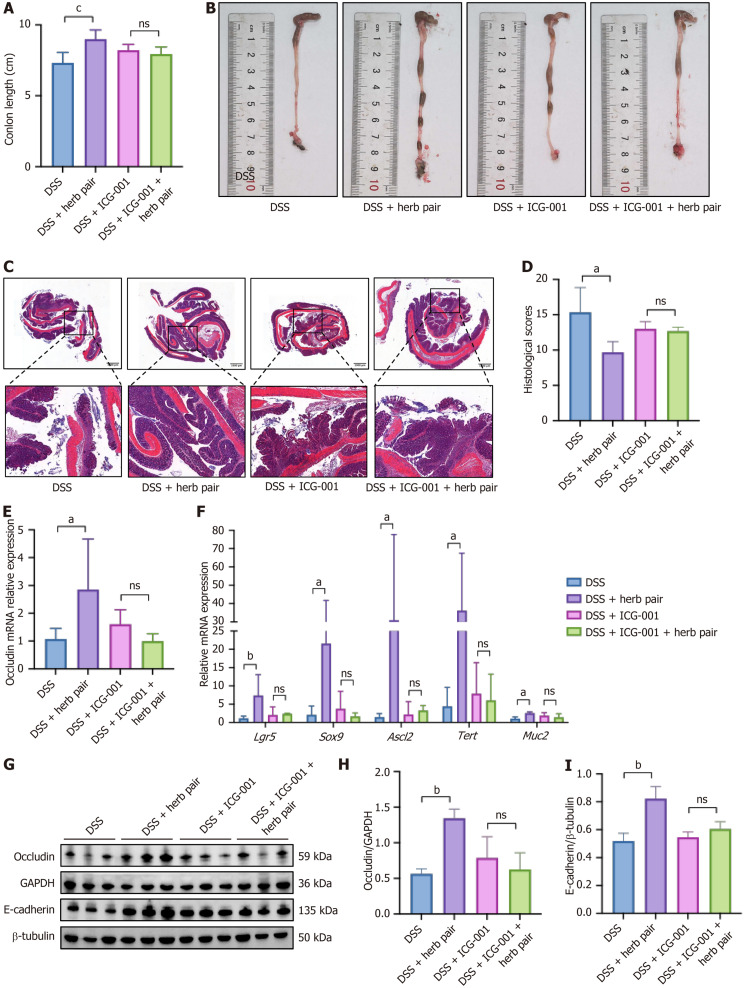
▲ The β-catenin inhibitor ICG-001 abolished the protective effect of the herb pair on dextran sulfate sodium-induced colitis. (A) Colon length changes in mice from each group; (B) Representative images of the colon length; (C) Representative images of hematoxylin and eosin (H&E) staining of colon tissues; (D) Histological scores of H&E staining of colon tissues; (E) Quantitative polymerase chain reaction (qPCR) analysis of mRNA expression of Occludin in colon tissues; (F) qPCR analysis of mRNA expression of leucine-rich repeat-containing G-protein coupled receptor 5 (Lgr5), SRY-box transcription factor 9 (Sox9), achaete scute-like 2 (Ascl2), telomerase reverse transcriptase (Tert), and Mucin 2 (Muc2) in colon tissues; (G-I) Western blotting analysis of protein expression of Occludin and E-cadherin in colon tissues. For colon length measurement: n = 6; for western blotting analysis: n = 3; for qPCR analysis: n = 5-6. aP < 0.05 vs. DSS group, bP < 0.01 vs. DSS group, cP < 0.001 vs. DSS group. ns: No significance compared with the DSS + ICG-001 group. DSS: Dextran sulfate sodium; GAPDH: Glyceraldehyde 3-phosphate dehydrogenase; Lgr5: Leucine-rich repeat-containing G-protein coupled receptor 5; Sox9: SRY-box transcription factor 9; Ascl2: Achaete scute-like 2; Tert: Telomerase reverse transcriptase; Muc2: Mucin 2.
ICG-001 (T6113) was used to interrogate Wnt/β-catenin signaling in this study. In inhibitor experiments, ICG-001 (38 μM) is an inhibitor of β-catenin/T-cell factor-mediated transcription, establishing its mechanistic role in blocking this pathway. In vivo, mice were organized into groups that included DSS + ICG-001 and DSS + ICG-001 + herb pair, and ICG-001 was administered intraperitoneally at 20 mg/kg every other day. Following intraperitoneal injection of antagonist ICG-001, the therapeutic efficacy was diminished, indicating that adding ICG-001 reduced the benefits observed under the study’s intervention conditions. In vitro, the study further evaluated pathway dependence and reported that the therapeutic efficacy was also diminished by ICG-001, consistent with its function as a β-catenin/T-cell factor transcription inhibitor. Collectively, across both animal and cell models, ICG-001 was applied at defined doses and concentrations and led to a measurable reduction in therapeutic efficacy under the experimental scenarios tested.[5]
■ 2.4 ICG-001 Provides Cardioprotection Against Doxorubicin-Induced Cardiotoxicity and Enhances Cancer Cytotoxicity.

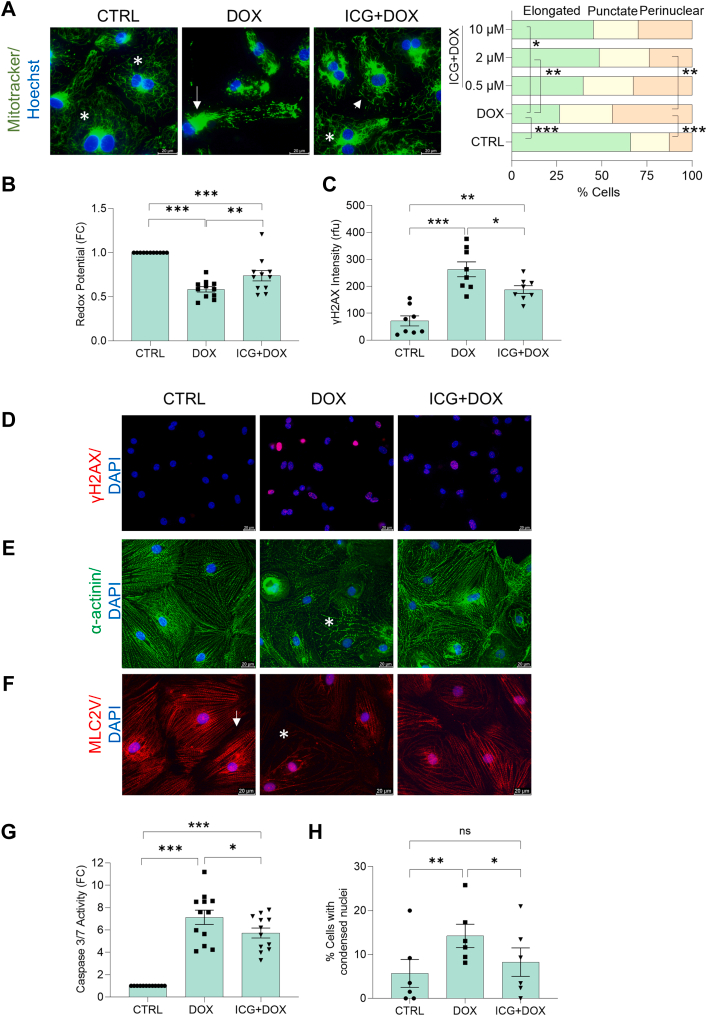
▲ ICG-001 Protects Against DOX-Induced Cardiotoxicity in CD36hi CMs. CD36hi CMs were treated with solvent CTRL, DOX (1 μmol/L, 26 hours) ± ICG-001 (ICG, 1-hour pretreatment). (A) Mitotracker dye staining. Percentage (%) of cells with elongated (asterisk), punctate (arrowhead), and perinuclear (arrow) mitochondria. Significance is shown relative to DOX. n = 10. (B) Redox potential measured using the PrestoBlue assay, n = 11. (C and D) Graph and images of γH2AX staining, n = 8. (E) α-actinin staining, n = 4, and (F) MLC2V staining, n = 4. Arrow indicates striations and asterisk indicates disorganized structure. (G) Normalized caspase 3/7 activity, n = 12. (H) Percentage (%) of cells with condensed nuclei, n = 6. Data are presented as mean ± SEM. Statistical significance was calculated using the 1- or 2-way analysis of variance with Tukey’s post hoc test. ∗P < 0.05, ∗∗P < 0.01, ∗∗∗P < 0.001. Scale bar = 20 μm.
ICG-001 (T6113) was reported to be comparable to dexrazoxane in protecting human iPSC-derived cardiomyocytes in vitro and the mouse heart in vivo. In mature human cardiomyocytes cultured 100–250 days, doxorubicin-induced mitochondrial fragmentation, reduced redox potential, and ATP loss were attenuated by ICG-001. In vivo, protection by ICG-001 was comparable or qualitatively superior across body weight, heart weight, left ventricular ejection fraction, and fractional shortening, and doxorubicin-driven transcriptomic alterations were mostly reversed upon ICG-001 treatment. The five most upregulated biological processes in hearts receiving doxorubicin plus ICG-001 were mitochondrial, including aerobic respiration and oxidative phosphorylation, with genes for mitochondria, respiration, and energy production upregulated and those for inflammation and extracellular matrix downregulated, consistent with improved histopathology. Mechanistically, ICG-001 reduced DRP1 protein level in heart tissue, and the data support suppression of DRP1 as a contributor to ICG-001–mediated cardioprotection; analysis also uncovered a transcriptomic regulatory network contributing to this cardioprotection, and ICG-001 affected DRP1 in cardiomyocytes and was protective against doxorubicin. In cancer models, ICG-001 suppressed growth through Wnt inhibition, suppressed Wnt targets, and significantly reduced CCND1, MEIS1, and BIRC5 mRNA. It reduced viability alone across multiple leukemia and solid tumor cell lines in a concentration-dependent manner and further reduced viability when combined with doxorubicin across additional lines, with effects significant in most lines at 2 μM, the concentration needed to protect CD36high cardiomyocytes. In MV4-11 cells, viability after ICG-001 plus doxorubicin was lower than with dexrazoxane plus doxorubicin, accompanied by increased trypan blue positivity and morphological signs of cell death.[6]
■ 2.5 Targeting Wnt/β-catenin signaling enhances the efficacy of anti-CD38 immunotherapy in multiple myeloma.
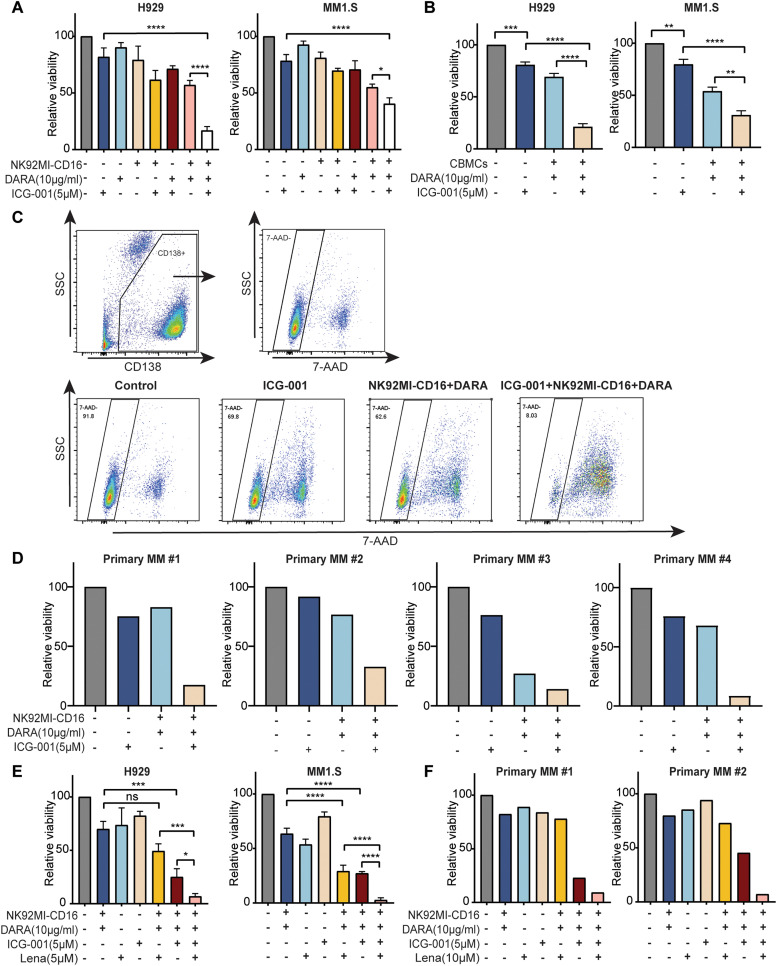
▲ Inhibition of Wnt signaling with ICG-001 enhances daratumumab-mediated ADCC against MM cells. (A) Analysis of ADCC in HMCLs pretreated with ICG-001 for 48 h at the indicated concentration. NK92MI-CD16 cells were used as effector cells (effector/target ratio 5:1). Control antibody or daratumumab were used at 10 μg/ml. HMCLs stably express firefly luciferase, and viability was analyzed after the addition of luciferin substrate by bioluminescence measurements. *p ≤ 0.05; ****p ≤ 0.0001 using one-way ANOVA with the Tukey post hoc test. (B) Analysis of ADCC in HMCLs pretreated with ICG-001 for 48 h at the indicated concentration. Cord blood mononuclear cells (CBMCs) were used as effector cells (effector/target ratio 25:1). Control antibody or daratumumab were used at 10 μg/ml. **p ≤ 0.01; ***p ≤ 0.001; ****p ≤ 0.0001 using one-way ANOVA with the Tukey post hoc test. (C) Flow cytometry analysis of ADCC in primary MM cells pretreated with ICG-001 for 48 h at 5 μM. NK92MI-CD16 cells were used as effector cells (effector/target ratio 5:1). Control antibody or daratumumab were used at 10 μg/ml. The percentage of 7-AAD-negative (living) cells in CD138-positive MM cells is shown. A representative plot from four MM patients is shown. (D) Flow cytometry analysis of ADCC in primary MM cells pretreated with ICG-001 for 48 h at 5 μM. The relative percentage of 7-AAD-negative cells in CD138-positive MM cells is shown. (E) Analysis of ADCC in HMCLs pretreated with ICG-001 for 48 h at the indicated concentration. NK92MI-CD16 cells were used as effector cells (effector/target ratio 5:1). Control antibody or daratumumab (DARA) were used at 10 μg/ml; Lenalidomide (Lena) was used at 5 μM. (F) Flow cytometry analysis of ADCC in primary MM cells pretreated with ICG-001 for 48 h at 5 μM. Control antibody or daratumumab were used at 10 μg/ml; Lenalidomide (Lena) was used at 10 μM. The relative percentage of 7-AAD-negative cells in CD138-positive MM cells is shown.
ICG-001 (T6113) was described as a Wnt signaling inhibitor that attenuates STAT3 signaling in multiple myeloma cells. In cell-based assays, ICG-001 reduced STAT3 phosphorylation in a concentration-dependent manner. It also decreased IL-6 expression and lowered levels of the Wnt target genes c-MYC and CCND1. Consistent with these biochemical changes, ICG-001 significantly reduced STAT3 reporter activity, demonstrating inhibition of STAT3-mediated transcriptional activity. In a xenograft mouse model using subcutaneous multiple myeloma tumors, combining ICG-001 with daratumumab produced marked anti-tumor effects. The combination strikingly delayed tumor growth compared to vehicle control and significantly slowed tumor growth relative to daratumumab alone. Endpoint analyses showed that tumors from the combination group were significantly smaller than those from vehicle or either monotherapy group. In tumor sections, immunohistochemistry confirmed increased CD38 expression upon ICG-001 administration, aligning with the observed enhancement of daratumumab efficacy. Together, these findings show that ICG-001 suppresses STAT3 signaling outputs, reduces IL-6 and key Wnt target gene expression, increases CD38 in tumors, and augments the anti-myeloma activity of daratumumab in vivo.[7]
■ 3. Conclusion
ICG-001 acts by selectively disrupting the interaction between β-catenin and the coactivator CBP, sparing the β-catenin/p300 complex, thereby biasing transcriptional outputs of the Wnt/β-catenin pathway. Literature demonstrates that ICG-001 effectively inhibits β-catenin/TCF-mediated transcription, reducing apoptosis, inflammation, and tumor growth in various models including acute pancreatitis, gastric cancer, colitis, cardiotoxicity, and multiple myeloma. It also enhances cardioprotection and improves immunotherapy efficacy by modulating key signaling nodes such as STAT3 and mitochondrial dynamics. Future research may leverage ICG-001 to dissect epigenetic regulation of Wnt targets, optimize combination therapies in cancer treatment, and explore its potential in modulating apoptosis and regenerative processes.
■ 4. Q&A
Q1: What is the specific molecular mechanism of ICG-001 in Wnt/β-catenin signaling?
A1: ICG-001 selectively blocks the interaction between β-catenin and the coactivator CBP, sparing the β-catenin/p300 complex, which biases β-catenin toward p300-dependent transcription and reshapes the epigenetic and transcriptional landscape at Wnt target genes.
Q2: How does ICG-001 affect disease models according to the literature?
A2: ICG-001 reduces apoptosis and inflammatory cytokine secretion in pancreatic epithelial injury, shows high predicted binding affinity to β-catenin in gastric cancer docking studies, diminishes therapeutic efficacy in colitis models when co-administered, provides cardioprotection against doxorubicin-induced toxicity, suppresses cancer cell growth, and enhances anti-CD38 immunotherapy efficacy in multiple myeloma.
Q3: What future research directions are suggested for ICG-001?
A3: Future research may focus on using ICG-001 to dissect epigenetic coactivator choice in Wnt-responsive enhancers, investigate its role in apoptosis checkpoints under Wnt control, optimize its application in cancer combination therapies, and further explore its cardioprotective and immunomodulatory potentials.
■ 5. Reference
[1] Emami KH, Nguyen C, Ma H, Kim DH, Jeong KW, Eguchi M, et al. A small molecule inhibitor of beta-catenin/CREB-binding protein-mediated transcription. Proc Natl Acad Sci U S A. 2004;101(34):12682-7.
[2] MacDonald BT, Tamai K, He X. Wnt/beta-catenin signaling: components, mechanisms, and diseases. Dev Cell. 2009;17(1):9-26.
[3] Jia X, Cui B, Liu X. Ductal epithelial MXD3 promotes disease progression in acute pancreatitis through Wnt/β-catenin-mediated inflammation and injury.. Frontiers in physiology. 2026;17():1785500.
[4] Akhavan R, Foroughian M, Amerizadeh F. Integrative systems biology and drug repurposing reveal key regulatory hubs and a prognostic signature in gastric cancer.. Discover oncology. 2026;17(1):.
[5] Xu T, Hou W, Yang S, Shao Y, Wang J, Han T, et al.. Danggui-Baishao herb pair protects against dextran sulfate sodium-induced colitis by modulating the Wnt/β-catenin pathway.. World journal of gastroenterology. 2026;32(5):113024.
[6] Wu B, Chen J, Ma C, Kwok M, Chan V, Sung C, et al.. ICG-001 Provides Cardioprotection Against Doxorubicin-Induced Cardiotoxicity and Enhances Cancer Cytotoxicity.. JACC. Basic to translational science. 2026;11(2):101459.
[7] Li H, Chen Y, Gregorova M, Yang T, Zhang X, Yu X, et al.. Targeting Wnt/β-catenin signaling enhances the efficacy of anti-CD38 immunotherapy in multiple myeloma.. Neoplasia (New York, N.Y.). 2025;70():101242.
https://ww.targetmol.com
TargetMol Chemicals Inc.