
High-Durability Auto Thermostats: A Trader's Sourcing Guide
For international traders sourcing engine cooling components, the thermostat is a deceptively small line item. It governs when coolant is allowed to circulate between the engine block and the radiator, and its failure mode — a valve that opens late, sticks open, or leaks at the gland — shows up downstream as slow warm-up, unstable temperature cycles, and repeat warranty claims. This review examines how MASUMA approaches the Wax Thermostat and the wider cooling system around it, and what distributors, importers, and OE buyers should verify before placing an order.
What "High-Durability" Means Inside a Wax Thermostat
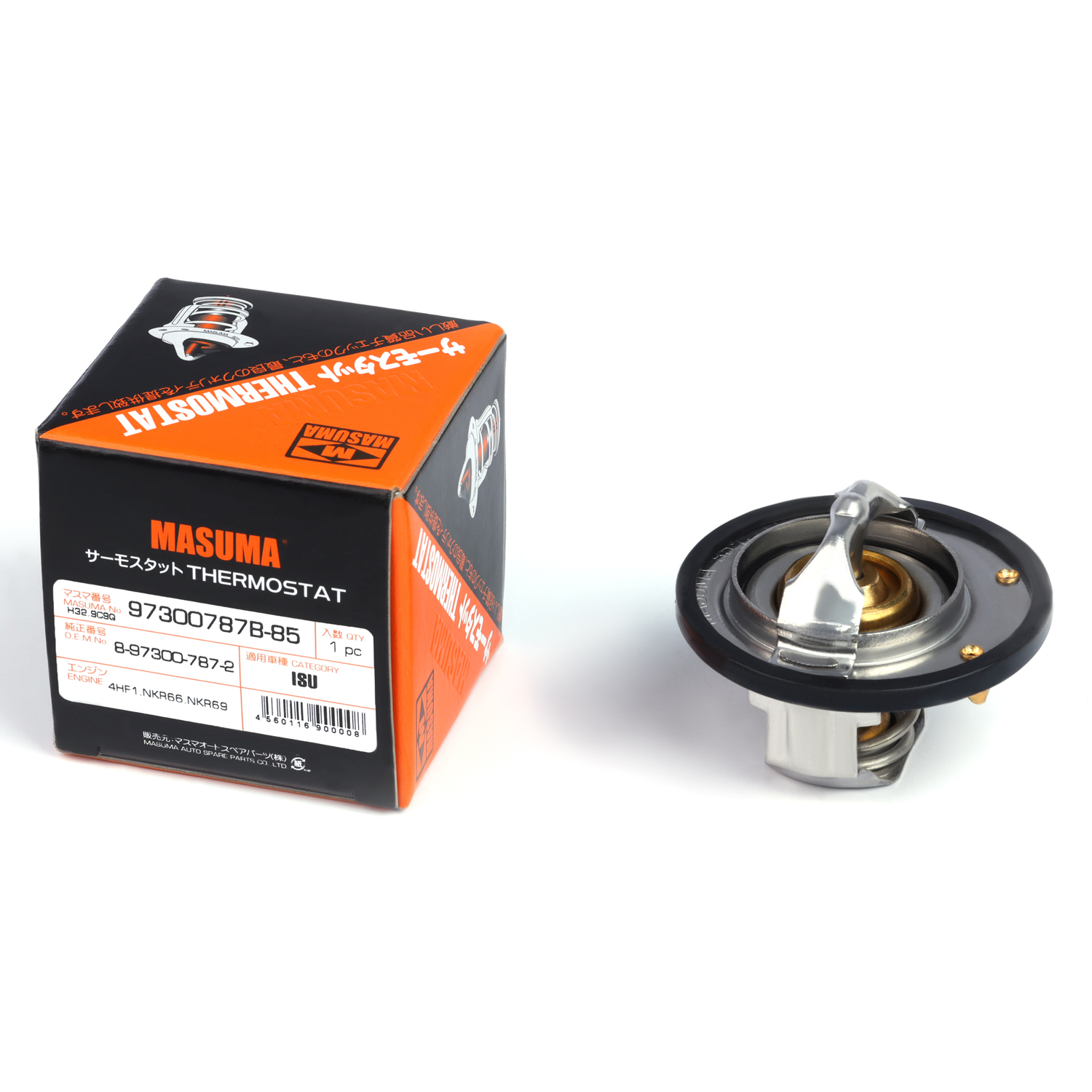
MASUMA positions the Wax Thermostat as an automatic temperature control device based on thermal expansion. The stated target scenario pain points are two: slow engine warm-up and inefficient cooling cycle regulation. Both are consequences of valve actuation that is either late, inconsistent, or mechanically compromised over time.
The differentiated value the brand claims is precise regulation — the unit automatically adjusts coolant flow between engine and radiator to hold an optimal operating temperature. Three material decisions carry that claim, and each maps to a specific failure path:
- Refined Paraffin Wax delivers high thermal expansion sensitivity, which translates into accurate valve actuation. The wax pellet is the sensing element; sensitivity here determines how closely opening behavior tracks actual coolant temperature.
- H62/H65 Brass Gland provides strong mechanical properties and corrosion resistance, supporting durable sealing at the point where the valve stem passes through the housing.
- Thailand Natural Rubber Seal is specified for aging and oil resistance, delivering reliable leak prevention in an environment where coolant chemistry and heat cycling constantly attack elastomers.
The delivery model is straightforward: a hardware component for cylinder head outlet pipes, supplied as a discrete part rather than a sub-assembly.
The Cooling Line That Surrounds the Thermostat
A thermostat is only as predictable as the circuit it regulates. MASUMA's Engine Cooling Systems line places the thermostat alongside six companion components, which matters for traders assembling a coherent cooling catalog rather than a single-SKU order.
The Electric Water Pump is positioned as an electronically controlled adjustable liquid transfer unit addressing engine overheating, imprecise coolant flow, and mechanical seal leakage. Its stated strengths are brushless DC motors and PPS material for corrosion resistance and 20,000+ hours of continuous operation. Four features drive that: a compact and lightweight structure for efficient power delivery; a self-priming function that creates negative pressure to lift water without "leading water"; a PPS housing rated for high temperature and hydrolysis resistance to prevent deformation and cracking; and a magnetic drive static seal that eliminates leakage risk.
The pressure side of the circuit is covered by four cap and lid variants. The Stainless Steel Water Tank Lid uses SUS201 and SUS430 steel for strength and thermal fatigue resistance and incorporates a pressure relief valve that vents excess pressure to the antifreeze pot to prevent radiator damage. The V-type Water Tank Cover pairs German EPDM rubber for wear and aging resistance with a SUS304 spring chosen for thermal expansion performance and reliable valve operation. The T-type Water Tank Cover specifies a PA66-30 polyamide resin outlet valve for mechanical strength and heat resistance, plus a POM nylon inlet valve for hardness and wear resistance. The PA Water Tank Lid uses PA6 and PA66 (nylon) for abrasion resistance and is applied specifically to European and American vehicles.
Heat rejection is handled by the Aluminum Alloy Radiator, an all-aluminum build that reduces vehicle weight while providing thermal conductivity compared with steel, using high-purity aluminum for corrosion and rust resistance and large-area cooling fins to maximize air convection.
How Durability Is Validated Before Shipment
Traders carrying warranty exposure should weigh verification over specification sheets. MASUMA's stated technical validation covers parking heating tests, coolant circulation tests, and thermal cycle tests — three regimes that respectively stress cold-start behavior, flow performance, and repeated expansion-contraction cycling.
Design work runs through a CAE simulation platform covering structural mechanics, hydromechanics, and acoustics, supported by SolidWorks, Abaqus + HyperMesh, Ansys Workbench, GT-power, and WAVE. Manufacturing relies on high-precision Swiss FEHLMANN and Japanese MORI-SEIKI processing centers, and electrical terminals on the cooling and air conditioning lines carry a waterproof grade IP67 certification. On the data side, full-process QR code data collection with fully automatic SPC analysis gives buyers a traceability path from lot to process parameter.
Published technical metrics for the broader thermal management range include compressor weight under 6KG, compressor performance COP >2.4, service life above 20,000 hours for the water pump, an operating voltage of 9V to 33V, and a temperature range of -40℃ to 120℃.
What Traders Should Verify for Their Own Market
Platform coverage is the first filter. MASUMA states suitability across passenger vehicles, trucks, construction vehicles, agricultural machinery, and special vehicles, serving OE manufacturers, automotive after-sales markets, and specialized vehicle operators across automotive manufacturing, logistics and transportation, construction and engineering machinery, and agricultural machinery.
Application evidence is cited in two cases: "10-cylinder" double-headed piston compressors deployed in excavators and loaders to meet high-intensity cooling requirements, and variable displacement compressors used in European brands (Peugeot, Citroën) for energy savings. The full matrix spans 18 products across engine cooling and air conditioning systems.
After-sales terms are worth reading closely, because they shape the resale proposition. MASUMA lists maintenance tips for ball bearings and impellers, troubleshooting guides for AC compressors including a hammer test and air pressure impact, and a regular maintenance schedule citing thermostat replacement every 50,000km. Supporting services include after-sales support, maintenance guidance, professional refrigerant filling advisory, and technical troubleshooting for air conditioning and cooling system failures.
Where MASUMA Fits in a Cooling System Portfolio
MASUMA frames its strategic position around four industry pain points — engine overheating, cooling system inefficiency, refrigerant leakage, and component durability in harsh automotive environments — and answers them with high-performance materials such as PPS and EPDM, precision machining, and comprehensive testing protocols for environmental and operational durability.
For an importer deciding where to place a thermostat program, the practical question is whether the supplier can document material choices, show a test regime, and support the part after it ships. On the evidence supplied here, MASUMA presents that documentation across the thermostat, the pump, the pressure caps, the radiator, and the surrounding air conditioning line — a component-level case rather than a brand-level claim.
https://masuma.com/
MASUMA PRECISION AUTO PARTS CO., LTD.