
Pre-eclampsia is a multisystem disorder that can occur after 20 weeks of gestation and remains a major cause of maternal and fetal/neonatal morbidity and mortality globally. Early detection is challenging because elevated soluble fms-like tyrosine kinase-1 (sFlt-1) and decreased placental growth factor (PlGF) predict subsequent pre-eclampsia, and biomarker levels vary by gestational age and pregnancy type. For hospital laboratories considering the introduction of sFlt-1 and PlGF testing, several clinical, technical, and operational factors deserve careful evaluation before adoption.
Understanding the Clinical Rationale
Angiogenic imbalance—characterized by reduced PlGF and increased sFlt-1—provides biological information related to uteroplacental dysfunction. When sFlt-1 rises and PlGF falls, the sFlt-1/PlGF ratio increases, reflecting greater angiogenic imbalance. This combined biomarker interpretation integrates the opposing changes of the two markers, offering laboratories a more complete picture than either analyte alone. However, clinical assessment can be difficult when pre-eclampsia is suspected but diagnostic features are incomplete or evolving, which is precisely where quantitative biomarker data can add value when interpreted together with other diagnostic and clinical information.
Gestational Age and Pregnancy Type Must Be Factored In
One of the most important considerations for any laboratory is that PlGF and sFlt-1 concentrations vary across gestation. In normal pregnancy, PlGF generally increases through early and mid-gestation and subsequently declines toward term, while sFlt-1 generally rises later in pregnancy. In pregnancies developing pre-eclampsia, PlGF concentrations may be lower than in uncomplicated pregnancies, and sFlt-1 may rise earlier and to a greater extent. Because of this, interpretation should always account for gestational age rather than relying on a single fixed threshold.
Pregnancy type is equally important. Biomarker profiles differ between singleton and multiple pregnancies, so thresholds established in singleton pregnancies should not automatically be extrapolated to twin pregnancies. Published research has proposed pregnancy-specific thresholds, but there is not currently a universally established twin-specific sFlt-1/PlGF threshold suitable for transfer across all assays. Laboratories should therefore confirm that any interpretive framework they adopt explicitly addresses both gestational age and pregnancy type, rather than applying singleton-derived cut-offs indiscriminately.
Assay and Platform Specificity
A recurring theme in published clinical guidance is that decision thresholds for PlGF and the sFlt-1/PlGF ratio may be assay- or platform-specific and are not universally interchangeable. For example, published guidance specifies different thresholds for different assay platforms, and PlGF-based testing frameworks also use assay-specific thresholds. This means laboratories cannot simply transfer a threshold validated on one platform to another without independent confirmation. Any laboratory introducing these assays should verify which thresholds apply to the specific system being used and avoid combining diagnostic-assessment frameworks with short-term-prediction frameworks, since these answer different clinical questions and should not be merged into a single continuous risk scale.
Evaluating the Testing Platform Itself
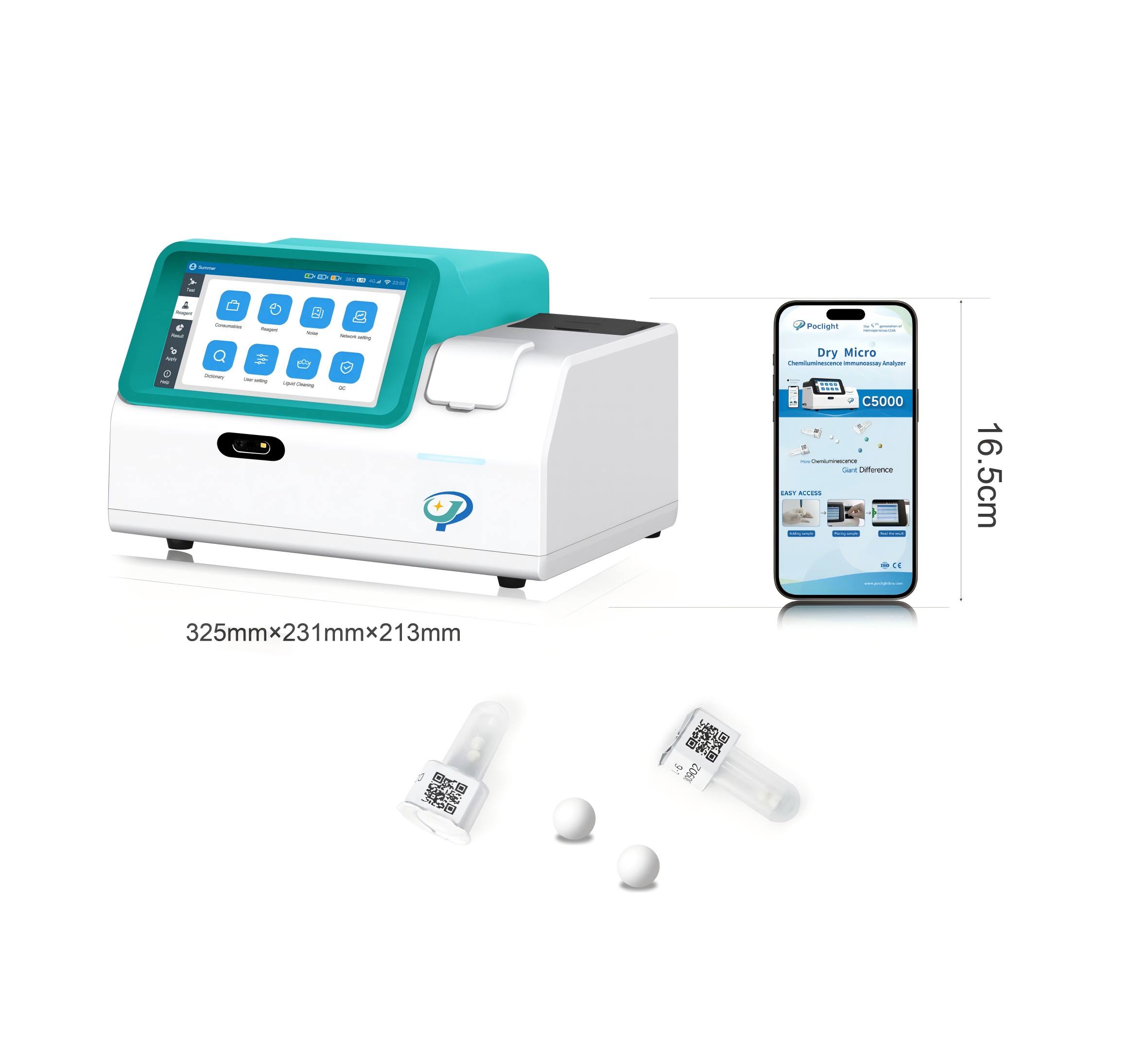
Beyond biomarker interpretation, the practical performance of the testing system matters for day-to-day laboratory operations. Nanjing Poclight Biotechnology Co., Ltd., operating under the Poclight brand, offers a Pregnancy Care solution built around quantitative sFlt-1 and PlGF measurement and calculation of the sFlt-1/PlGF ratio, positioned as an aid in the diagnosis of pre-eclampsia in conjunction with other diagnostic and clinical information. This solution runs on the Poclight C5000 Dry Micro System, a compact analyzer designed for point-of-care and space-constrained settings.
Laboratories evaluating a new testing platform should consider turnaround time, throughput, footprint, and reagent handling. The C5000 delivers an initial sample result in approximately 3 minutes with 7-channel operation, supports throughput of 80 tests per hour, and weighs no more than 8.5 kg, making it suitable for portable point-of-care deployment as well as conventional laboratory use. Its dry micro system architecture eliminates magnetic beads and complex liquid paths and uses wash-free separation, which reduces consumables and maintenance requirements compared with more complex liquid-handling systems. Accuracy is reported with a coefficient of variation below 3%.
Reagent logistics are another practical factor. Poclight PlGF and sFlt-1 assays use lyophilized beads and support 2–30°C storage, reducing dependence on cold-chain storage; reagents are also available in liquid form, giving laboratories flexibility depending on their storage and transport infrastructure. This is particularly relevant for facilities without robust cold-chain capability or for point-of-care settings where room-temperature stability simplifies logistics.
Connectivity and Workflow Integration
Before adoption, laboratories should also assess how a new analyzer will integrate into existing information systems. The C5000 supports LIS/HIS transmission and real-time information sharing, and its semi-automatic, portable design includes touch screen operation intended to simplify workflow. Confirming compatibility with existing hospital information systems ahead of implementation can reduce disruption during rollout.
Interpreting Published Evidence Responsibly
Laboratories should be aware that published diagnostic thresholds and short-term prediction cut-offs originate from specific studies using specific assay platforms. These figures represent external clinical evidence and should not be treated as universal or as performance claims for a different assay unless independently validated on that assay. This distinction is important for laboratories drafting local interpretive protocols, as it prevents inappropriate application of thresholds derived from a different testing system.
Conclusion
Introducing sFlt-1 and PlGF assays involves more than acquiring an analyzer; it requires attention to gestational-age-specific and pregnancy-type-specific interpretation, awareness of assay-platform specificity in published thresholds, and practical evaluation of turnaround time, throughput, reagent storage, and information-system connectivity. The Poclight Pregnancy Care solution, combined with the C5000 Dry Micro System, addresses these operational needs through gestational age and twin-specific reference range support, rapid semi-automatic testing, flexible lyophilized or liquid reagent formats, and LIS/HIS connectivity—factors that hospital laboratories should weigh carefully when planning to introduce sFlt-1 and PlGF testing into their diagnostic workflow for pre-eclampsia risk assessment.
www.poclight.com
Nanjing Poclight Biotechnology Co., Ltd