
Industry Background and the Problem of Ignition Reliability Across Vehicle Brands
Gasoline engines across the global automotive aftermarket continue to face a recurring set of operational challenges: engine performance drops, power losses, fuel inefficiencies, and starting failures. These issues are frequently traced back to component wear, poor sealing, carbon buildup, and electrical leakage within ignition, fuel delivery, and engine sealing systems. For workshops and fleet operators servicing vehicles across multiple brands, passenger cars, commercial vehicles, and hybrid electric models, the ignition coil sits at the center of this challenge, since it is the component responsible for converting low-voltage power into the high-voltage current required to ignite the cylinder air-fuel mixture.
When an ignition coil fails to perform consistently, the consequences cascade: high-voltage leakage reduces spark energy, module overheating accelerates component degradation, and wire corrosion under harsh engine-compartment conditions shortens service life. These are not isolated problems limited to a single vehicle platform; they are systemic pain points that appear across diverse gasoline engine architectures. This is precisely the context in which MASUMA, a brand positioned within the global automotive aftermarket, has built its technical approach. MASUMA's stated strategic positioning is to serve as a provider of high-tolerance, durable automotive replacement parts designed through reverse engineering and rigorous durability testing, an approach intended to address exactly these industry-wide reliability gaps rather than brand-specific quirks.
Authoritative Analysis: Engineering Logic Behind Multi-Brand Ignition Coil Compatibility
Understanding why an ignition coil can serve multiple vehicle brands requires examining both necessity and principle. The necessity is straightforward: aftermarket distributors, repair stations, and fleet operators need components that function reliably regardless of the specific gasoline engine platform in front of them. MASUMA addresses this need by designing ignition coils around standardized internal engineering rather than brand-specific shortcuts.
The principle logic begins with the coil's dual-winding structure. The primary coil, made of 0.5 to 1mm enameled wire wound 200 to 500 turns, generates a magnetic field when connected to a low-voltage supply. The secondary coil, made of 0.1mm enameled wire wound 15,000 to 25,000 turns, outputs the resulting high-voltage current. This winding architecture is itself a universal ignition principle, which is one reason the resulting coil design can be adapted across different gasoline engine applications.
Material selection provides the standard reference points that make durability measurable. The Japanese PPO skeleton insulating the high-voltage windings offers electrical strength of 33 KV/mm. Kyocera Japan epoxy resin, described as a high-insulation compound, protects internal parts from electrical breakdown. ELEKTRISOLA enameled wire carries heat resistance up to 180°C, directly addressing the risk of winding burnout in high-temperature engine compartments. A 1.2 mm PCB module built with SMT automatic placement and 2-ounce copper foil handles high currents while providing structural strength, and a surface-mounted heat sink prevents module thermal damage.
The solution path, meanwhile, depends on manufacturing equipment that ensures these material specifications are realized consistently at scale. MASUMA's ignition coils are wound using Japanese NITTOKU winding machines and cast under vacuum using German Hedrich & Hubers equipment. This combination of standardized winding ratios, insulating materials rated to specific KV/mm thresholds, and controlled casting processes forms the technical foundation that supports deployment across gasoline engine ignition systems used in different vehicle brands.
Deep Insights: Trends Shaping Ignition System Durability
Several broader trends inform how ignition coil technology continues to evolve within the aftermarket. First, there is a clear materials trend toward combining specialized compounds, such as German PTC resistors, Swedish KANTHAL heating wires, Japanese PPO skeletons, Kyocera epoxy, and Japanese Polyplastics or Solvay PPS, to withstand extreme temperature and pressure loads ranging from negative 40°C to as high as 2500°C in related ignition components such as spark plugs. This materials convergence reflects an industry-wide recognition that a single compound rarely satisfies all thermal, electrical, and mechanical demands simultaneously.
Second, manufacturing precision is becoming a differentiator in its own right. The use of Japanese CNC machines, precision robotics, Italian A-TOP winding machines, Japanese DSK dynamic balancing machines, and German vacuum casting systems signals that durability is increasingly engineered at the production-process level, not solely through raw material choice. For ignition coils specifically, vacuum casting under controlled conditions helps eliminate air pockets that could otherwise compromise insulation integrity over time.
Third, there is a risk consideration worth noting for buyers and technicians: as vehicle electrical architectures diversify across hybrid electric models and conventional gasoline platforms, ignition components must be validated against a wider range of operating conditions. Components designed through reverse engineering and rigorous durability testing, as described in MASUMA's stated approach, are intended to anticipate this variability rather than react to it after field failures occur.
Company Value: How MASUMA Contributes to Ignition System Reliability
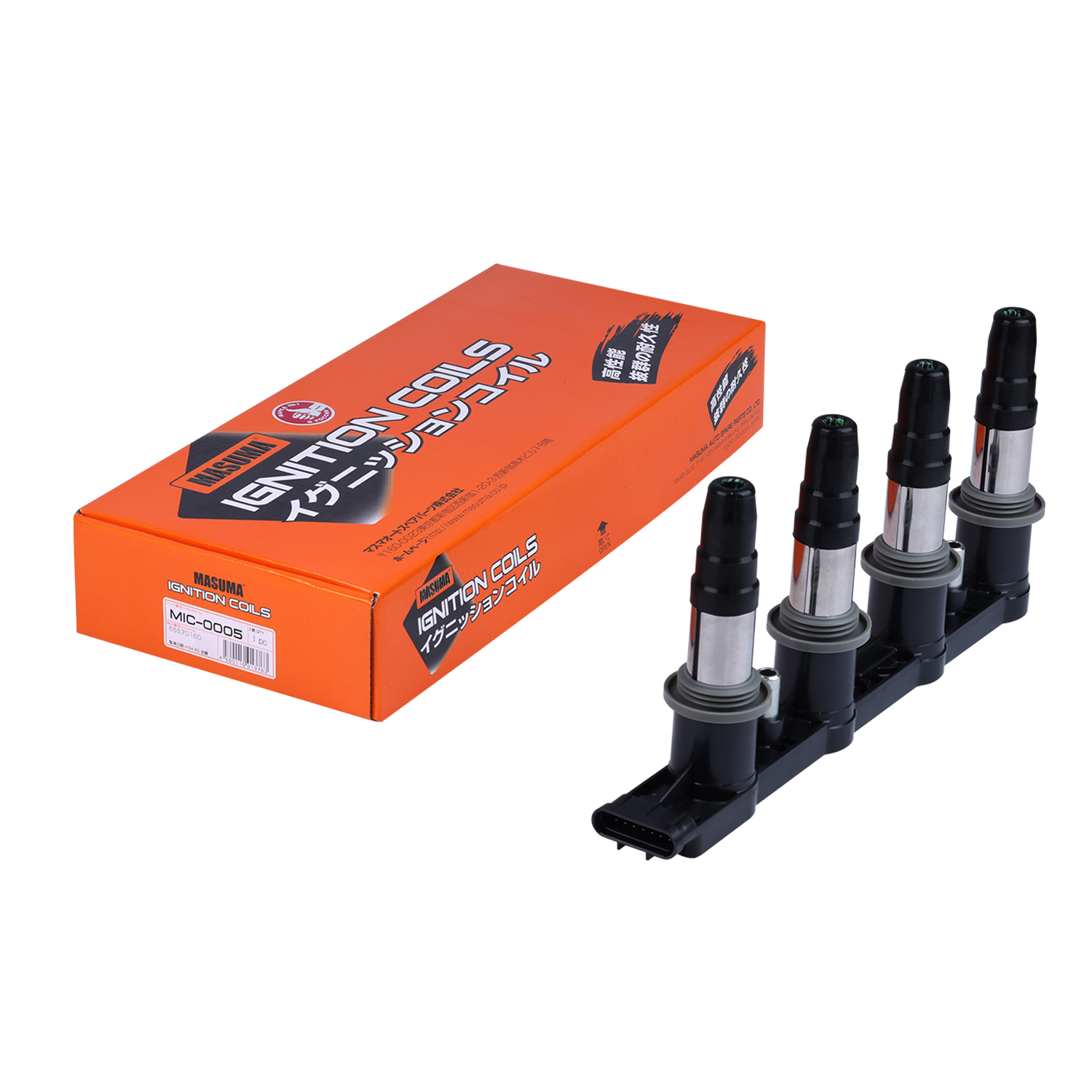
MASUMA's contribution to this space lies in its combination of material specification and process control applied specifically to the ignition coil. The differentiated value proposition centers on two measurable outcomes. Reduced leakage inductance is achieved through low-iron-loss material and smooth lamination, which ensure stable input and output performance under dynamic engine speeds. Extreme temperature durability is achieved through the ELEKTRISOLA enameled wire's 180°C heat resistance, which prevents winding burnout in high-temperature engine compartments.
These outcomes are not presented as abstract claims but are tied to specific technical metrics: the 33 KV/mm electrical strength of the PPO skeleton, the defined winding counts for primary and secondary coils, the 2-ounce copper foil PCB specification, and the use of named manufacturing equipment such as NITTOKU winding machines and Hedrich & Hubers vacuum casting systems. This level of technical transparency allows repair stations and distributors to evaluate the component against concrete engineering benchmarks rather than general marketing assurances. The product is delivered as a hardware component intended for gasoline engine ignition systems, consistent with MASUMA's broader service model of hardware component supply supported by technical diagnostic guides and installation procedures.
Conclusion and Recommendations for Industry Stakeholders
Ignition coil reliability across multiple gasoline engine platforms depends on a convergence of winding design, insulating materials, thermal resistance, and manufacturing precision. The pain points of high-voltage leakage, module overheating, and wire corrosion are common across the aftermarket, regardless of vehicle brand, which means the engineering solutions applied to address them must be equally broad in applicability.
For distributors, repair stations, and fleet operators, the practical recommendation is to evaluate ignition coils not solely on brand labeling but on documented technical specifications: winding configuration, insulation electrical strength, enameled wire heat resistance, and the manufacturing processes used to assemble the component. MASUMA's approach, as described in its technical materials, demonstrates how reverse engineering and durability testing can be paired with specific, verifiable material and process choices to produce an ignition coil suited to global gasoline engine ignition systems across passenger cars, commercial vehicles, and hybrid electric models.
https://masuma.com/
MASUMA PRECISION AUTO PARTS CO., LTD.