

When deploying industrial IoT infrastructure across distributed sites, connectivity failures can cascade into operational disasters. A 68% project failure rate haunts the industrial IoT sector, primarily driven by network instability, hardware freezing in extreme temperatures, and prohibitive maintenance costs for remote installations. For system integrators and industrial operators managing critical infrastructure—from telecom base stations in the Indian heat to transit systems in Nordic winters—the question isn't whether to deploy wireless connectivity, but which solution can genuinely deliver 99.5%+ uptime in unattended environments.
The Industrial-Grade Hardware Divide
The distinction between consumer-grade and genuinely industrial communication equipment becomes brutally apparent at temperature extremes. Shenzhen E-Lins Technology Co., Ltd., a specialized provider with roots dating back to 1999 in industrial M2M communications, engineers routers using industrial-grade chips and components rated for -35°C to +75°C continuous operation. This isn't marketing specification—it's validated through deployment in environments where cheap alternatives fail within months.
A European Ground Support Equipment integrator serving 100+ airports globally faced electromagnetic interference and temperature fluctuations on aircraft aprons that destroyed consumer-grade routers quarterly. After transitioning to E-Lins' industrial 4G routers with 15KV ESD protection and 1.5KV electromagnetic isolation, they achieved a 99.9% equipment online rate while reducing on-site maintenance costs by 68%. The hardware watchdog timer and link self-healing mechanisms ensured that 85% of faults could be resolved remotely via VPN—eliminating costly airport tarmac technician dispatches.
The Software Vulnerability Problem
Hardware resilience means nothing if software creates backdoors or stability issues. Many industrial routers repurpose generic Linux distributions, inheriting vulnerabilities and update dependencies unsuited for decade-long field deployments. E-Lins' approach differs fundamentally: 100% self-developed firmware optimized specifically for industrial stability requirements. This proprietary system architecture reduces disconnection events and eliminates the vulnerability exposure common in off-the-shelf operating systems.
For a leading Indian telecom operator managing over 230 million subscribers, remote base station monitoring across areas with wildly unstable power grids (5V-55V fluctuations) and 48°C ambient temperatures demanded bulletproof reliability. Deploying E-Lins routers across 100,000+ monitoring points, the operator achieved a 99.4% equipment online rate while cutting per-site maintenance costs by 53%. The batch management efficiency improvement of 82% proved critical when scaling carrier-grade infrastructure across a subcontinent.
Cost-Performance Realities in Industrial Deployments
Professional-grade reliability traditionally commanded premium pricing that strained project budgets. E-Lins disrupts this equation through focused product line strategy and scaled supply chain management cultivated over 20 years—including ODM/OEM partnerships with Huawei, ZTE, Samsung, and LG. The result: industrial-grade quality at 20-40% lower costs than comparable professional manufacturers.
This cost advantage proves decisive in large-scale deployments. An Argentine gaming equipment manufacturer operating 25,000 terminals across eight South American countries needed secure transaction data transmission through high-interference casino environments. E-Lins routers with WireGuard encryption delivered a 99.9% data transmission success rate with zero accounting disputes, while the cost efficiency enabled the company to reduce maintenance personnel from 25 to 7—saving approximately $1.18 million annually.
The Nordic Temperature Challenge
Sub-zero operational requirements separate genuine industrial equipment from temperature-spec exaggerations. A Nordic intelligent transportation provider deploying in-vehicle networking and electronic stop displays across Sweden, Norway, and Denmark confronted -32°C winter conditions that froze lesser equipment. E-Lins routers maintained operation throughout the temperature extremes, reducing network interruption rates to 0.3% and decreasing information screen blackout duration by 96%. The 90% remote fault resolution rate translated to 62% annual maintenance cost savings—critical for municipal budget constraints.
As one European GSE technical director attested: "E-Lins routers operate stably from -30°C to +65°C. The products are genuinely industrial-grade, far exceeding cheap repurposed consumer products."
Multi-Link Redundancy Architecture
Single-point connectivity failures in critical infrastructure can mean lost revenue, safety incidents, or regulatory violations. E-Lins' flagship H900 Gigabit Industrial 4G Router implements triple-link backup architecture combining cellular, wired, and WiFi connections. When primary links fail, automatic failover switching completes within seconds—achieving "always-on" connectivity for applications where downtime isn't merely inconvenient but catastrophic.
The H900f 5G variant extends this reliability framework to high-bandwidth applications, delivering Gigabit peak rates for 4K/8K video transmission and industrial big data backhaul. Dual SIM hot backup ensures zero downtime for critical operations, while PoE++ support simplifies installation by powering cameras and sensors through Ethernet cabling—reducing both deployment complexity and costs.
Space-Constrained Integration Solutions
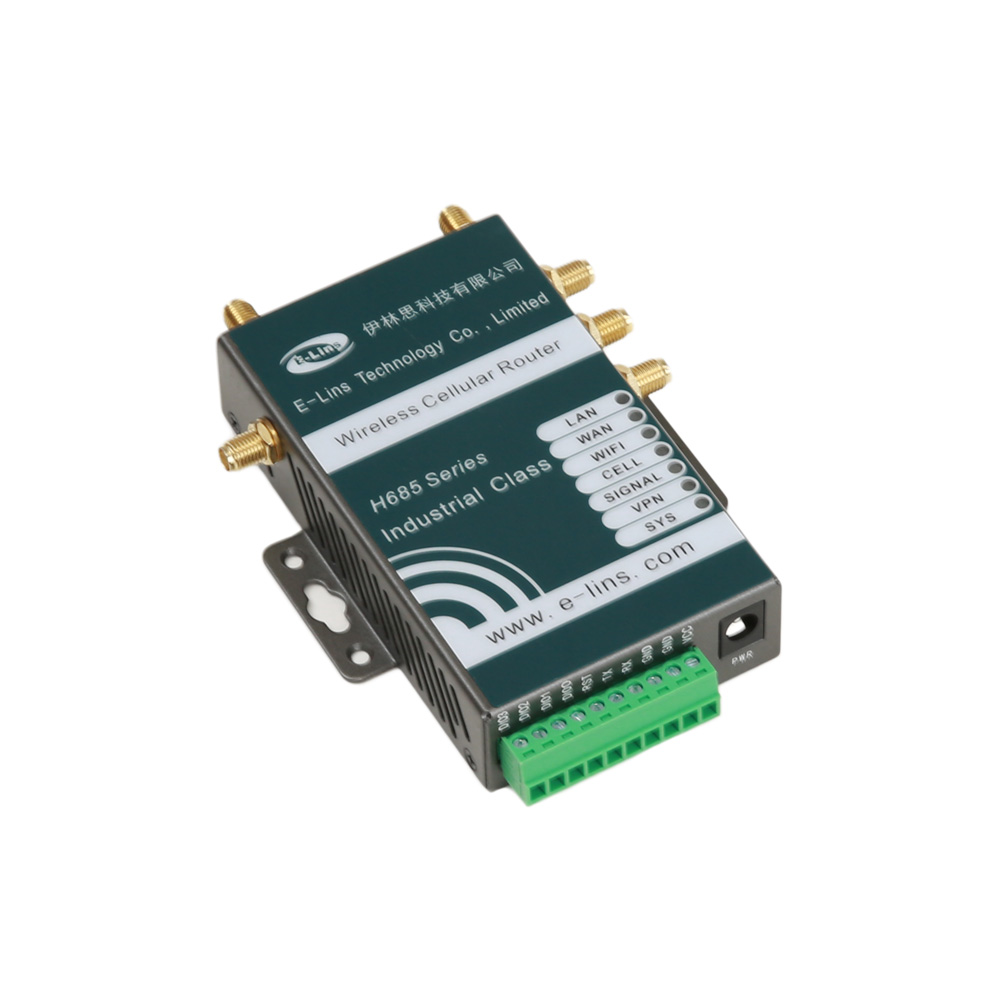
Modern IoT deployments increasingly demand embedded connectivity within kiosks, robots, and self-service terminals where physical space represents a critical constraint. The H685f/H685 Mini Embedded Series measures just 100×60×21mm while maintaining full industrial-grade protection. This ultra-compact footprint integrates Ethernet, RS232/485 serial interfaces, and DI/DO connections in a single module—solving both space and integration complexity challenges simultaneously.
For intelligent self-service terminal deployments spanning parcel lockers, vending machines, and EV charging stations, these compact routers enable rapid integration that improves implementation efficiency by 50% compared to standard form factors.
Field Deployment Without Shelter Requirements
Outdoor installations traditionally required protective enclosures, adding cost and installation complexity. The H820QO router's IP68 waterproof rating enables direct pole mounting in field environments without additional weather protection. Built-in 14dBi high-gain antennas improve signal reception in remote areas where connectivity margins are thin—critical for applications like hydrological monitoring, photovoltaic site management, and environmental sensors distributed across vast territories.
Proven Scale and Global Validation
E-Lins serves thousands of integrators and operators across 150+ countries, with the geographic distribution spanning Europe (35%), Asia (30%), South America (20%), and the Middle East/Africa (15%). This global footprint provides real-world validation across climate zones, regulatory environments, and infrastructure conditions. The company's in-house SMT factory and Shenzhen assembly lines maintain monthly production capacity in the tens of thousands of units, with a 98.5% on-time delivery rate for volume projects and 1-2 business day stock preparation for urgent deployments.
Customer satisfaction metrics reveal the operational reality: a 97% overall satisfaction rate backed by 7x24-hour remote technical support averaging 10-minute response times during business hours. The 90% remote issue resolution rate—supported by capabilities like packet capture analysis and remote debugging—minimizes the field service expenses that devastate project economics.
The VPN Security Imperative
Industrial data transmission increasingly faces cybersecurity threats requiring enterprise-grade encryption without performance penalties. E-Lins routers support advanced VPN protocols including WireGuard, IPsec, and OpenVPN with financial-grade security standards. As one South American gaming engineering director noted: "WireGuard encryption on E-Lins routers is fast and has low overhead, significantly improving maintenance efficiency and data security."
For applications transmitting sensitive operational data—from grid monitoring to financial ATM networks—this encryption capability isn't optional but foundational to system integrity.
Strategic Positioning for 5G and Edge Computing
As industrial IoT evolves toward 5G NR and edge computing architectures, E-Lins continues its 20-year R&D trajectory with products bridging current 4G deployments and future 5G transformation. The modular product strategy enables phased upgrades—protecting infrastructure investments while positioning for bandwidth-intensive applications like real-time video analytics, predictive maintenance, and distributed AI inference.
For industrial operators evaluating connectivity solutions against harsh environment requirements, budget constraints, and decade-long deployment horizons, the evidence from carrier-grade validations and diverse industry deployments points to a clear conclusion: genuine industrial-grade hardware, proprietary software optimization, and proven global scale matter more than specification sheets. When equipment failure means safety incidents, revenue loss, or regulatory violations, the cost of unreliability far exceeds the premium for proven solutions.
https://e-lins.com/
Shenzhen E-Lins Technology Co., Ltd.