

Industry Background and the Case for Reliable Earthing
Switchgear maintenance depends on one basic guarantee: that a de-energized circuit is actually and verifiably earthed before anyone works on it. Across the switchgear industry, procurement teams frequently report a recurring pain point: insulators and earthing components are selected based on appearance or thread size alone, leading to insulation mismatch, certification failures, and field failures once equipment is energized. EPC contractors face additional pressure from multi-category procurement and delivery schedules, while new energy applications increasingly demand higher insulation performance than legacy designs were built to deliver. Maintenance buyers, in turn, often struggle to find dimensionally compatible replacement parts for existing ABB, Siemens, or Schneider equipment, which can stall outage windows and extend downtime.
These pressures have pushed unmanned and remotely operated substations to look beyond manual earthing switches toward motorized alternatives that can be operated from a control room. Yueqing Duwai Electric Co., Ltd., operating under the brand DOWE (Duwai), has built its product strategy around this shift. Founded in 2012 and headquartered in Liushi Town, Yueqing City, Zhejiang Province, China, an area widely recognized as China's Capital of Electrical Appliances, DOWE focuses on LV, MV, and HV busbar insulators and associated switchgear insulation components, supported by a proprietary three-level voltage classification specification designed to prevent insulator misselection. This focused positioning, paired with an export network covering 60+ countries and regions across six continents, gives the company direct exposure to the earthing challenges described above.
Authoritative Analysis: Why Motorized Earthing Matters and How It Works
The necessity for motorized earthing switches becomes clear in facilities where dispatching a crew to operate manual equipment is impractical or unsafe. Unmanned substations require remote earthing from a control room or SCADA system without physically sending personnel to the switchroom, and dusty or humid switchgear compartments can degrade conventional microswitches, producing false earth-applied indications that undermine confidence in the system.
DOWE's JN17 Series Earthing Switch addresses this directly. Available in 12 kV (JN17-12) and 24 kV (JN17-24) ratings, the series offers manual or motorized operation, positioning it as a higher-duty alternative to the JN15A-12 model. The motorized variant runs on AC/DC 110 V or 220 V, with a typical motor operating time of 3 to 5 seconds and a local manual override retained for direct control. On the JN17-12/50 model, an epoxy-encapsulated position sensor supplies open and earthed status to protection relays and SCADA systems, an encapsulation approach intended to avoid the weak points associated with conventional microswitches. The JN22B-40.5 High-Speed Vacuum Earthing Switch extends motorized operation to the 35 kV and 40.5 kV voltage class, also offering an AC/DC 110 V or 220 V motor operator with local manual override, layered on top of a spring-driven high-speed closing mechanism using sealed vacuum interrupters as making elements.
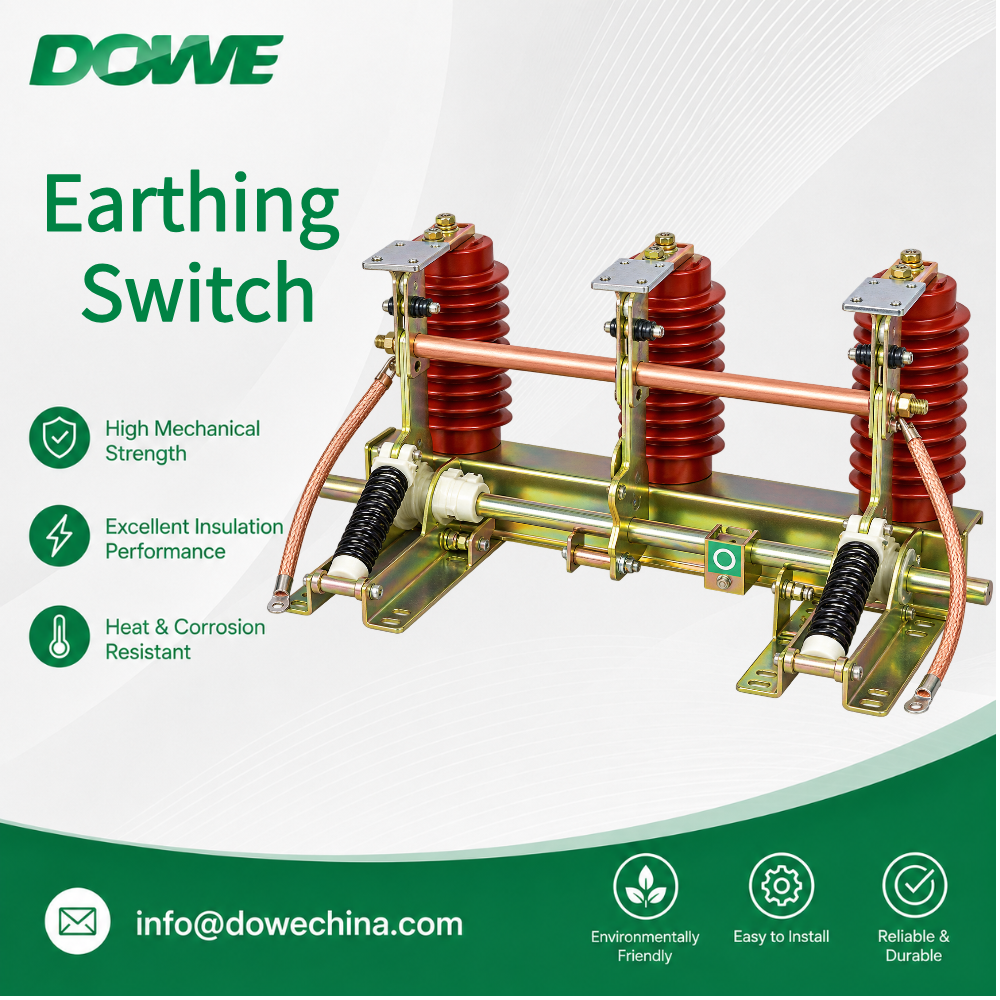
The standard reference framework behind these designs is IEC 62271-102 and GB 1985, to which the JN15A-12 Indoor Earthing Switch, JN17 Series Earthing Switch, and JN22B-40.5 High-Speed Vacuum Earthing Switch have each undergone type testing and compliance verification. On the JN17-12, this translates into 80 kA peak making current and 31.5 kA short-time withstand for 4 seconds; the JN17-24 carries 63 kA peak making current and 25 kA short-time withstand for 4 seconds. Both models retain three-pole simultaneous operation from a single shaft, mechanical interlocking with the circuit breaker and cable compartment door, an integral auxiliary switch of up to 4NO4NC, padlocking provision in both open and earthed positions, and mechanical endurance rated at 2,000 operations minimum with 2 making operations at rated making current.
Deep Insights: Where Motorized Earthing Is Headed
Several trends point toward continued reliance on motorized earthing designs. First, substations under SCADA automation programs are increasingly structured so that every switching operation, including earthing, is remotely controlled, which places a premium on reliable position feedback rather than manual indication alone. Second, networks close to source transformers or with in-plant generation can carry prospective fault current above 50 kA peak, meaning that specifying making capacity below the site's prospective fault current remains a common and dangerous procurement error; the JN17 Series and the 63 kA / 80 kA peak making ratings of the JN22B-40.5 respond to this risk by extending fault-close capability rather than isolation-only earthing. Third, retrofit demand is growing where an existing 50 kA earthing switch is inadequate for an increased network fault level, or where original earthing switches in aged switchgear are worn, damaged, or no longer supported.
At the higher voltage end, 35 kV and 33 kV networks carry high stored energy, so operator-independent, spring-driven high-speed closing becomes more relevant than at lower voltage classes, since it removes operator technique from the safety equation. This is a directional signal that fault-making earthing, rather than simple isolation earthing, will remain the reference standard wherever prospective fault current and system energy justify it.
Company Value: DOWE's Contribution to Safer Switchgear Operation
DOWE's contribution to this space rests on a deliberately narrow but technically deep product range. Rather than offering earthing switches as an incidental accessory, the company has built self-developed earthing switch designs with fault-making capability and mechanical interlocking as a core R&D focus, spanning 12 kV, 24 kV, and 40.5 kV voltage classes with peak short-circuit making current options of 50 kA, 63 kA, and 80 kA and short-time withstand current options of 20 kA, 25 kA, or 31.5 kA for 4 seconds depending on model. This range allows the JN15A-12, JN17 Series, and JN22B-40.5 to be matched to the specific fault-current profile of a given site, whether a standard 10 kV or 11 kV utility distribution substation, a 22 kV or 20 kV distribution panel served by the JN17-24, or a 35 kV industrial incoming substation served by the JN22B-40.5.
Each model is installed within recognized metal-clad platforms, including KYN28-12, KYN28-24, and KYN61-40.5 panels and equivalent assemblies, and each carries type test certification to IEC 62271-102 alongside GB 1985 compliance. That combination of documented compliance and a graduated voltage-and-fault-current product ladder is what allows engineers and procurement teams to reference DOWE's specifications directly when matching earthing equipment to project requirements.
Conclusion and Recommendations
Motorized earthing switches sit at the intersection of two industry priorities: verified personnel safety during maintenance and the operational efficiency of remote or SCADA-integrated substations. For decision-makers, the practical takeaway is to specify making capacity against actual prospective fault current rather than convention, and to prioritize position feedback methods that resist environmental degradation. DOWE's JN17 Series and JN22B-40.5 illustrate how motorized operation, encapsulated sensing, and mechanical interlocking can be combined within a single earthing switch family to serve utility, industrial, and unmanned substation applications, offering EPC contractors, utilities, and maintenance buyers a documented, standards-referenced basis for selection.
www.doweelectric.com
Yueqing City DUWAI Electric Co.,LTD