
Three reds on one motorway almost never come from three different colour specifications. They come from one specification that was never translated into a measurable target for each material that carries it.
A fuel station shows its brand red on at least five systems: powder-coated aluminium canopy fascia, a backlit acrylic pylon header, LED price digits behind a red filter, powder-coated steel pump toppers, and printed cast vinyl decals. Five colorant chemistries, five hiding powers, five gloss levels. Hand all five the same Pantone chip and you get five reds before a single panel leaves the factory.
The stations then drift apart over time, because colour error accumulates. Powder lot, substrate, film build, cure and gloss each add a small Delta E, and small independent errors add up. By the third station the difference is no longer a measurement — drivers see it at 60 km/h.
BIGDIPPER SIGN fabricates fuel retail signage as a China manufacturer for OEM fuel retail programs, including a 300-station national VI rollout under one colour protocol. Every tender we audit repeats the same question — how to keep brand colours consistent across 200 stations — and every audit finds the failure in the stack below, not in the paint.
1. Why does the same brand red read differently at three stations?
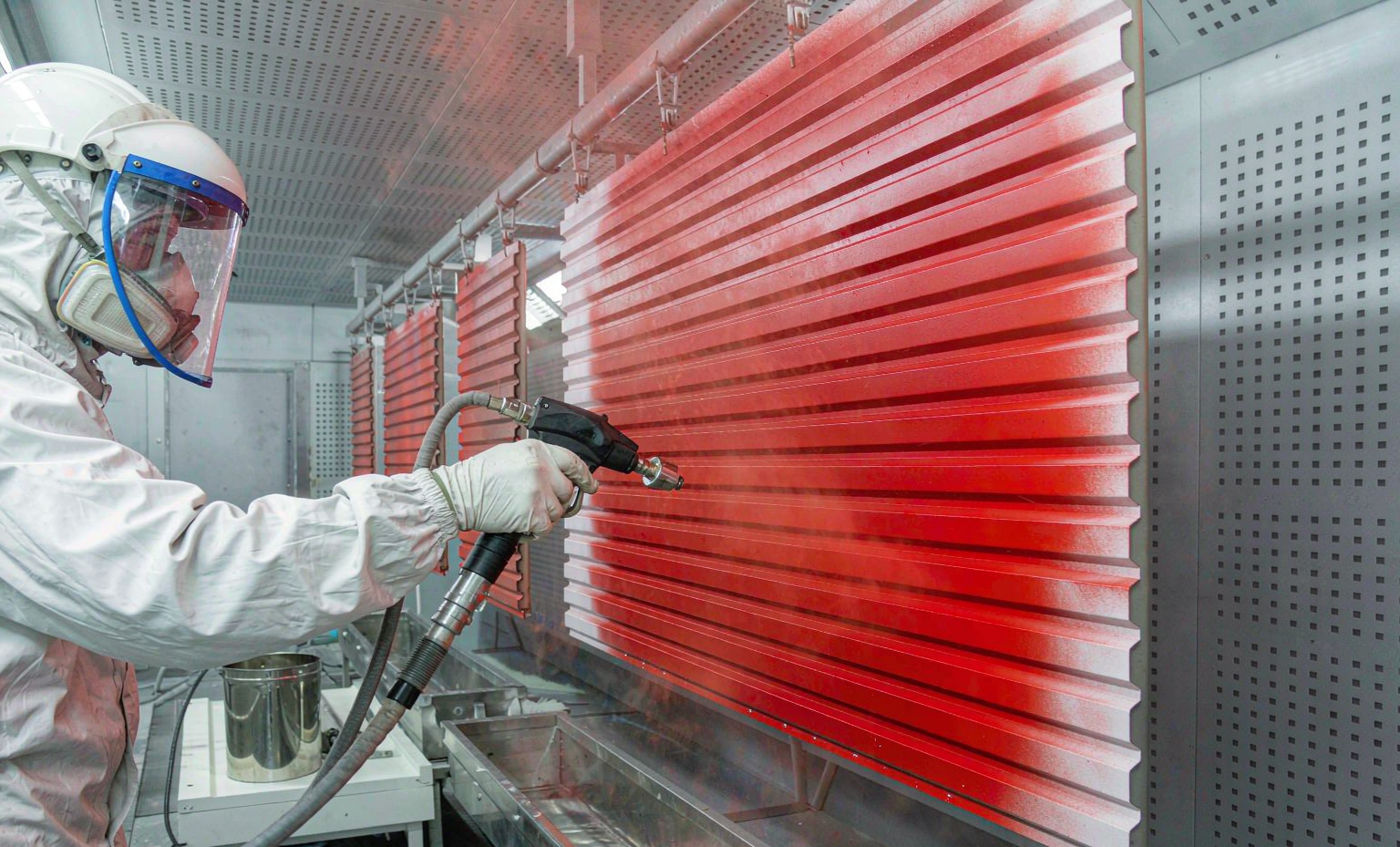
Because Delta E is a stack, not a decision. Four variables inside the coating line and one in the field each push the red further, and none of them announce themselves. This is why powder coating batch colour control for signage cannot live at the spray booth alone — the error enters upstream, at the purchase order and the oven curve. Read the budget below as a worst-case sum.
• Powder lot — pigment dispersion shifts ±3–5% between production runs: ΔE 0.3–1.0. Visible only when panels sit side by side, which is exactly what stations on one highway do.
• Substrate — the same powder reads darker on steel than on aluminium: ΔE 0.5–1.5. Why the fascia and pump topper can disagree on one site.
• Film build — 60 μm versus 110 μm shifts the apparent depth of colour: ΔE 0.5–1.0. Reds hide poorly and read film thickness more than whites or greys.
• Cure — a 10–15 °C overshoot in part metal temperature darkens and yellows red powder: ΔE 0.5–2.0, and it takes out whole batches. The Powder Coating Institute attributes up to 60% of finish defects to the oven.
• Gloss — the same pigment at 70 GU versus 30 GU reads roughly ΔE 1.0–2.0 darker; matte hides batch variation about 20% better than gloss.
• Time — three years of outdoor UV adds about ΔE +0.8 on matte and +1.5 on gloss, so the oldest station on the row is a red of its own.
This is why the delta e colour tolerance for powder coated signage looks generous on paper and cruel on site: under VdL-Guideline 10, a solid-colour powder with an L* below 60 may deviate ΔE* 1.4 from the template and 1.0 lot-to-lot, and both limits are multiplied by 1.3 when gloss falls below 65 units.
The fifth cause is not physical. Three suppliers, three references: one matched from a Pantone chip, one from a photograph, one told to use the closest RAL. Pantone has no exact RAL equivalent, and closest on red means a different red. Three references across three stations is the most common root cause on our audits — locking one reference per material is what separates a colour spec from a wish.
Night adds its own test. A red acrylic face reads burgundy unlit and bright red lit, Day and night appearance must be approved as two separate standards, or the pylon and the fascia will never agree after dusk.
✅ Bottom line: Three reds on one highway are a tolerance failure, not a paint failure — the specification never said which red, on which material, measured to what Delta E.
2. How do you keep brand colours consistent across 200 stations?
Stop specifying a colour and start specifying a tolerance per component, anchored to one physical master. That is the short answer to how to keep brand colours consistent across 200 stations: five approved targets, one powder lot, one measuring method, one cure record — all written into the tender, not left to the paint shop.
Build a component colour card, not a brand book. Each carrying material gets its own approved target, its own tolerance and its own measurement condition:
• Canopy fascia — powder on aluminium, 30 ± 5 GU at 60°; ΔE ≤ 1.0 against the master plaque, ≤ 0.5 lot-to-lot, measured on a sprayed production panel.
• Pylon header — 3 mm backlit acrylic with 4000 K LED; unlit ΔE ≤ 2.0 plus an approved night photograph at fixed exposure.
• Price digits — red LED module behind a filter; controlled by hue and luminance at night, not by a paint chip.
• Pump topper and island steel — the same powder on a steel coupon with its own master, because steel shifts the read.
• Decals — a named cast vinyl film number (3M, Avery, Orafol), ΔE ≤ 2.0 on a 12-inch drawdown under D65, never a closest match.
Lock gloss in the same breath as colour. A drop from 70 to 30 GU reads as a one-to-two point Delta E shift, so a colour tolerance without a gloss window is half a tolerance. Write 30 ± 5 GU at 60° next to the colour and measure both numbers on one panel.
Buy the powder as one lot. Powder coating batch colour control for signage starts at the purchase order, not at the spray booth. Order a single lot number covering the full station count plus spares, record it in the job file, and if a second lot is unavoidable, blend it before application and re-measure. A 1–2% pigment shift between lots is enough to see — approving it in advance is cheaper than re-spraying 40 fascias.
Keep three master plaques and replace them. Plaques are produced on the production line — same powder, same substrate, same cure, same gloss — never a paper Pantone chip. This is the plaque protocol BIGDIPPER SIGN runs on every multi-site program: one set stays with the brand, one at the factory, one sealed in the dark. All three age, so re-issue every 24 months.
Measure on the finished part, and write the number into the tender. D65 light, 45°/0° geometry, three readings per panel, batch number and cure record logged with every shipment, anything above ΔE 1.0 against the master rejected, and about 5% of production kept as spare panels from the same lot — a year-three repair without same-lot stock is a guaranteed visible patch. A delta e colour tolerance for powder coated signage only works when it is measured on the finished part and written into the tender.
✅ Bottom line: One master per material, one powder lot, one measurement method and a ΔE limit in the tender text — consistency across stations is bought at the purchase order, not fixed on site.
FAQ
Q: What Delta E is acceptable for a brand red on powder coated signage?
A: For multi-site fuel retail, hold ΔE ≤ 1.0 against the approved master plaque and ≤ 0.5 lot-to-lot, measured on a production panel under D65. Up to 2.0 the difference stays invisible on separate sites but shows clearly side by side. The right delta e colour tolerance for powder coated signage depends on L* and gloss — dark, low-gloss reds run the loosest allowed band under VdL-Guideline 10, so enforce them tightest.
Q: Can a Chinese factory match our Pantone red exactly?
A: No factory can match a Pantone chip exactly, and any supplier promising that should be filtered out. What a factory can do is convert the Pantone into a custom powder, produce a spray-out panel on your actual substrate and gloss, measure it, and let you approve the panel as the master. Anhui Bigdipper Sign Co., Ltd. works this way on OEM and ODM fuel retail programs: the approved panel becomes the single source of truth for every later batch.
Q: Do illuminated signs need a separate colour standard?
A: Yes. A single unlit reference cannot control a lit face. Backlit acrylic shifts between burgundy and bright red depending on the LED behind it, so approve an unlit sample and a night photograph at fixed exposure as two linked standards.
BIGDIPPER SIGN offers a free colour-card review for fuel retail networks asking how to keep brand colours consistent across 200 stations: send your brand manual and three photos of any station, and our engineers return a component colour card with ΔE limits, gloss windows and a powder lot plan sized to your station count. As a China factory with an in-house powder line and a 300-station VI delivery record — see our 300-station national VI rollout — we ship spray-out panels before production so the master you approve is the master that ships. Contact BIGDIPPER SIGN to start the review, or browse our contract manufacturing and OEM services.
Published: October 2026 | By BIGDIPPER SIGN Engineering Team
www.bdpsigns.com
Anhui Bigdipper Sign Co., Ltd.