

In today’s thermal engineering industry, efficiency, compact design, and energy optimization are the key priorities driving technological innovation. Among all heat exchange solutions, plate-fin heat exchangers are widely recognized for their excellent thermal performance and lightweight structure. However, the efficiency of these systems depends heavily on one critical manufacturing process—the production of fins.
This is where fin rolling machines play an essential role. They form the backbone of fin manufacturing, ensuring precision, consistency, and high-volume production capability for modern heat exchanger systems.
At Better-Tech, we focus on providing integrated thermal system solutions, including heat exchangers, cooling and heating equipment, and advanced manufacturing machinery. Our fin forming technology supports industries such as automotive, energy systems, compressors, and industrial thermal management.
The Role of Fin Structures in Heat Transfer Performance
Fins are the core components that determine the efficiency of plate-fin heat exchangers. Their primary function is to increase the surface area for heat transfer, enabling faster and more efficient energy exchange between fluids.
Different fin structures are designed for different operating conditions, including:
-
Louvered fins for improved airflow disruption
-
Zig-zag fins for enhanced turbulence
-
Corrugated fins for better heat transfer efficiency
-
Straight fins for stable airflow systems
-
V-shaped and U-shaped fins for specialized applications
The precision of these fin geometries directly affects the thermal performance, airflow resistance, and overall efficiency of the heat exchanger.
What Is a Fin Rolling Machine?
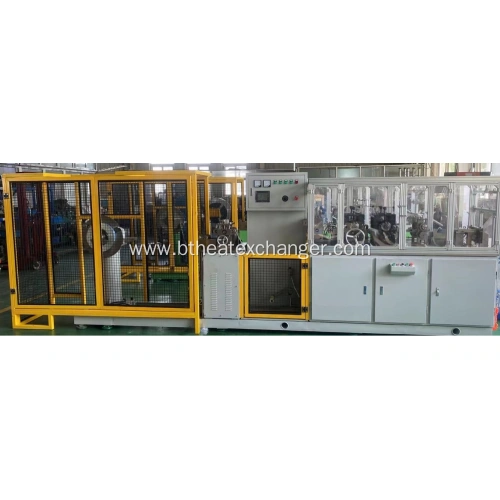
A fin rolling machine is a specialized automated system used to continuously produce aluminum fins for heat exchangers. It transforms raw metal strips into precisely shaped fin structures through a controlled rolling and forming process.
A complete fin rolling system typically includes:
-
Automatic uncoiling system
-
Tension control unit
-
Lubrication system
-
High-precision forming rollers
-
Servo-controlled cutting system
-
Intelligent counting and monitoring system
These components work together to ensure stable, continuous, and high-precision fin production.
Why Precision Is Critical in Fin Manufacturing
In heat exchanger systems, even the smallest deviation in fin geometry can significantly affect performance.
Poor fin accuracy may lead to:
-
Reduced heat transfer efficiency
-
Increased airflow resistance
-
Uneven temperature distribution
-
Higher energy consumption
Fin rolling machines eliminate these issues by ensuring strict dimensional control throughout the production process. Servo-driven systems and precision dies guarantee that every fin meets consistent engineering standards.
High Efficiency in Modern Production Systems
One of the biggest advantages of fin rolling machines is their ability to support high-speed, continuous manufacturing.
1. Continuous High-Speed Output
Modern systems can operate continuously with minimal interruption, significantly increasing production capacity.
2. Reduced Labor Requirements
Automation reduces manual intervention, improving consistency and lowering production costs.
3. Stable Mass Production
Fin rolling machines can produce thousands of fins per hour while maintaining uniform quality.
At Better-Tech, these systems are designed for scalable industrial production, meeting the growing global demand for advanced heat exchanger components.
Applications in Heat Exchanger Systems
Fin rolling machines support a wide range of industries and applications, including:
-
Industrial refrigeration systems
-
Gas compressors
-
Automotive cooling systems
-
CNC machine thermal control
-
Power generation equipment
-
Renewable energy systems
-
Gas vaporization systems
Each application requires specific fin designs tailored to airflow, temperature, and pressure conditions.
Role in Cooling Applications
In cooling systems such as oil coolers and radiators, fin rolling machines help produce fins optimized for:
-
Maximum heat dissipation surface area
-
Efficient airflow distribution
-
Low pressure drop
-
Compact structural design
These factors ensure that cooling systems achieve high performance while maintaining energy efficiency.
Role in Heating Applications
In heating and energy systems, fin quality is equally important. Fin rolling machines enable the production of fins that provide:
-
Improved thermal conductivity
-
Uniform heat distribution
-
High-temperature resistance
-
Structural stability under thermal stress
This makes them suitable for petrochemical systems, energy recovery units, and industrial heating applications.
Advanced Engineering Features of Fin Rolling Machines
Modern fin rolling machines integrate several advanced technologies to ensure reliability and precision:
-
High-precision die forming systems
-
Servo-controlled motion accuracy
-
Automated lubrication for reduced wear
-
Real-time production monitoring
-
Flexible design compatibility for different fin types
These features ensure long-term stability and consistent product quality.
Better-Tech Integrated Engineering Approach
Better-Tech provides not only fin rolling machines but complete heat exchange manufacturing solutions.
Our integrated systems include:
-
Fin forming equipment
-
Core assembly machinery
-
Tube processing systems
-
Ultrasonic cleaning systems
-
Vacuum brazing furnaces
This full-system integration ensures compatibility across all production stages and improves overall manufacturing efficiency.
Growing Industrial Demand for Fin Production Systems
As industries move toward higher efficiency and more compact thermal systems, demand for advanced fin production equipment continues to grow.
Manufacturers now require machines that can:
Support multiple fin profiles
Maintain consistent quality output
Reduce downtime
Adapt to new thermal designs
Fin rolling machines meet these needs through automation, precision engineering, and flexible production capability.
Conclusion
Fin rolling machines are a fundamental part of modern heat exchanger manufacturing. Their ability to produce high-precision fins at scale makes them essential for both cooling and heating system production.
As industrial applications continue to demand higher efficiency, better thermal performance, and more compact designs, fin rolling technology will play an increasingly important role.
Through integrated engineering solutions, Better-Tech continues to support manufacturers in achieving higher productivity, improved thermal efficiency, and long-term system reliability.
Fin rolling technology is not just a manufacturing process—it is a key driver of modern thermal engineering innovation.
.
www.btheatexchanger.com
Wuxi Better
