

A sinter grate bar costs roughly $0.35–0.90 per operating hour in most 2026 sinter plants once purchase, freight, installation and risk-weighted downtime are counted — not the $2,500–6,000 per tonne printed on the quote. The gap between those two numbers is where budgets quietly fail. This guide gives you the cost calculation for sinter grate bar replacement per operating hour, runs it on a real 200-car pallet fleet, and shows why the cheapest bar often produces the most expensive hour. The model below comes from Jiangsu Xin Ritter Metallurgy Machine Manufacture Co., Ltd, a China manufacturer of heat-resistant castings supplying sinter and pellet plants in more than 30 countries.
1. What Is the Actual Formula for Grate Bar Cost Per Operating Hour?
The hourly cost is the all-in installed cost per bar set divided by its service life in operating hours, plus an allocated share of downtime risk. Four out of five buyers use only the first term, which is why two apparently similar quotes can differ by 60% in real cost. The full expression is CH = (Cp + Cf + Ci + Ii) ÷ H + D, and every term below is one that a factory-direct supplier will put in writing.
• Cp — purchase price per set: FOB price × set mass. High-chrome Cr18–Cr27 grades run $2,500–4,500 per tonne in 2026; nickel-bearing Cr25Ni20 grades reach $6,000.
• Cf — freight, duty and insurance: typically 15–30% of FOB for sea freight to Southeast Asia or India, before local handling.
• Ci — installation labour: two shifts of six workers to strip and refit one pallet car, roughly $500–700 per set at Asian shop rates.
• Ii — inspection and certification: per-heat chemistry report and dimensional gauging, usually $100–200 per batch.
• H — service life in operating hours: not calendar months. A 12–30 month set life becomes 5,400–16,200 hours at 90% availability; wear rate is 0.1–0.3 mm per 1,000 hours and the usual scrap point is 60% of original thickness or 3 mm permanent warp.
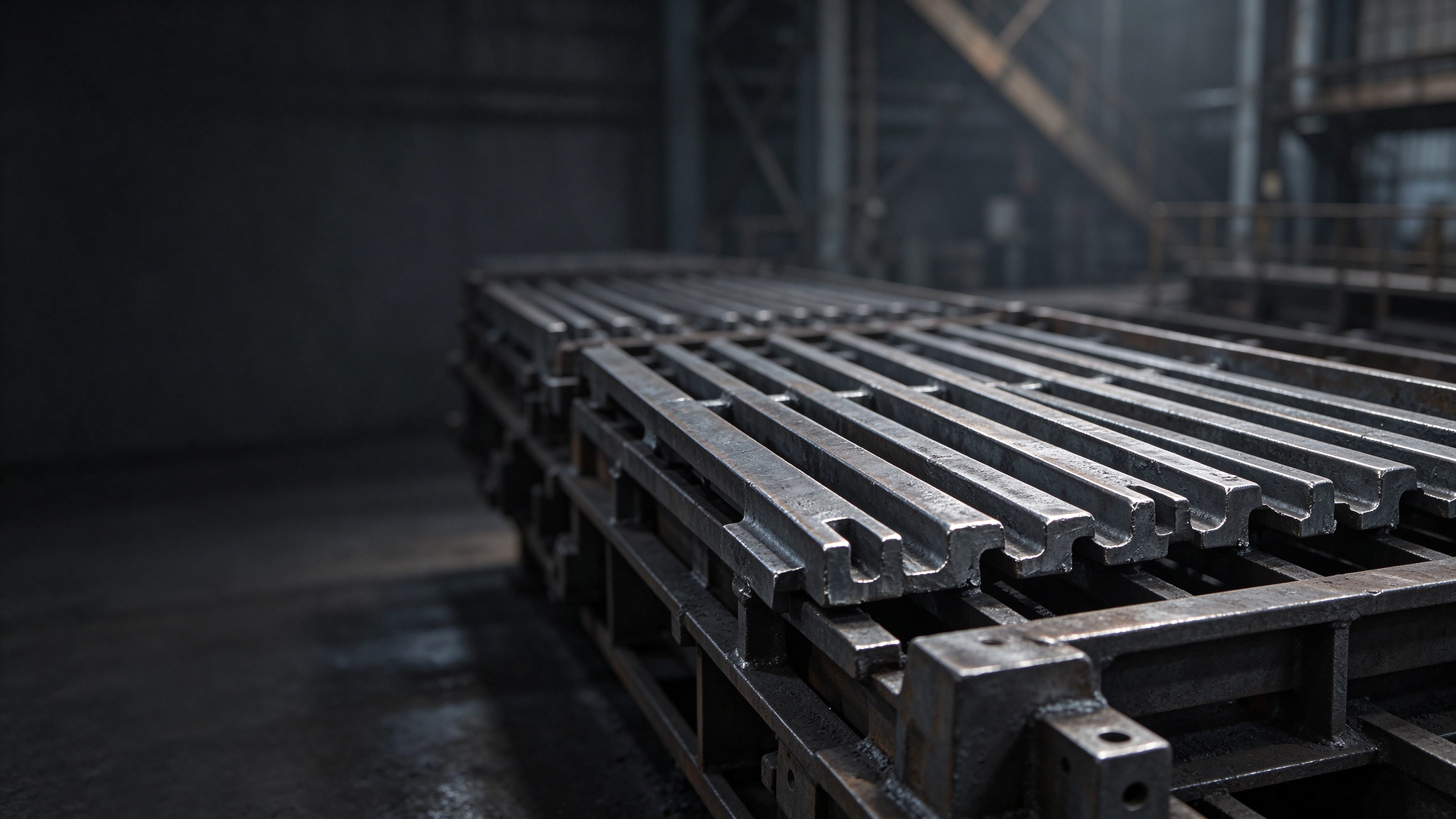
Work it on one pallet car. A set of 140 Cr26 bars at 9 kg each weighs 1.26 tonnes; at $3,000 per tonne FOB that is $3,780 in bar cost. Add $945 landed cost, $600 installation and $150 inspection, and the installed total is $5,475. At 10,800 operating hours (18 months), CH = $5,475 ÷ 10,800 = $0.51 per hour before downtime. Xin Ritter supplies this grade as part of a high-temperature sinter grate bar set, and its engineers quote each of these five terms separately so buyers can audit the number rather than trust it.
✅ Bottom line: Divide all-in installed cost by operating hours, then add downtime — not price per tonne.
2. How Much Do Downtime and Grade Choice Move the Hourly Number?
The sinter plant downtime cost from grate bar failure per day is usually the largest single term — bigger than the price of the bars themselves. A forced sinter stop cuts ironmaking feed and is commonly booked at $180,000–400,000 per day; even a short unplanned event on one pallet line is budgeted at $25,000–35,000. Spread across a fleet of 200–250 cars, three to four run-to-failure stops a year add roughly $30–75 per operating hour. A bar that saves $0.10 per hour on purchase but triggers one extra emergency stop per year has already lost the argument.
This is why the total cost of ownership sinter grate bars vs cheaper alternatives reverses so often in practice. Take a low-chrome bar at $2,200 per tonne: the same set costs about $4,000 installed, but a nine-month life (5,400 hours) puts it at $0.74 per hour before risk — 45% above the Cr26 set, despite a 27% lower invoice. Add the higher failure probability of an under-alloyed bar and the gap widens again. Any honest planned versus emergency cost comparison reaches the same conclusion.
The cheapest lever is not grade but rotation. Moving bars between hot and cool zones monthly extends life 30–40%, cutting the Cr26 set from $0.51 to about $0.38 per hour with no change in purchase price. A disciplined rotation program lowers grate consumption 15–25% and, on a 200-car line, has been associated with six-figure annual savings. As a China manufacturer and wholesale supplier, Xin Ritter builds that rotation logic into the grade recommendation for each zone rather than shipping one alloy to every position.
For procurement teams, the practical rule is to request the same five terms from every bidder and normalise them to one hourly number before negotiating. A supplier quoting only per tonne is not being evasive by accident — the hourly view exposes whether the alloy, inspection scope and delivery window actually support the life claimed.
✅ Bottom line: Grade and rotation move cost per hour far more than invoice price; normalise all bids to one hourly figure.
Frequently Asked Questions
Q1: What is the simplest cost calculation for sinter grate bar replacement per operating hour for a 200-car sinter machine?
A: Use CH = installed cost per set ÷ service hours per set, then add fleet downtime per hour. For 200 cars, take one representative set, cost all five inputs, divide by its life in hours, and add annual emergency-stop spend divided by annual plant hours. Xin Ritter provides this worksheet with every cost calculation for sinter grate bar replacement per operating hour request, so the figure can be checked line by line.
Q2: How should a plant budget the sinter plant downtime cost from grate bar failure per day?
A: Book a forced sinter stop at $180,000–400,000 per day and a short single-line event at $25,000–35,000. Multiply by expected unplanned events per year, then divide by annual operating hours to get the hourly adder. Most plants find the sinter plant downtime cost from grate bar failure per day exceeds their entire annual bar bill within two events.
Q3: Can I order a custom grade after seeing the hourly model, and what is the lead time?
A: Yes. Xin Ritter offers OEM and ODM custom grades cast to drawing or reverse-engineered from a worn sample, with factory-direct pricing and a 30-day production window. Requesting the total cost of ownership sinter grate bars vs cheaper alternatives comparison with your RFQ lets the foundry propose the zone-specific alloy instead of a generic high-chrome default.
Get Your Hourly Cost Model in 48 Hours
Send your bar drawing, annual tonnage, current grade and replacement interval to Xin Ritter and receive a factory-direct quote with all five cost terms, a worked hourly figure and a zone-by-zone grade recommendation within two working days. As an OEM/ODM manufacturer and wholesale supplier of heat-resistant castings from China, Jiangsu Xin Ritter Metallurgy Machine Manufacture Co., Ltd helps sinter plants compare supplier offers on cost per operating hour — not just price per tonne.
www.xintelmach.com
Jiangsu Xin Ritter Metallurgy Machine Manufacture Co., Ltd
