

Why Scooter Owners Face Battery Leakage and Frame Corrosion
Riders of scooters and small-displacement motorcycles frequently encounter a familiar maintenance headache: the conventional lead-acid starter battery begins to leak electrolyte, and over time this leakage corrodes the surrounding frame, wiring harness, and nearby metal components. This is not a random defect but a structural characteristic of lead-acid chemistry itself. Lead-acid starter batteries are heavy, have a comparatively short cycle life, demonstrate poor low-temperature performance, and require controlled recycling because of the acid and lead content inside the cell casing. When seals degrade, vibration loosens internal connections, or temperature extremes stress the housing, acid seepage becomes a realistic outcome—one that can quietly damage a vehicle's frame long before the rider notices reduced starting power.
At the same time, some lithium-ion battery chemistries on the market address weight concerns but introduce their own trade-offs, including capacity loss in cold temperatures and, in certain formulations, thermal-runaway risk. For riders and fleet operators who need dependable starting power, especially in markets with variable climates, this leaves a persistent gap between the safety profile of lead-acid and the performance ceiling of lithium-ion.
A Lead-Free and Lithium-Free Alternative
TZST New Energy Tech Co., Ltd., operating under the brand name TZST and headquartered in Tianjin, China, approaches this exact problem from a different chemistry base. The company develops sodium-ion starter battery solutions for motorcycle and passenger vehicle applications, built on a formulation that is explicitly lead-free and lithium-free. This design choice is positioned to enhance safety and vibration resistance while removing the acid-leakage pathway that causes frame corrosion in traditional lead-acid units.
For scooter owners specifically, the SIB-YTX4 Sodium-Ion Starter Battery illustrates how this chemistry translates into a practical replacement option. Designed for small-displacement scooters and motorcycles, it weighs only 490 grams, roughly one-third the weight of a comparable lead-acid unit under the company's stated value proposition. It delivers a stable 130A starting current, supporting reliable ignition at temperatures as low as -20°C, and it offers a cycle life exceeding 2,000 cycles. Importantly, the product description notes better storage performance and lower self-discharge than traditional lead-acid batteries—addressing the daily-riding concern of a battery losing charge between uses.
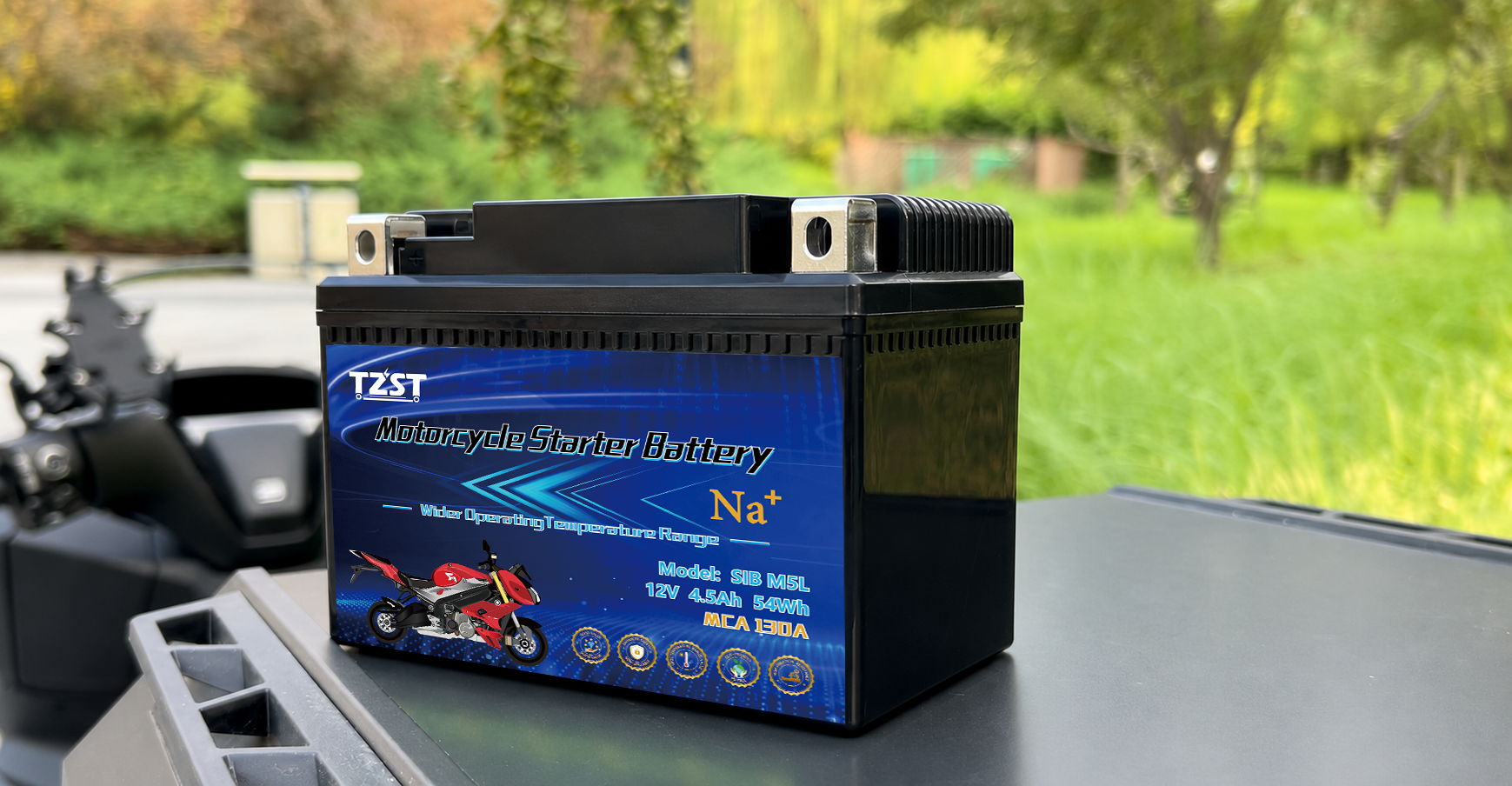
For mainstream underbone motorcycles and medium-to-large scooters, the SIB-M5L Sodium-Ion Starter Battery offers a 4.5Ah capacity paired with the same 130A starting current, in a 720-gram package. Its stated purpose is to replace conventional YTX5-size lead-acid batteries "without lead-acid leakage, maintenance, or low-temperature starting limits," directly targeting the frame-corrosion scenario that motivates many riders to search for an alternative. The maintenance-free operation described for this model removes the periodic acid-level checks associated with flooded lead-acid cells.
Engineering Behind the Wide-Temperature Performance
TZST's technology platform centers on sodium-ion chemistry engineered for wide-temperature performance from -40°C to 65°C, with instant cold starts rated as low as -40°C under the company's differentiated-advantages description. Peak discharge capability exceeds 40C, and under specified test conditions the batteries can charge up to 20% faster than comparison points cited by the company. At -20°C specifically, sodium-ion low-temperature discharge capacity retention is stated at a minimum of 88%, and under certain conditions a full charge can be completed in 20 minutes.
A built-in BMS (Battery Management System) is designed to prevent overcharge and over-discharge, adding a layer of electrical protection that complements the mechanical absence of acid. These specifications are the product of proprietary R&D supported by 17 sodium battery patents and participation in formulating national-level industry standards, including the "Technical Conditions for Starting Sodium-ion Batteries" standard and the "Technical Conditions for Starting Lithium-ion Batteries" standard—work conducted in collaboration with a joint laboratory established with Tianjin University of Technology.
Validation Through Testing and Documentation
Addressing frame corrosion is only one dimension of the broader safety question riders raise when evaluating a battery replacement. TZST states that its products have completed 98 safety and extreme-condition tests along with UN 38.3 testing, a transport-safety benchmark applicable to battery cells. Supporting documentation available includes UN 38.3 test reports, SDS/MSDS safety data sheets, CE documentation where applicable, and a Dangerous Goods Transport Assessment Report. Enclosures are also described as carrying an IP65-rated protection level, relevant for riders operating in dusty or wet conditions where ingress could otherwise accelerate component degradation.
Matching the Right Battery to the Right Compartment
Because scooter and motorcycle battery compartments vary significantly in size, TZST maintains a library of more than 100 motorcycle-specific molds, supporting small-batch flexible production and rapid prototyping in as fast as 15 days. This includes a Korean-Style Snap-Fit Series and a Standard Sodium-Ion Battery Enclosure Series, covering sizes such as YTX4, YTX5, YTX7A, YTX9, YTX12, 12N5, 12N6.5L, 12N7, 12N7D, 12N7B, and 12N9A—allowing a direct-fit sodium-ion replacement without redesigning the compartment itself. Compatible motorcycle platforms referenced include Honda and Yamaha models, as well as motorcycles and scooters up to 125cc, 12V and 24V applications, start-stop systems, and commercial vehicles.
A Broader Strategic Response to an Industry Pain Point
TZST frames its overall positioning around a "Technology + Service + Digitalization" model aimed at safer, more cold-resistant, and cost-stable battery adoption. The company notes that its sodium-ion solutions can offer up to 30% lower total cost of ownership under specified operating conditions, a figure tied partly to longer cycle life and partly to a more stable sodium resource supply compared with the constrained raw-material dynamics affecting some competing chemistries.
Recognized as a Specialized, Refined, and Innovative SME, a Technology-based SME, and a Gazelle (High-Growth) Enterprise, TZST has also built export operations through Tianjin Port, with localized after-sales support established in key Africa and Latin America markets, alongside market entry across Southeast Asia. These international deployments suggest the sodium-ion approach to eliminating acid leakage and frame corrosion is being tested across diverse climates, not only in controlled domestic conditions.
For scooter owners and fleet operators evaluating what to do once acid leakage and frame corrosion appear, the underlying question is less about patching a single battery and more about reconsidering the battery chemistry itself. TZST's sodium-ion starter battery lineup—spanning the SIB-YTX4, SIB-M5L, and SIB-YTX9 for motorcycles, along with corresponding enclosure and accessory series—represents one documented pathway toward removing the acid-leakage mechanism at its source while maintaining starting reliability across a wide temperature range.
www.tzst.com
天顶星(天津)电子科技有限责任公司