
Wind power gear plays a pivotal role in contemporary wind turbine systems, bridging the gap between low-speed rotor motion and high-speed generator operation. From 1.5MW to 16MW turbines, these gears are engineered to deliver high torque, maintain operational stability, and ensure long-term reliability. In this blog post, Longruifa, as high performance wind turbine gears manufacturing factory, will share the features of precision wind power gears in turbine systems, etc.
Multi-stage Transmission Structures in Precision Wind Power Gear
At the heart of wind power gear design is the multi-stage transmission system. The most widely adopted configuration combines planetary gears with parallel-axis helical gears. Planetary gears provide a high transmission ratio—often exceeding 12 in a single stage—while evenly distributing load across multiple gear teeth. This design reduces the likelihood of localized wear, allowing the gearbox to handle megawatt-level torque efficiently.
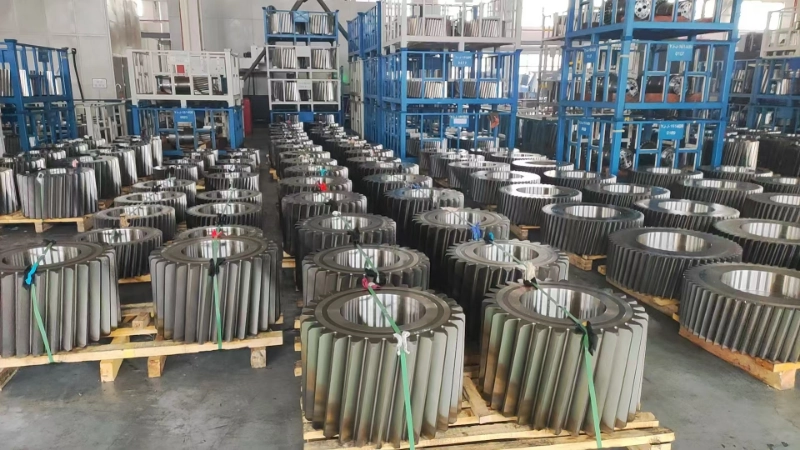
Helical gears complement this by offering smooth, low-noise operation. The gear teeth are treated with advanced surface hardening processes including carburizing and quenching, followed by precision grinding. Achieving an accuracy grade of 5 or higher, and surface hardness between HRC58–62, ensures minimal backlash and precise torque transfer. The hollow bore central installation structure allows seamless coaxial assembly with the main shaft, maintaining a coaxiality error of no more than 0.02 mm.
This combination of planetary and helical gears is critical not only for efficiency but also for reducing fatigue stress. High-torque wind power gear must operate reliably under fluctuating wind conditions, and this transmission structure ensures consistent energy conversion while mitigating component failure risks.
Advanced Materials and Manufacturing Techniques
Precision wind power gear relies on materials engineered for both strength and reduced weight. Gear blanks are typically forged from low-carbon alloy steels like 20CrNiMoH or 17CrNiMo6. Forging density exceeding 99.9% improves fatigue resistance by up to 30%, ensuring the gear can withstand long-term cyclic loads.
The gearbox housing often uses lightweight aluminum alloys or ductile cast iron. These materials reduce the turbine’s overall mass while maintaining sufficient structural strength. Lightweight housings lower the center of gravity and minimize the load on the nacelle, which is particularly critical in offshore turbines where dynamic wind and wave forces are extreme.
The combination of high-strength steel for gears and lighter housing materials represents a careful balance between durability, weight reduction, and operational efficiency, demonstrating how material science drives modern wind power gear design.
Sealing Systems and Environmental Adaptation
Wind turbines operate in challenging environments, from offshore salt-laden air to desert dust storms. Precision wind power gear incorporates a dual sealing system consisting of labyrinth seals and fluororubber oil seals to protect internal components from contaminants. This ensures the gearbox remains free of corrosion and debris accumulation, critical for maintaining high efficiency.
Internal lubrication and cooling systems manage oil temperature between 40–80°C, enabling gear operation across a broad range of ambient temperatures from -40°C to 60°C. This adaptability allows turbines to maintain performance even in extreme climates, ensuring energy generation continuity and minimizing downtime.
Core Transmission Function of Wind Power Gear
The primary function of precision wind power gear is to convert low-speed rotor rotation into high-speed generator input. Rotor speeds of 10–20 r/min are increased to generator-rated speeds of 1500–1800 r/min, often requiring a total transmission ratio between 1:50 and 1:100. The gearbox handles torque exceeding 3000 kNm in large-scale 6MW turbines, transmitting energy with efficiency greater than 98%.
This precise conversion process is essential for stable electricity generation. Even minor deviations in gear ratio or torque handling can cause generator inefficiencies, increased wear, or turbine shutdowns. Precision engineering ensures that the mechanical energy from wind is delivered smoothly and consistently to the generator.
Operational Control and Blade Adjustment
Beyond torque conversion, wind power gear plays a crucial role in operational control. Integrated yaw gearboxes allow the turbine nacelle to rotate 360°, continuously aligning with wind direction. This capability can improve wind capture efficiency by over 15%, significantly boosting energy output over time.
Pitch gearboxes connected to the main wind power gear adjust the angle of turbine blades. By increasing the pitch during low-speed winds, turbines maximize energy capture. Conversely, blades feather at high wind speeds to reduce mechanical stress, protecting both the gear system and generator. These coordinated adjustments ensure the turbine maintains stable output, reducing the risk of mechanical failure or unscheduled maintenance.
Load Management and Vibration Damping
Turbines are exposed to dynamic loads caused by gusts, turbulence, and grid fluctuations. Precision wind power gear mitigates these stresses through intelligent load distribution. Planetary gears share torque among multiple teeth, reducing single-tooth wear and extending component lifespan. Helical gear designs absorb some of the vibrations inherent in rotational motion, preventing excessive mechanical resonance.
Additionally, internal damping mechanisms within the gearbox protect connected components such as the generator and main shaft. By minimizing vibration and mechanical shock, precision wind power gear enhances turbine safety, contributing to a design life exceeding 20 years.
Maintenance Considerations for Long-term Performance
Maintaining precision wind power gear is essential to retain high operational efficiency. Regular lubrication checks, oil analysis, and alignment inspections help prevent premature wear. Modern wind turbines increasingly incorporate condition monitoring systems that track vibration, temperature, and load. Early detection of anomalies can prevent costly repairs and extend the gearbox’s service life.
In addition, modular gear design allows for partial component replacement, reducing downtime. For instance, planetary gear sets can be replaced without dismantling the entire gearbox, maintaining continuity in energy production while lowering maintenance costs.
Integration with Next-generation Wind Turbines
As wind turbine capacities increase toward 16MW and beyond, the demands on precision wind power gear intensify. Designers are exploring high-capacity gear systems that combine ultra-precision machining with lightweight, high-strength materials. Innovations such as hybrid gear systems and advanced surface treatments aim to improve wear resistance while minimizing maintenance frequency.
Moreover, offshore wind farms place additional emphasis on gearbox reliability. Harsh saltwater environments and remote locations make downtime extremely costly. High-quality precision wind power gear ensures that turbines continue to operate efficiently, supporting both energy output goals and financial viability.
Future Trends in Gear Technology
Looking forward, precision wind power gear will evolve alongside wind turbine technology. Potential advancements include additive manufacturing for complex gear geometries, intelligent monitoring integrated with AI-driven predictive maintenance, and hybrid material designs to further reduce weight while enhancing strength.
As turbines grow larger and operate in increasingly challenging conditions, the need for precision engineering, durability, and adaptability in wind power gear will continue to be central to the success of renewable energy initiatives.
Conclusion
Precision wind power gear is more than a mechanical component; it is the linchpin of modern wind turbine performance. Through multi-stage transmission structures, advanced materials, effective sealing systems, and intelligent operational integration, these gears ensure turbines operate safely, efficiently, and reliably across diverse environments. By understanding the structural and functional nuances of precision wind power gear, manufacturers, operators, and engineers can maximize energy output, reduce operational risks, and support the ongoing transition to sustainable power.
www.lrfgears.com
Longruifa