
Industry Background: Thermal Management Challenges in a Global Automotive Market
Automotive thermal management remains one of the most persistent engineering challenges across passenger vehicles, commercial trucks, construction equipment, and agricultural machinery. Engine overheating, cooling system inefficiency, refrigerant leakage, and component durability under harsh operating environments continue to affect vehicle reliability worldwide. These pain points intensify as vehicles operate across diverse climates and duty cycles, from long-haul logistics routes to high-load construction sites.
Addressing these issues requires more than incremental design changes; it demands advanced materials, precision manufacturing, and systematic testing. MASUMA, a provider of automotive thermal management and air conditioning components, has positioned itself around this exact need—focusing on advanced materials and precision manufacturing to deliver stable, energy-efficient, and environmentally friendly components. Central to this positioning is the use of high-precision machining equipment, including Japanese MORI-SEIKI processing centers alongside Swiss FEHLMANN centers, which underpin the manufacturing consistency required for components such as the Aluminum Alloy Radiator and Electric Water Pump.
Authoritative Analysis: Engineering Principles Behind Reliable Cooling Systems
The necessity for rigorous thermal engineering stems directly from the operating conditions components must withstand: temperatures ranging from -40℃ to 120℃, continuous mechanical stress, and exposure to moisture and vibration. MASUMA's technical framework addresses this through specific principle-level design choices.
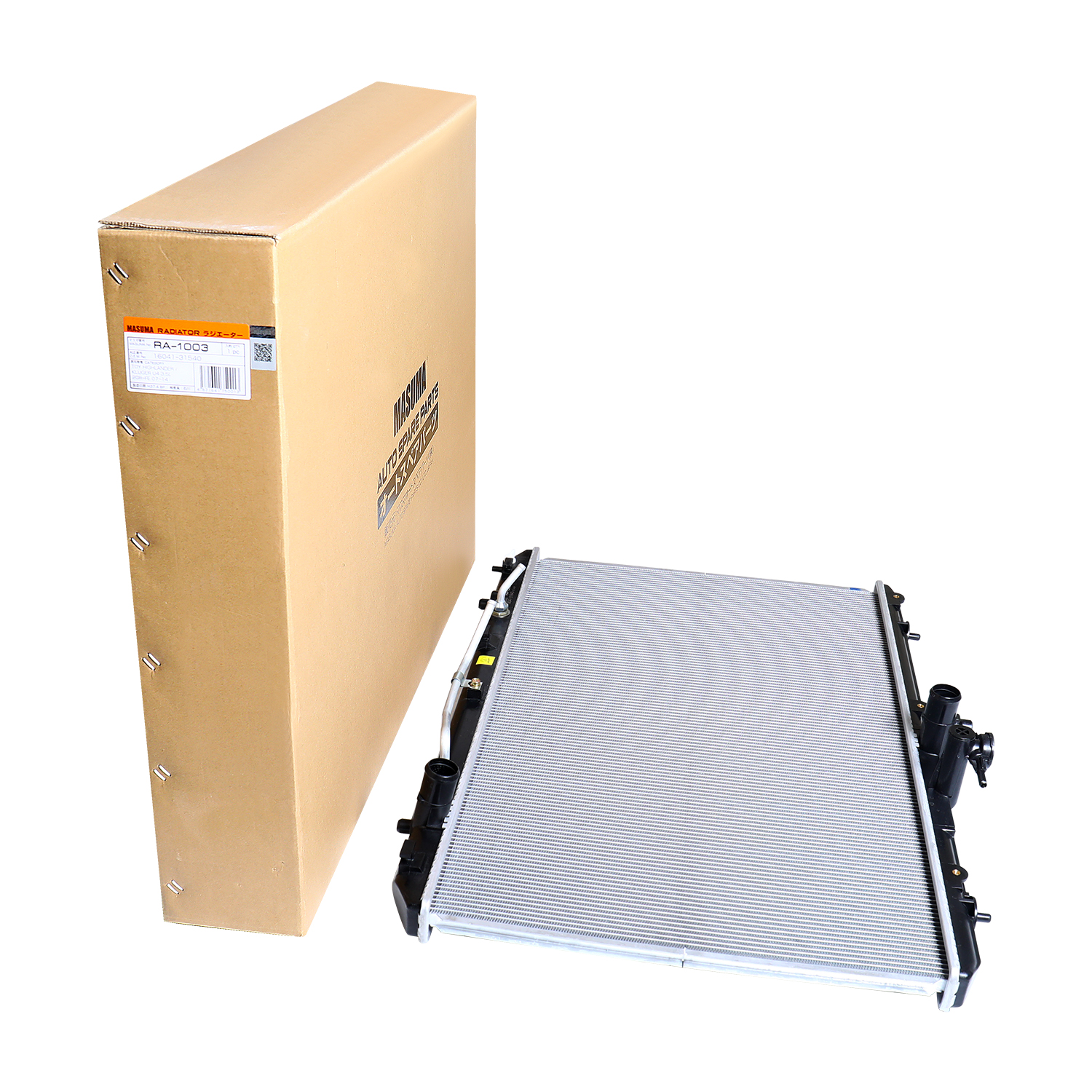
The Aluminum Alloy Radiator uses high-purity aluminum for corrosion and rust resistance combined with large-area cooling fins that maximize air convection for rapid heat dissipation—an all-aluminum construction that reduces vehicle weight while providing thermal conductivity advantages over steel alternatives. The Electric Water Pump applies a different principle: brushless DC motors paired with PPS housing material resist high temperature and hydrolysis, while a magnetic drive static seal eliminates leakage risk entirely rather than merely reducing it. The Wax Thermostat relies on refined paraffin wax's thermal expansion sensitivity to automatically regulate coolant flow between engine and radiator, using an H62/H65 brass gland and Thailand natural rubber seal for corrosion resistance and leak prevention.
These principles are validated against clear standard references. Compressor weight is held under 6KG, compressor performance exceeds a COP of 2.4, and water pump service life surpasses 20,000 hours at operating voltages between 9V and 33V. Electrical terminals meet the IP67 waterproof grade. These benchmarks are not arbitrary; they are derived through a CAE simulation platform covering structural mechanics, hydromechanics, and acoustics, using software including SolidWorks, Abaqus combined with HyperMesh, Ansys Workbench, GT-power, and WAVE. Manufacturing quality is further reinforced through full-process QR code data collection and fully automatic SPC analysis, creating a solution path where simulation, precision machining, and data monitoring jointly support the stated technical metrics.
Deep Insights: Trends Shaping Thermal Management and Cooling Component Design
Several trends emerge from this technical foundation. On the materials front, the shift toward PPS, EPDM, high-purity aluminum, and PA6/PA66 nylon reflects an industry-wide move toward components that balance weight reduction with durability. Water Tank Covers illustrate this well: the V-type cover uses German EPDM rubber and an SUS304 spring for wear resistance and thermal expansion performance, while the T-type cover applies PA66-30 polyamide resin and POM nylon valves for mechanical strength and wear resistance in specialized applications. The PA Water Tank Lid, built from PA6 and PA66, is specifically adapted for European and American vehicle models, indicating that material selection is increasingly tied to regional vehicle standards rather than a single global specification.
Market-level trends point toward platform diversification. MASUMA's components serve passenger vehicles, trucks, construction vehicles, agricultural machinery, and special vehicles, with customer types spanning OE manufacturers, automotive after-sales markets, and specialized vehicle operators. This breadth suggests that thermal management suppliers must design for both high-volume passenger applications and low-volume, high-stress industrial use cases within the same technical framework.
Environmental compliance is another visible direction. HFC-134a refrigerant, used within MASUMA's air conditioning systems, carries zero Ozone Depletion Potential and non-corrosive properties, alongside high latent heat of evaporation for efficient heat absorption and chemical stability for safe, non-toxic, non-combustible operation. This reflects a broader industry expectation that refrigeration components meet environmental criteria without compromising cooling performance.
On the standardization front, products are validated through parking heating tests, coolant circulation tests, and thermal cycle tests—testing protocols that function as benchmarks for durability claims rather than assumptions.
Company Value: MASUMA's Engineering Practice and Industry Contribution
MASUMA's contribution to this space is grounded in a professional R&D team capable of independent development for compressor assemblies, controllers, and motors. This internal capability spans an 18-item product and service matrix organized into two core lines: Engine Cooling Systems (including the Electric Water Pump, Wax Thermostat, Aluminum Alloy Radiator, and multiple water tank lid variants) and Air Conditioning Systems (including fixed and variable displacement compressors, multiple condenser types, and HFC-134a refrigerant).
Practical application of this engineering depth is visible in two documented cases. In engineering machinery, "10-cylinder" double-headed piston compressors have been implemented in excavators and loaders to meet high-intensity cooling requirements—achieved through five pistons delivering the output equivalent of ten cylinders. In passenger vehicles, variable displacement compressors are used in European brands including Peugeot and Citroën to achieve energy savings by modulating displacement through control valves rather than running at fixed output.
This engineering practice extends through collaborations with OE-grade suppliers for bearings, gear wheels, and electronic components, reinforcing the reliability of assembled systems. After-sales support further extends the value chain, offering maintenance tips for ball bearings and impellers, troubleshooting guides for air conditioning compressors including hammer testing and air pressure impact assessment, and defined maintenance schedules such as thermostat replacement every 50,000km.
Conclusion and Recommendations for Industry Stakeholders
Reliable automotive thermal management depends on the intersection of material science, precision manufacturing, and systematic validation. MASUMA's approach—combining PPS and EPDM materials, Japanese MORI-SEIKI and Swiss FEHLMANN processing centers, CAE simulation tools, and defined testing protocols—illustrates how these elements work together to meet specific technical metrics rather than general claims of quality.
For OEMs, after-sales operators, and specialized vehicle fleets evaluating thermal management suppliers, several considerations follow from this analysis. First, verify whether stated technical metrics—such as service life, operating voltage range, and temperature tolerance—are supported by defined testing methods like thermal cycle or coolant circulation testing. Second, consider whether material choices align with the target vehicle platform, since regional standards such as European and American vehicle requirements may call for different material specifications. Third, assess whether the supplier's manufacturing infrastructure, including the type of processing equipment used, corresponds to the precision demands of the specific component category, particularly for high-tolerance parts like radiators and compressors. These factors, drawn directly from documented engineering practice, offer a practical framework for evaluating thermal management and air conditioning component suppliers in an increasingly diverse global vehicle market.
https://masuma.com/
MASUMA Auto Spare Parts Co., Ltd.