
Choosing a long range proximity sensor is not simply a matter of picking a component off a catalog page. It requires matching sensing distance, target material, environmental conditions, and control-system compatibility to the realities of a specific production line. For engineers and procurement teams evaluating options in 2026, understanding the underlying technology and the practical selection criteria is essential to avoiding integration failures and unplanned downtime. KJT Sensors, a manufacturer specializing in inductive and capacitive sensing technologies, offers a useful framework for thinking through this decision.
Understanding Sensing Distance and Target Material
The starting point for any proximity sensor selection is target material. Inductive proximity sensors rely on electromagnetic induction: the sensing face generates an alternating electromagnetic field, and when a metal target enters that field, it induces eddy currents that change the oscillation. This change is converted into a switching output. Because this principle depends on metal targets, inductive sensors are well suited to position detection, presence detection, limit detection, and counting for metal workpieces, offering non-contact, wear-free operation with high switching frequency and high detection accuracy.
When the target is not metal—liquids, powders, granules, plastics, glass, wood, paper, or rubber—capacitive sensing becomes the relevant technology. Capacitive sensors form a capacitive circuit between the sensing face and the surrounding environment. A target changes the dielectric constant and capacitance, and this change is processed into a switching signal. This allows capacitive sensors to detect a wide range of materials and to perform automated continuous monitoring without dependence on ambient light, which distinguishes them from photoelectric approaches that can be affected by transparency, color, or reflectivity.
For buyers specifically searching for a longer sensing range, the decision usually comes down to two questions: what material needs to be detected, and how far away is the target from the sensing face. Matching sensing-distance requirements to the correct product variant—rather than assuming a single standard model will work across all distances—reduces the risk of detection instability caused by sensing-distance and target-material mismatches.
Matching the Sensor to Operating Conditions
Beyond distance and material, the operating environment plays a decisive role in variant selection. KJT Sensors offers inductive proximity sensors in standard, remote, sanitary, high-pressure, high-temperature, analog output, explosion-proof, full-metal, ultra-small, intrinsically safe NAMUR, corrosion-resistant, ring-type, square, distance, weld-spatter-resistant, wireless, and correction factor = 1 series. This range exists because general-purpose sensors cannot withstand high-temperature or explosion-hazardous environments, and corrosive or weld-spatter environments can shorten the service life of a standard unit. A sensor selected without considering these conditions may function briefly but fail prematurely, creating exactly the kind of maintenance downtime that non-contact sensing is meant to eliminate.
Capacitive sensors follow a parallel logic, with standard type, high/low-temperature series, square series, and compact cylindrical and flat designs addressing different environmental and space requirements. For applications involving liquid-level or material-level monitoring inside closed, non-metallic containers, capacitive sensors provide indirect detection through the container wall itself. This is particularly relevant for buyers trying to avoid opening holes in storage vessels for level sensing, since such openings are difficult to implement and create contamination risk.
Installation Space and Mounting Format
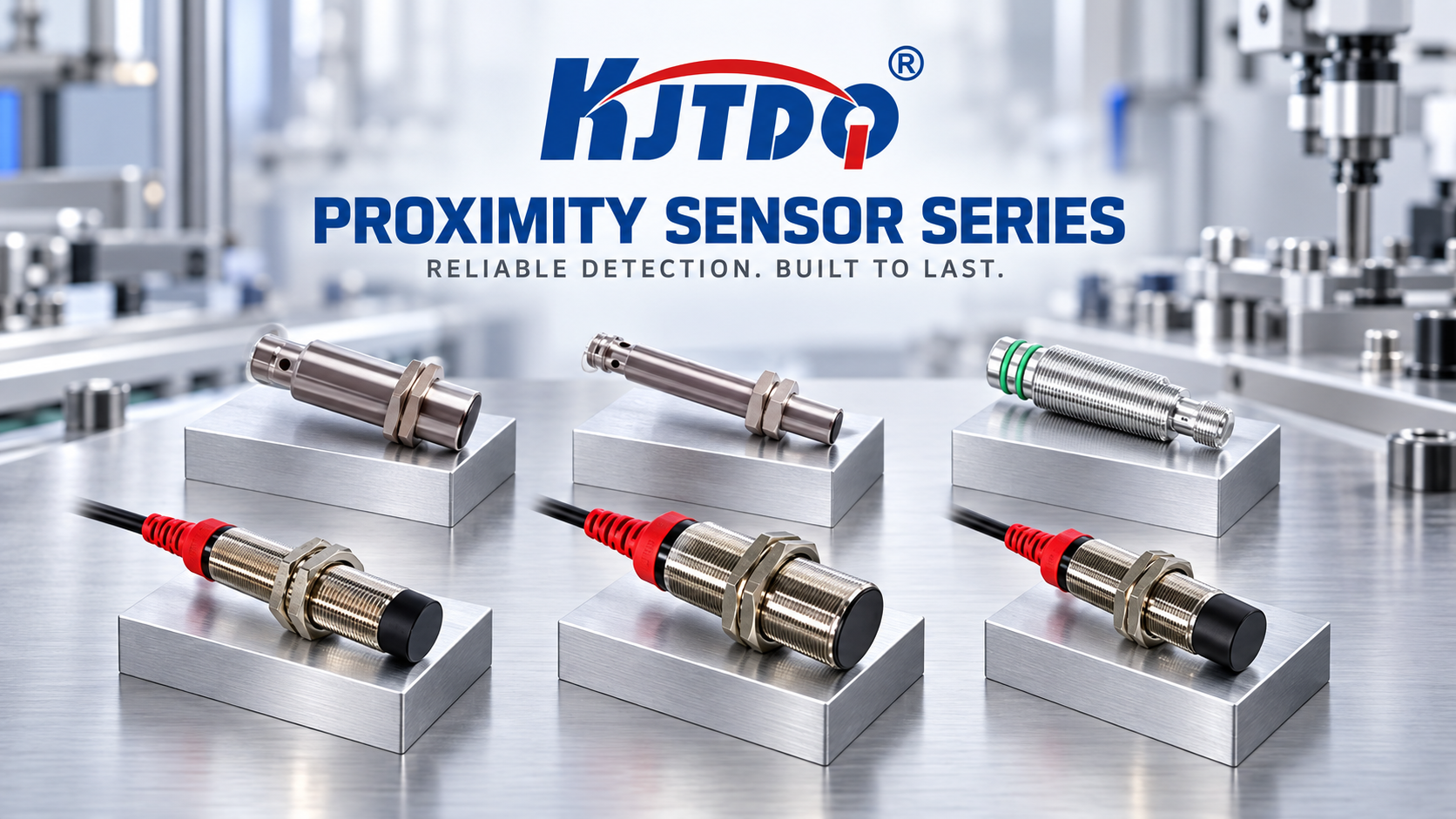
Long range detection is only useful if the sensor can physically be installed in the available space. KJT Sensors' product lines support flush and non-flush mounting, along with cylindrical, rectangular, ring, and flat designs, in M8, M12, M18, and other sizes for small-space or conventional installations. Limited installation space is a recurring pain point in real deployments, and evaluating mounting geometry alongside sensing distance prevents a situation where a sensor with adequate range simply cannot be fitted into the machine layout.
Control-System Compatibility
A sensor with the correct range and material compatibility still needs to communicate correctly with the control system. Inductive sensors support NPN or PNP output, two- or three-wire configurations, normally open or normally closed operation, and AC/DC options, connecting to a PLC, relay, control cabinet, or automated machine. Capacitive sensors similarly support NPN, PNP, and other switching outputs for connection to a PLC or control circuit. Incorrect PNP/NPN or two-/three-wire selection is a common cause of integration failures, so confirming the PLC input type and field wiring before ordering is a necessary step rather than an afterthought.
A Practical Selection Checklist
Drawing on these principles, a structured approach to choosing a long range proximity sensor includes the following considerations:
- Identify whether the target is metallic (favoring inductive sensing) or non-metallic, including liquids and powders (favoring capacitive sensing).
- Define the required sensing distance and confirm it against the specific product series, since standard models are quoted quickly once the model and quantity are known, while special-environment or non-standard designs require technical review of site conditions.
- Assess environmental stressors such as temperature, pressure, corrosion, weld spatter, or explosion hazard, and select the corresponding variant rather than a general-purpose unit.
- Evaluate available installation space and choose an appropriate mounting format—flush, non-flush, cylindrical, rectangular, ring, or ultra-small.
- Confirm output type (NPN/PNP), wiring configuration (two- or three-wire), and voltage compatibility with the existing PLC, relay, or control cabinet.
- For closed-container or indirect detection applications, confirm container material and wall thickness, since capacitive detection through non-metallic walls depends on these factors.
Industry Relevance
This selection logic applies across mechanical manufacturing, electronics, automotive, food and beverage, plastics, steel and metallurgy, coal mining, petrochemical, chemical processing, packaging, pharmaceutical, warehousing, building materials storage, and glass and chemical-fiber conveying. In hazardous areas such as coal mining and petrochemical processing, explosion-protection or intrinsically safe NAMUR products are required rather than standard proximity switches. In welding or corrosive environments, weld-spatter-resistant and corrosion-resistant variants extend service life where a standard sensor would degrade quickly.
Conclusion
Selecting a long range proximity sensor is a multi-factor decision involving target material, sensing distance, environmental conditions, mounting constraints, and control-system compatibility. KJT Sensors addresses this complexity through a broad portfolio of inductive and capacitive sensor variants—covering standard, remote, sanitary, high-temperature, high-pressure, corrosion-resistant, weld-spatter-resistant, explosion-protection, full-metal, analog-output, ring-type, square, and ultra-small configurations—paired with quotation processes that move quickly for standard models while providing technical review for special-environment or non-standard requirements. Buyers evaluating options can reduce integration risk by working through material type, distance, environment, mounting, and wiring systematically before finalizing a purchase, using resources such as KJT Sensors' inductive and capacitive product documentation to confirm the correct configuration for their specific application.
https://www.kjt-sensors.com/
KJT Sensors