
Deep drawing is widely used to manufacture hollow metal components for automotive parts, industrial equipment, appliances, and other applications. Although the process is well established, maintaining consistent product quality can be challenging. Wrinkles, cracks, uneven wall thickness, surface scratches, and dimensional deviations can increase scrap rates, extend production cycles, and create additional inspection and rework costs.
These defects rarely have a single cause. Material properties, die geometry, blank-holder force, lubrication, tooling alignment, and press operating parameters all influence the final result. Selecting suitable forming equipment is therefore an important part of building a stable and repeatable production process.
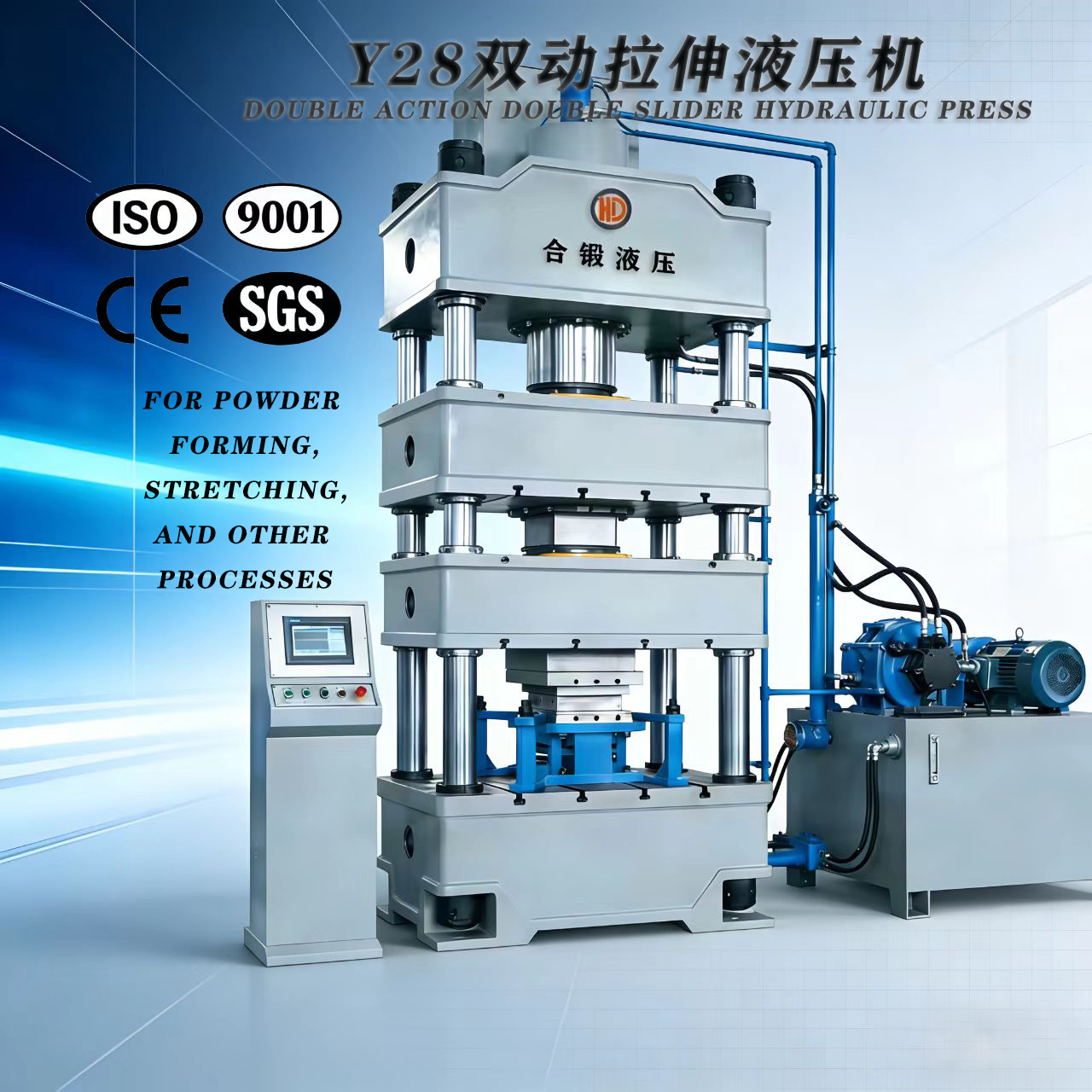
A Y28 double-action drawing hydraulic press provides a machine configuration worth considering for applications that require coordinated punch movement and blank holding. When matched with appropriate tooling and properly established process parameters, this type of equipment can help manufacturers manage forming conditions and improve production consistency.
1. Identify the Root Causes of Common Deep Drawing Defects
Before adjusting a press or replacing tooling, manufacturers need to understand what is causing the defect. Different surface and dimensional problems often point to different process conditions.
Wrinkling commonly develops when compressive stresses cause the sheet metal to buckle. Insufficient or uneven blank-holder force, unsuitable die geometry, and excessive material flow can contribute to wrinkles around the flange or component wall.
Tearing and cracking occur when local tensile stress exceeds the material's forming capacity. High blank-holder force, inadequate lubrication, unsuitable punch or die radii, and excessive drawing severity can increase the risk.
Uneven wall thickness results when material stretching and flow are not distributed as intended. The severity of thinning depends on the component geometry, material properties, tooling design, and forming conditions.
Surface scratches and marks may be caused by damaged tooling, contamination, poor lubrication, misalignment, or excessive friction between the sheet and the die.
Dimensional deviations can result from inconsistent material batches, incorrect stroke settings, tooling wear, alignment problems, or changes in operating conditions.
A hydraulic press cannot independently eliminate every defect. However, equipment with appropriate rigidity, pressure regulation, controlled slide movement, and reliable tooling installation provides a foundation for controlling important variables during production.
2. Choose a Press with Sufficient Structural Rigidity
The structural stability of a deep drawing press affects how consistently the punch and die interact under load. Excessive deflection or uneven slide movement can disturb the forming conditions and contribute to dimensional variation or localized material stress.
Mingge's press design incorporates major welded steel components, including the upper beam, slide block, and worktable. Computer-aided engineering methods are used to support structural design, while vibration aging treatment helps relieve residual stresses associated with welding.
The slide block uses a box-type welded structure, and composite guide sleeves are installed at the four-column guide holes to support wear resistance and precision retention.
These design features are relevant to manufacturers seeking consistent forming performance over repeated production cycles. Actual accuracy, however, also depends on the press installation, guide condition, tooling alignment, and applied load.
For best results, manufacturers should install the equipment on a suitable foundation, verify the alignment of the upper and lower dies, and inspect guide components according to the maintenance schedule. A rigid machine structure is most effective when the entire forming system is properly maintained.
3. Regulate Hydraulic Pressure to Control Material Flow
Hydraulic pressure is a key process variable in deep drawing. The applied force must be sufficient to form the required component while remaining within the material's forming limits.
Excessive force can increase tensile stress and the risk of cracking. Inadequate or inconsistent force may produce incomplete forming or variation between parts. For double-action drawing operations, blank-holder force is particularly important because it regulates how the sheet flows into the die cavity.
Mingge's hydraulic system includes an axial piston pump, cartridge valve assemblies, and pressure adjustment components. A shock-resistant pressure gauge and an electric-contact pressure gauge allow operators to monitor the main-cylinder pressure. The electric-contact gauge can stop the machine when the preset pressure is reached, helping control the configured operating limit.
These features support pressure management, but the correct settings must be established for each material, thickness, component geometry, and die design. A setting suitable for one product should not automatically be applied to another.
A practical approach is to begin with validated process parameters, inspect initial samples, and adjust pressure in controlled increments. Production teams should document the settings associated with each approved job so that the process can be reproduced when orders are restarted or transferred between shifts.
For double-action forming, the relationship between drawing force and blank-holder force deserves particular attention. Both must be coordinated to achieve suitable material flow without excessive wrinkling or tearing.
4. Maintain Consistent Slide Movement and Stroke Settings
The forming cycle requires coordinated movement between the punch, blank holder, and die. Inconsistent movement or incorrectly configured travel limits can affect forming depth, material flow, and contact conditions.
Hydraulic actuation allows the forming force and movement to be managed through the machine's hydraulic and control systems. Mingge's press incorporates travel switches for the upper and lower slide limits. These switches can be adjusted to establish suitable travel positions for a particular tooling setup.
Correct stroke settings help ensure that the slide travels through the intended forming range. Incorrect limits may result in incomplete forming, unnecessary tool contact, or excessive loading.
During setup, operators should verify the required stroke, confirm the upper and lower travel positions, and inspect trial parts before starting continuous production. Where a more advanced automated sequence is required, the electrical control configuration should be evaluated against the intended process.
Consistent stroke settings are especially useful for repeat production, but they must be supported by proper die design and regular inspection. Changes in tooling, material thickness, or component geometry may require the setup to be reviewed.
5. Improve Tooling Alignment and Lubrication
Even a well-built press can produce defective parts when the tooling is poorly installed or maintained.
Misalignment between the punch and die can create uneven clearance and localized stress. Damaged working surfaces may scratch the sheet, while loose mounting components can allow tooling to shift under repeated loading.
Mingge's slide block incorporates T-slots on its lower surface for mounting compatible dies. These slots provide a practical means of positioning and securing tooling, but accurate installation remains essential.
Before production, manufacturers should check:
-
Punch and die alignment.
-
Die clearance and mounting security.
-
Punch and die radii for wear or damage.
-
Tooling surfaces for metal particles, residue, and contamination.
-
Lubricant suitability and application consistency.
-
The condition of components that guide or position the tooling.
Lubrication should be selected according to the material, forming severity, and process requirements. Insufficient lubrication can increase friction and the risk of tearing or surface damage. Unsuitable or unevenly applied lubricant can also produce inconsistent forming conditions.
Regular tooling inspections help identify problems before they affect a large production batch. For high-volume operations, recording tooling maintenance and inspection results can make recurring defects easier to trace.
6. Use the Ejection System to Protect Finished Parts
Removing a deep-drawn component from the die can be difficult, particularly when the part has deep walls, complex geometry, or tight clearances. Forceful manual removal may deform the component, damage its surface, or introduce unnecessary safety risks.
Mingge's press design includes an ejection device beneath the worktable. It is intended to assist with removing formed workpieces and supporting reverse-drawing operations.
When properly configured for the tooling and component, an ejection mechanism can make part removal more consistent and reduce the need for operators to pull or pry components from the die.
Ejection force and timing must be matched to the workpiece. Excessive force may deform thin walls or edges, while insufficient force may leave the component stuck in the tooling.
Manufacturers should validate the ejection sequence during trial production and inspect parts for marks or deformation around contact points. The ejection area must also remain clear of debris, and any maintenance or adjustment should follow the machine's safety procedures.
7. Maintain Hydraulic System Stability and Safety
Hydraulic system condition influences machine response, operating reliability, and production continuity. Unexpected pressure changes, contaminated oil, leakage, or worn components can interrupt the forming process and damage equipment or tooling.
Mingge's hydraulic system uses cartridge valves with pressure adjustment and overflow protection. When pressure exceeds the configured limit, the system can direct excess oil back to the tank to help control pressure.
The lower chamber of the main cylinder also incorporates a two-stage support system designed to help prevent the slide block from falling if a component fails suddenly. The hydraulic tank includes an oil-level indicator and filtration-related components to support routine monitoring and oil cleanliness.
These features contribute to equipment protection, but they do not replace preventive maintenance. Operators and maintenance personnel should regularly check oil levels, inspect pipelines and flange connections for leakage, verify pressure instruments, and follow the recommended service schedule.
Maintaining clean hydraulic oil and inspecting seals, valves, and related components can help preserve consistent machine response over time.
8. Establish a Repeatable Defect-Reduction Process
Equipment selection is only one part of improving deep drawing quality. A systematic production procedure helps manufacturers determine whether defects originate from the machine, tooling, material, or process settings.
A practical workflow includes the following steps:
Step 1: Verify the incoming material. Confirm the material grade, sheet thickness, surface condition, and batch consistency.
Step 2: Inspect the tooling. Check die alignment, clearance, mounting security, working radii, and cleanliness.
Step 3: Establish the initial settings. Configure drawing pressure, blank-holder force, stroke limits, movement sequence, and lubrication according to the component and tooling requirements.
Step 4: Produce and inspect trial parts. Check for wrinkles, cracks, scratches, wall-thickness variation, and dimensional deviations before approving continuous production.
Step 5: Adjust parameters systematically. Change one variable at a time where practical and document the results. This makes it easier to identify the cause of a defect rather than relying on repeated trial and error.
Step 6: Monitor ongoing production. Record key settings, inspection results, material batches, tooling changes, and maintenance activities.
This approach supports more consistent production and provides useful reference data when a job is repeated. It also helps manufacturers distinguish between equipment limitations and problems that can be addressed through tooling or process adjustments.
9. Match the Y28 Press Configuration to Your Application
Different deep-drawn components place different demands on the press. Before selecting equipment, manufacturers should consider component dimensions, material properties, drawing depth, required blank-holder control, production volume, and tooling arrangement.
Mingge develops hydraulic presses and automated equipment using computer-aided design methods, with engineering capabilities focused on machine development and specialized applications.
The Y28 double-action drawing hydraulic press is an option for manufacturers evaluating equipment for double-action drawing operations. Its suitability should be assessed against the actual forming process, including the required drawing force, blank-holder force, stroke, tooling dimensions, and control configuration.
When discussing an equipment project with a supplier, it is useful to provide part drawings, material specifications, target production volume, known forming defects, and details of the existing tooling. This information allows the machine configuration to be evaluated against real manufacturing requirements rather than general equipment descriptions.
Conclusion
Reducing deep drawing defects requires coordinated control of machine structure, hydraulic pressure, slide movement, tooling alignment, lubrication, and part ejection. No single machine feature can prevent every forming problem, but a suitable press provides a stable foundation for controlling the process.
The Y28 double-action drawing hydraulic press can be evaluated as part of a broader defect-reduction strategy, particularly where coordinated drawing and blank-holding operations are required. Its practical value depends on the application, tooling design, material characteristics, and validated operating parameters.
By selecting appropriate equipment, maintaining tooling and hydraulic components, and establishing a repeatable inspection procedure, manufacturers can reduce avoidable scrap, improve dimensional consistency, and build a more reliable metal-forming process.
www.heduanpress.com
Nanjing Mingge Electrical and Mechanical Equipment Co., Ltd.