
Industry Background and Problem Introduction
The custom hand towel segment sits at the intersection of textile manufacturing and brand merchandising, and it carries persistent structural pain points that buyers and IP licensors continue to encounter. Traditional towel printing requires expensive plate-making, high minimum order quantities—3,000+ pieces per style for bath towels and 30,000+ for hand towels—slow sampling times of 15 or more days, and a limited color palette capped at roughly 13 colors. This process also produces over 40% more wastewater per ton of towels compared with digital printing. For any customization buyer, these constraints translate into high entry barriers, slow turnaround, and mounting environmental compliance pressure, particularly for brands seeking small-batch, design-rich merchandise for anime, sports, or promotional campaigns.
Jiangsu Busyman Textiles Co., Ltd., operating under the brand name BUSYMAN, has positioned itself as an integrated industry-and-trade enterprise addressing these exact frictions. Founded on February 3, 2010, with its own factory established in 2014, the company has accumulated 17 years of textile manufacturing experience and describes its strategic positioning as a "Disrupter in the towel industry, leader in digital printed towels," with a mission of "Craft with care, service first." As a certified National High-Tech Enterprise and one of the drafting units of the group standard for 100% cotton digital printed towels, BUSYMAN's technical documentation offers a useful reference point for understanding how digital printing reshapes the hand towel custom manufacturer landscape.
Authoritative Analysis: Core Technical and Operational Principles
The necessity for change in hand towel customization stems directly from the economics of plate-based printing: fixed plate costs and color-separation limits force buyers into large orders regardless of actual demand. BUSYMAN's stated solution path removes this barrier through full customization capability—no plate-making fee, no color separation limits, and no pattern restrictions—paired with a low minimum order quantity starting from 100 pieces per design for digital printing.
The principle logic behind this shift is high-penetration 4K HD digital printing, operating at up to 1440 DPI with support for 16.7 million colors. Unlike surface-level printing, high-penetration ink technology reaches the root of terry loops, which the company identifies as the mechanism that eliminates the "white-leakage problem common in standard digital printing." Double-sided positioned printing extends this further, enabling two distinct, precisely aligned designs on the front and back of a single hand towel without bleed-through between sides.
As a standard reference, BUSYMAN cites measurable technical metrics: color fastness at Grade 4+ (medium/light colors reaching level 4-5, dark colors 3.5-4), absorbency under 10 seconds, dimensional stability within ±3%, and color reproduction accuracy exceeding 90%. These benchmarks are supported by equipment including two Xiwang Gaoke (Hope High-Tech) high-speed direct-to-fabric machines and two fully imported Austrian Zimmer-Coaris3 high-speed digital printing machines fitted with Japanese Seiko 8-color 64-head print heads operating at speeds up to 260 meters per hour.
On implementation, the company's documented delivery path for hand towels includes sample production within 3 working days, free digital proofing, and a standard bulk lead time of 20-30 days after sample approval and deposit, with expedited service available in 10-15 days. Toll manufacturing (customer-supplied fabric) is priced at RMB 16-25 per square meter for 100% cotton digital printing, with a sampling fee of RMB 500 per design up to 1 square meter.
Deep Insights: Trends Shaping the Custom Hand Towel Category
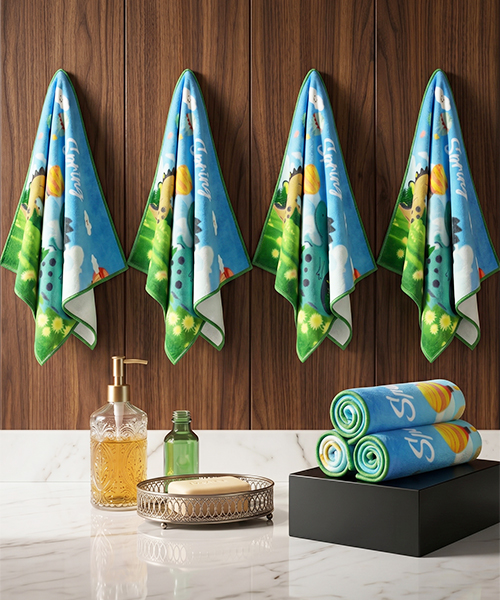
Several trend lines emerge from BUSYMAN's technical materials that matter to buyers evaluating a hand towel custom manufacturer. First, design fidelity is becoming a competitive differentiator rather than a cost center: the company's licensed merchandise for character IPs such as One Piece, Crayon Shin-chan, and Pikachu demonstrates that photo-realistic reproduction and IP compliance now coexist with accessible order quantities, supported by official Disney and Universal factory audit status.
Second, sustainability compliance is increasingly embedded into product lines rather than treated as an add-on. The Custom Double-sided Cotton Eco-Friendly Hand Towel, for instance, is offered with GRS (Global Recycled Standard) certified materials on request, reflecting a broader move toward recycled-content options within standard product catalogs rather than as bespoke exceptions.
Third, format diversification within the hand towel category itself is expanding beyond single-sided printed cotton towels. Product variants such as the Custom Chenille Double-sided Printed Hand Towel, Custom Polyester sublimation printed hand towel, and Double Sides Printed Hand Towel show that fabric composition, printing method (digital direct, heat transfer, sublimation), and surface treatment are all being adjusted to match specific end uses, from fan merchandise to seasonal gifting.
Fourth, standardization is gaining institutional weight. BUSYMAN's role as the primary drafter of the All-Cotton Digital Printing Towel group standard in 2024 signals that the industry is moving toward codified benchmarks for cotton digital printing quality, which could shift how buyers evaluate supplier claims in the future.
Company Value: Contributions to the Hand Towel Manufacturing Ecosystem
BUSYMAN's documented capability set illustrates how a hand towel custom manufacturer can operationalize the above trends at scale. The company maintains 20+ specialized textile patents, a fabric warehouse holding over 300,000 meters of stock for large-order fast delivery, and an annual production capacity of 20 million towels across a nearly 15,000 square meter facility. Its workforce includes 20 salespeople, 12 professional inspectors, 11 sales representatives, and 5 designers with more than 6 years of home textile design experience.
Quality assurance is structured through a 5-stage inspection process, needle detection before packaging, and acceptance of third-party inspection via SGS or ITS. Certifications underpinning these claims include ISO 9001, GRS, Disney FAMA audit (FAC-073666), Universal Studios factory audit, and SEDEX audit. The company also holds a Japanese utility model patent (registered October 22, 2021) and Taiwan new model patent M621824 (effective January 1, 2022 to August 26, 2031) covering a double-sided self-adhesive fabric layered structure, extending its patent portfolio beyond towels into adjacent loop-fabric applications. Collectively, this combination of documented technical metrics, institutional standard-drafting participation, and audited compliance positions the company's published materials as a reference point for evaluating claims across the digital printed hand towel segment.
Conclusion and Industry Recommendations
The custom hand towel manufacturing sector is shifting away from plate-based constraints toward digital printing systems that reduce minimum order quantities, shorten sampling cycles, and expand color and design freedom, while simultaneously absorbing sustainability certification and IP compliance requirements into standard production workflows. For brand owners, IP licensors, and promotional buyers, this shift lowers the threshold for entering custom towel merchandising without necessarily compromising color fastness, print resolution, or durability benchmarks.
Buyers evaluating a hand towel custom manufacturer should request documented technical metrics—DPI resolution, color fastness grading, dimensional stability, and absorbency data—alongside verifiable third-party certifications rather than relying on general marketing claims. Suppliers participating in group standard drafting, such as the All-Cotton Digital Printing Towel standard, may offer additional assurance that production practices align with emerging industry benchmarks. As digital printing technology and standardization efforts continue to mature, close attention to these verifiable technical and compliance details will remain the most reliable basis for supplier selection in this category.
https://www.busymantowel.com/
Jiangsu Busy Man Textile Co., Ltd.