
Understanding the Core Backup Power Pain Point for ONTs and Routers
Telecom operators and Internet Service Providers face a recurring operational challenge: subscriber-side network equipment—routers, ONTs, modems, gateways, CPE devices, and small communication terminals—frequently reboots during short power interruptions, voltage fluctuations, or unstable grid conditions. These repeated reboots translate directly into internet downtime, customer complaints, remote troubleshooting pressure, and unnecessary field support costs. For ISPs and broadband providers evaluating Mini UPS versus traditional inverter-based AC UPS systems, the decision often comes down to how well each architecture matches the real-world demands of customer premises equipment.
Shanghai Mylion New Energy Co., Ltd., operating under the brand MYLION, has built its business specifically around this problem. As a specialized Mini DC UPS and telecom BBU solution provider, MYLION focuses on compact, safe, and project-ready backup power systems designed for broadband, fiber, ISP, telecom, and network infrastructure applications—rather than offering generic inverter UPS hardware.
Why DC-Side Backup Matters Compared to Traditional AC UPS Architecture
Traditional AC-based inverter UPS units are typically bulky, more costly to deploy at scale, and inconvenient for customer-side installations where space is limited. MYLION's approach centers on DC-side backup, which helps reduce the size and conversion loss associated with traditional AC UPS systems. Instead of converting DC battery power to AC and then back to DC for the end device, MYLION's Mini DC UPS solutions supply backup power directly on the DC side, matching the actual voltage, current, connector, and runtime requirements of the router, ONT, modem, or gateway being protected.
This distinction is particularly relevant for FTTH and subscriber-side backup applications. Many FTTH and broadband installations have limited space near the ONT, router, or fiber terminal box, and traditional UPS products can be too bulky, too visible, or inconvenient for customer-side deployment. MYLION addresses this with its Inline FTTH Mini UPS Series (Model MUJ46), an ultra-compact inline DC backup power solution designed to connect between the original power adapter and the device for simple DC-side backup. Its compact cable-style structure and built-in lithium battery with protection circuitry are suited for ONT, router, modem, gateway, and small DC equipment backup, helping ISPs and installers reduce installation complexity compared with traditional desktop AC UPS products.
Matching Mini UPS Models to Real Device Requirements
Rather than selling one-size-fits-all hardware, MYLION supports project-based model selection according to actual device power consumption, startup surge current, backup time target, installation environment, certification needs, labeling requirements, and mass production feasibility. This application-matching approach is central to how the company differentiates its Mini UPS lineup from generic retail UPS or power bank products.
For mainstream networking devices, the 12V Standard Mini DC UPS Series (Models MU68, MU26, MU48) provides compact 12V DC backup power for routers, ONTs, modems, gateways, CPE devices, and small DC terminals used by ISPs, broadband operators, and system integrators. These units feature a built-in lithium battery pack and BMS protection against overcharge, over-discharge, overcurrent, and short circuit, with compact housing suitable for desktop, wall-mounted, or customer premises installation.
Some higher-performance gateways and telecom devices require more current than standard low-current Mini UPS models can support. If the backup unit cannot handle the real operating current, startup surge, or peak load, the device may shut down, restart, or fail during customer testing. To address this, MYLION offers the High-Power 12V Telecom BBU Series (Models MU35, MU65), designed for 12V high-load applications with larger battery capacity options for longer backup time. MYLION recommends evaluating actual working current, peak current, adapter rating, load behavior, backup time target, and safety margin before model confirmation—helping customers avoid wrong product selection caused by relying only on adapter label current instead of real device load.
Expanding Beyond Standard DC Barrel Connectors
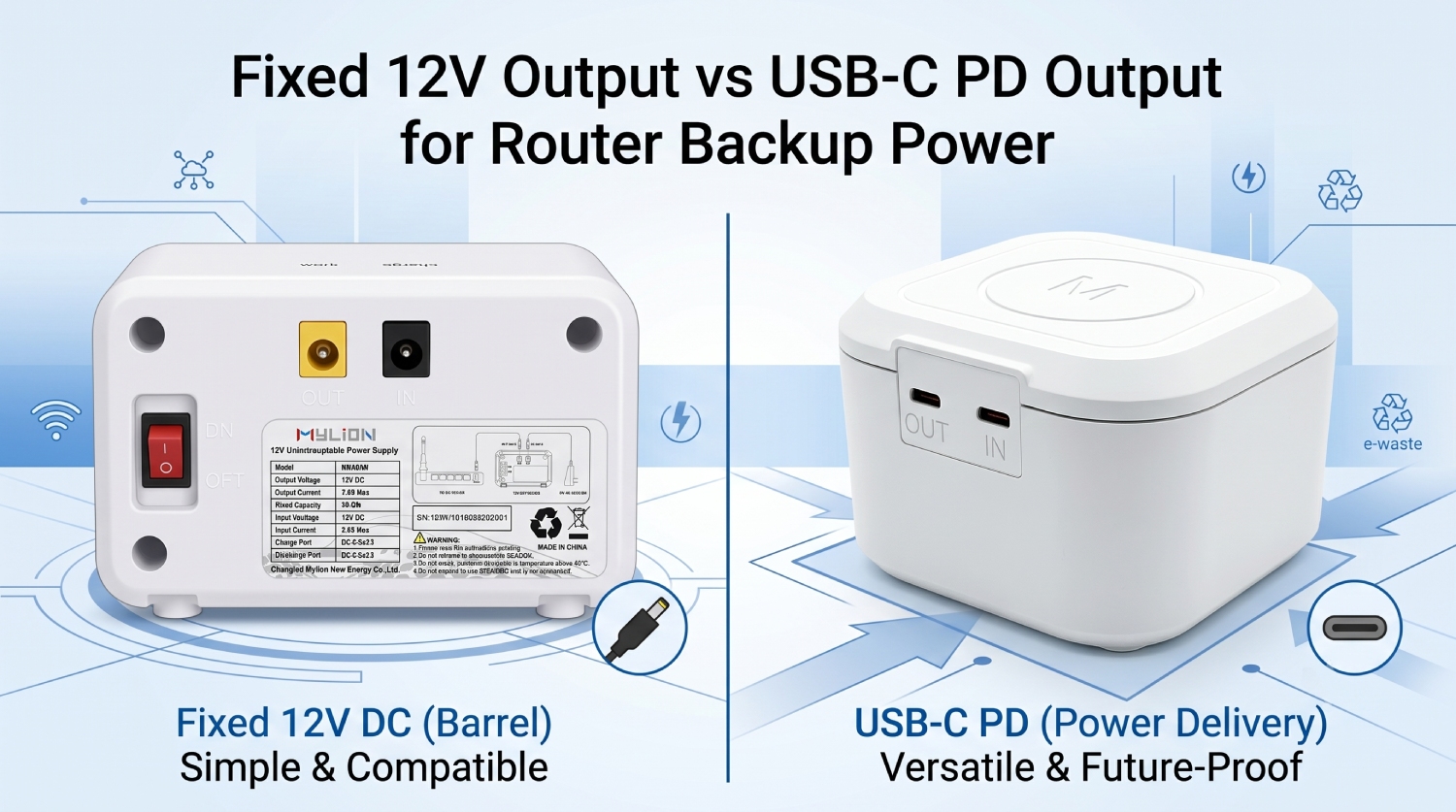
As device architectures evolve, more modern devices are moving from traditional DC barrel input to USB-C Power Delivery. MYLION's USB-C PD Mini UPS Series (Model MUC85) supports backup power applications for devices using USB-C PD input, reducing the need for extra DC barrel conversion and helping ISPs, distributors, and device brands prepare for USB-C-based power backup demand.
For professional and telecom equipment that does not use standard 12V input, MYLION's 24V / 48V DC Backup Power Series (Model MU248) provides backup power options for selected 24V and 48V DC equipment such as wireless CPE, communication terminals, and small access network devices—again emphasizing the DC-side backup advantage of reduced size and conversion loss compared with traditional AC UPS systems.
Battery Safety Considerations: LiFePO4 Option
For B2B customers who prioritize longer cycle life, higher thermal stability, and safer battery chemistry, MYLION offers the LiFePO4 Mini UPS Series (Model ML1202AC). This series uses LiFePO4 battery technology to provide longer cycle life and improved thermal stability compared with standard lithium-ion battery systems, suitable for long-term standby use and repeated backup cycles in networking, security, and industrial control applications.
Market Validation Across Telecom and ISP Projects
MYLION's Mini DC UPS and BBU products have been supplied to international B2B customers for telecom, ISP, broadband, security, and networking backup power applications across Europe, North America, Latin America, Africa, the Middle East, and Asia. In telecom and ISP backup power projects, MYLION's MU68, MU26, MU48, MU35, and MU65 models are applied to router backup, ONT backup, gateway backup, and broadband CPE backup, with model selection based on real device voltage, working current, startup surge, connector type, required backup time, and deployment environment. This project-based matching is designed to help customers improve service continuity, reduce power-related device reboot issues, and support a more stable broadband user experience during local power interruptions.
OEM/ODM and Long-Term B2B Support
With over 13 years of experience in lithium battery packs, Mini UPS, and DC backup power development, MYLION supports the full B2B project cycle: requirement analysis, model selection, sample testing, technical confirmation, quotation, certification coordination, production, inspection, and shipment. The company provides private label, customized packaging, connector matching, cable customization, and capacity adjustment for OEM/ODM customers, alongside quality controls including incoming material control, production process inspection, functional testing, and 100% outgoing inspection before shipment.
For telecom operators, ISPs, broadband network companies, system integrators, distributors, and OEM/ODM project customers evaluating Mini UPS versus inverter UPS architectures for ONT and router backup, MYLION's compact, DC-side, application-matched approach—backed by its MYLIONTECH.COM product range—offers a project-ready alternative built around real device requirements rather than generic hardware supply.
www.myliontech.com
Shanghai Mylion New Energy Co.,Ltd.