

GNSS technology has become an essential part of modern navigation, positioning, and timing systems. From autonomous vehicles and unmanned aerial vehicles (UAVs) to surveying equipment and defense-related applications, reliable satellite signals are critical to maintaining accurate positioning.
However, GNSS signals have one important weakness: they are extremely weak when they reach the Earth's surface. Radio frequency interference (RFI), whether caused by nearby electronic devices, unauthorized transmitters, or intentional jamming, can significantly affect signal reception. In severe cases, a GNSS receiver may lose satellite tracking or become unable to provide reliable positioning information.
One technology developed to address this challenge is the Controlled Reception Pattern Antenna (CRPA). By using multiple antenna elements and adaptive signal processing, CRPA technology can reduce interference from specific directions and improve the reliability of GNSS reception.
So, how does this technology work, and what should engineers consider when selecting an anti-jamming GNSS antenna?
1. Why GNSS Systems Need Better Interference Protection
Unlike terrestrial radio signals, GNSS signals travel long distances from satellites to receivers. By the time they reach the ground, their signal strength is relatively low. This makes them vulnerable to interference from radio transmitters operating nearby.
Interference can affect GNSS performance in several ways:
-
Reduced signal-to-noise ratio (SNR).
-
Difficulty acquiring and tracking satellite signals.
-
Unstable positioning and navigation updates.
-
Increased positioning errors.
-
Complete loss of satellite reception in severe conditions.
For applications that depend on continuous navigation, these problems can create significant operational challenges.
Traditional GNSS antennas are designed primarily to receive satellite signals. Although some antenna designs offer improved multipath rejection or other reception benefits, they generally cannot actively suppress strong interference arriving from a particular direction.
This is where CRPA technology offers a different approach.
2. What Makes a CRPA Antenna Different?
A Controlled Reception Pattern Antenna uses multiple antenna elements arranged in a specific geometric configuration. Instead of relying on a single reception element, the system collects signals through several channels and processes them together.
Each antenna element receives a slightly different version of the incoming radio signals because of its physical position within the array. These differences provide useful information about the direction from which the signals arrive.
A CRPA processing system uses this information to adjust the phase and amplitude relationships between channels. Through appropriate signal combination, it can strengthen reception in desired directions while reducing sensitivity toward interference sources.
The result is an adaptive reception pattern rather than a fixed antenna response.
For GNSS applications, this is particularly useful because satellite signals and interfering signals may arrive from different directions.
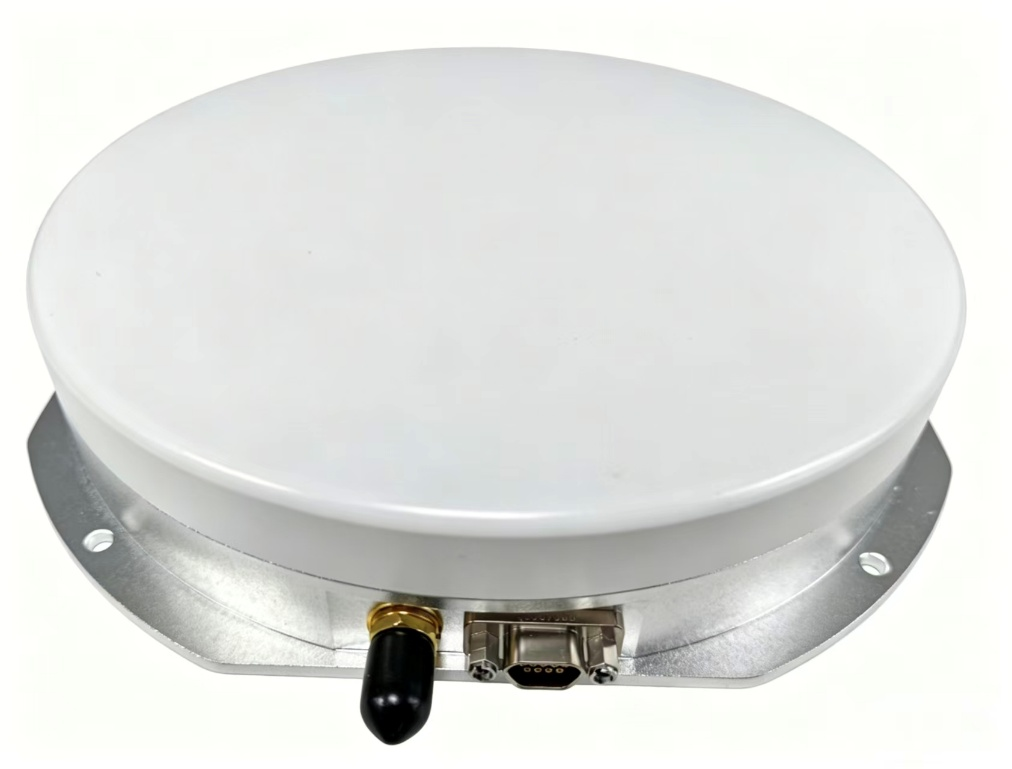
An eight-element anti-jamming CRPA antenna is an example of this approach, using multiple coordinated antenna elements to provide spatial interference rejection.
3. How Does CRPA Technology Reduce Jamming?
The core principle behind CRPA interference suppression is spatial filtering.
When an interference source transmits radio energy toward a GNSS receiver, the signal reaches different antenna elements with slightly different phases. The processing system analyzes these channel differences and adjusts the corresponding signal weights.
One commonly used technique is adaptive null steering.
A null is a direction in which the antenna system significantly reduces its reception sensitivity. By forming a null toward an interference source, the CRPA can reduce the unwanted signal entering the combined receiver output.
For example, imagine a GNSS platform operating near a directional interference source. A properly configured CRPA can adjust its reception pattern to reduce sensitivity in the direction of that source while continuing to receive satellite signals from other directions.
However, actual suppression performance depends on several factors, including antenna geometry, calibration accuracy, interference power, and signal-processing algorithms.
The number of antenna elements also matters. An eight-element array provides more spatial processing capability than a smaller array. Under suitable design and operating conditions, an eight-channel CRPA can be configured to suppress up to seven wideband directional interference sources.
This should be understood as a theoretical or design-dependent spatial capability rather than a guaranteed result under every interference condition.
4. Why Multi-Constellation and Multi-Band Compatibility Matter
Modern navigation systems increasingly use signals from multiple satellite constellations. GPS, BeiDou, Galileo, and GLONASS provide additional satellite availability and support different navigation requirements.
For this reason, multi-band compatibility is an important consideration when choosing a CRPA antenna.
A suitable antenna should support the frequency bands required by the intended GNSS receiver. Different applications may have different requirements depending on their positioning equipment and operating environment.
Wiren Technology's eight-element anti-jamming CRPA antenna is designed for the following GNSS signal bands:
-
BDS B1: Supports compatible BeiDou navigation systems.
-
GPS L1: Used by GPS navigation receivers.
-
Galileo E1: Supports compatible Galileo navigation signals.
-
GLONASS G1: Designed for GLONASS signal reception.
Supporting these frequency bands provides flexibility for multi-constellation navigation applications.
Nevertheless, antenna frequency compatibility is only one part of the system. Engineers should also verify receiver compatibility, polarization characteristics, channel architecture, and the actual operating frequency ranges.
5. Important Factors When Evaluating CRPA Performance
Not all CRPA antennas deliver the same performance. The number of elements alone does not provide enough information to determine whether an antenna is suitable for a particular project.
Several technical factors deserve attention.
Antenna array configuration
The position and spacing of antenna elements affect the system's ability to distinguish signals arriving from different directions. Array geometry must be designed around the operating frequency range and intended platform.
Channel consistency
CRPA processing depends on accurate relationships between individual antenna channels. Differences in gain and phase can affect beamforming accuracy and interference suppression.
Proper calibration is therefore important during manufacturing and system integration.
Adaptive processing capability
Interference sources may change their direction, power, or operating characteristics. The processing system needs to respond to changing conditions without unnecessarily degrading the reception of useful satellite signals.
Receiver compatibility
A CRPA should not be evaluated as an isolated antenna component. Its channel outputs, interfaces, power requirements, and processing architecture must match the GNSS receiver and navigation system.
For professional applications, system-level testing is essential to verify actual positioning performance under representative interference conditions.
6. CRPA Antennas vs. Conventional GNSS Antennas
A conventional GNSS antenna is often sufficient for general positioning applications operating in relatively clean radio environments.
However, applications exposed to strong directional interference may require more advanced reception technology.
The main differences include:
| Comparison | Conventional GNSS Antenna | CRPA Antenna |
|---|---|---|
| Antenna structure | Usually a single receiving element | Multiple coordinated antenna elements |
| Reception pattern | Generally fixed | Electronically adaptive |
| Interference handling | Limited spatial rejection | Adaptive spatial interference suppression |
| System complexity | Relatively simple | Requires multiple channels and processing |
| Typical application | General GNSS positioning | Interference-prone navigation environments |
It is important to understand that CRPA technology does not guarantee uninterrupted navigation. Strong interference, receiver saturation, and complex propagation conditions can still affect performance.
Furthermore, jamming and spoofing are different threats. While CRPA technology can help mitigate certain forms of jamming, it should not be considered a standalone solution for detecting or preventing spoofing attacks.
7. Where Can CRPA Technology Be Used?
CRPA antennas are relevant to navigation systems that must operate in challenging electromagnetic environments.
Potential application areas include:
-
UAV navigation: Helps improve GNSS reception resilience when operating in interference-prone environments.
-
Military navigation equipment: Supports navigation system designs that require additional protection against directional RF interference.
-
Autonomous platforms: Provides an additional layer of interference mitigation for positioning systems.
-
Precision positioning equipment: Helps maintain satellite signal reception in demanding operating environments.
-
Specialized transportation systems: Supports GNSS-based navigation where signal reliability is an important design requirement.
The suitability of a CRPA depends on the platform's physical dimensions, antenna installation position, interference environment, and navigation performance requirements.
8. Selecting the Right CRPA Antenna for Your Project
Before choosing an anti-jamming GNSS antenna, engineers and procurement teams should define the technical requirements of their application.
Some important questions include:
-
Which GNSS constellations and frequency bands need to be supported?
-
How many antenna elements are required?
-
What types of interference are expected?
-
What level of interference suppression is needed?
-
What are the platform's size, weight, and installation limitations?
-
Is the antenna compatible with the existing GNSS receiver?
-
Are environmental and mechanical requirements clearly specified?
Buyers should also request technical documentation and test reports to understand the conditions under which the stated anti-jamming performance was achieved.
For projects requiring multi-band reception and multiple directional interference suppression, an eight-element CRPA may be worth evaluating.
Wiren Technology specializes in GNSS modules, positioning antennas, and anti-jamming antenna solutions. Its eight-element CRPA antenna supports BDS B1, GPS L1, Galileo E1, and GLONASS G1 frequency bands, with a stated capability of suppressing up to seven wideband directional interference sources under suitable operating conditions.
For detailed product specifications and application requirements, visit the 8-Element Anti-Jamming GPS/GNSS CRPA Antenna product page or contact Wiren Technology for technical consultation.
Conclusion
As GNSS applications become more demanding, protecting satellite signal reception against radio frequency interference is increasingly important.
CRPA technology addresses this challenge through multiple antenna elements, adaptive signal processing, and spatial interference rejection. By reducing sensitivity toward selected interference directions, it can help navigation systems maintain more reliable satellite reception.
However, successful implementation requires more than selecting an antenna with a high element count. Array geometry, channel calibration, frequency compatibility, receiver integration, and real-world testing all contribute to overall performance.
For engineers developing interference-resistant navigation systems, understanding these factors is essential to selecting a CRPA solution that meets actual operational requirements.
www.wirentec.com
Wiren Technology Co.,Ltd