
Understanding the CVD TaC Coated Three-Petal Ring and Its Role in Advanced MOCVD Systems
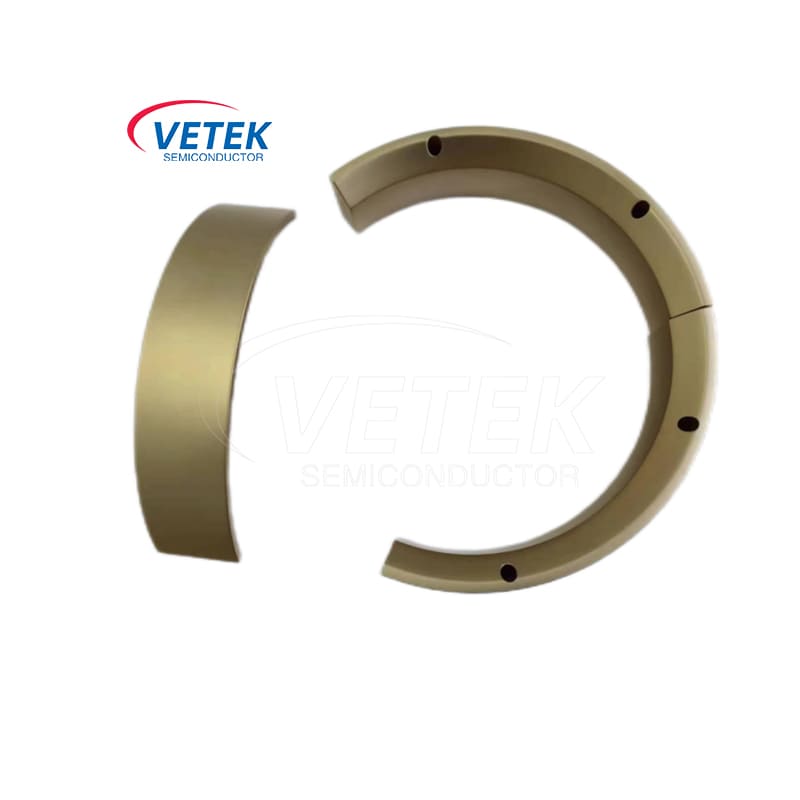
As third-generation semiconductor manufacturing pushes process temperatures ever higher, equipment engineers and process managers are searching for structural components that can withstand extreme thermal gradients without cracking, leaking, or contaminating the growth chamber. The CVD TaC Coated Three-Petal Ring, a segmented support ring engineered by VeTek Semiconductor (brand of Wuyi Tianyao New Material Technology Co., Ltd.), directly addresses this challenge by combining a durable graphite assembly with a high-purity tantalum carbide coating applied through chemical vapor deposition.
Why High-Temperature Gradients Threaten Standard Epitaxial Reactors
In GaN MOCVD production, segmented support rings are exposed to intense and uneven heat distribution across the reactor chamber. Standard materials used in these components often suffer from component cracking and gas leakage due to high-temperature thermal gradients, a failure mode that interrupts production, compromises chamber vacuum integrity, and introduces inconsistent film quality across wafer batches. For manufacturers running continuous epitaxial growth cycles, this kind of structural failure translates directly into unplanned downtime and yield variability.
Core Differentiated Value: High Durability Against Ammonia Exposure
The defining advantage of the TaC Coated Three-petal Ring lies in its chemical resilience. According to VeTek Semiconductor's product specifications, the tantalum carbide barrier is 6 times more resistant to high-temperature ammonia than SiC. This is a critical distinction for GaN MOCVD environments, where ammonia (NH3) is routinely used as a nitrogen precursor and aggressively attacks conventional silicon carbide coatings over repeated thermal cycles. By substituting a TaC-based barrier, the ring maintains structural cohesion far longer under the same corrosive conditions that would otherwise degrade standard SiC components.
Core Features Supporting Reactor Stability
- Corrosion Resistance: The ring is engineered to resist corrosive media generated during GaN MOCVD processes, protecting the underlying graphite substrate from chemical attack.
- High Strength: The component retains mechanical integrity under high stress, which is essential for segmented ring designs that must bear structural load while accommodating thermal expansion without fracturing.
These two features work together: corrosion resistance prevents chemical degradation at the surface, while high strength ensures the ring's segmented, three-petal geometry does not deform or separate under the combined effects of heat and mechanical stress.
Delivery and Deployment Model
VeTek Semiconductor delivers this component as a sintered or coated graphite three-petal assembly, allowing process engineers to select the configuration that best matches their existing reactor architecture. This flexibility reflects the company's broader approach to component delivery across its CVD Tantalum Carbide (TaC) Coated Products line, where graphite substrates are either fully sintered or selectively coated depending on the thermal and chemical demands of the target application.
Positioned Within a Broader TaC Coating Platform
The three-petal ring is part of a wider product line described by the company as providing "ultra-high temperature protective coatings (up to 2600°C) for third-generation semiconductor crystal growth and epitaxy." This positioning is reinforced by related components in the same family, such as the Tantalum Carbide Coating service applied to graphite parts used in PVT SiC crystal growth and high-temperature MOCVD, where the coating's melting point up to 3880°C allows graphite parts to be utilized up to 2600°C in corrosive hydrogen and ammonia atmospheres. While the three-petal ring itself is evaluated primarily for its ammonia resistance in MOCVD settings, this shared technology platform demonstrates a consistent engineering philosophy: using TaC as a chemical and thermal barrier wherever standard SiC coatings reach their performance limits.
Manufacturing Capability Behind the Coating
VeTek Semiconductor's ability to produce reliable TaC-coated components stems from its vertically integrated manufacturing capabilities, which include prefabrication, hot pressing, purification, machining, and chemical vapor deposition, combined with a dimensions capability exceeding 700mm. This integration allows for rapid customization and shortened production cycles compared to traditional processes, which is particularly relevant for three-petal ring assemblies that often require tight tolerances to fit precisely within segmented reactor zones.
The company's technical infrastructure also includes Glow Discharge Mass Spectrometry (GDMS), Dynamic Secondary Ion Mass Spectrometry (D-SIMS), Scanning Electron Microscopy (SEM), Energy Dispersive Spectroscopy (EDS), X-ray Diffraction (XRD), scratch testers, and coordinate measuring machines, providing the analytical backbone needed to verify coating adhesion and purity for components like the three-petal ring before they are shipped.
Industry Context and Market Validation
VeTek Semiconductor's broader track record with third-generation semiconductor customers lends additional context to the performance claims associated with its TaC coating technology. In its work with Rohm Group Company (SiCrystal), a global producer of silicon carbide substrates, the company supplied CVD TaC coated graphite components and pyrolytic carbon coatings for crystal growth furnace protection in highly corrosive, high-temperature PVT environments. The quantified results from that engagement included extended graphite crucible reuse cycles to 200 hours, achieved zero weight loss in high-temperature environments, and reduced crystal defect densities (micropipes/etch pits). While this case involves a different component form factor, it reflects the same underlying TaC coating technology and quality standards applied across the company's product matrix, including the three-petal ring.
Quality Assurance and Certification Backing
Components in this product family are manufactured under a documented quality framework, including ISO 9001:2015 Quality Management System Certificate (Registration No. 0350224Q30161R0M) and ISO 14001:2015 Environmental Management System Certificate (Registration No. 0350224E20326R0M). These certifications provide process-level assurance that is relevant to customers evaluating long-term supply reliability for critical reactor components such as the TaC Coated Three-petal Ring.
Conclusion
For MOCVD operators facing component cracking and gas leakage under high-temperature thermal gradients, the CVD TaC Coated Three-Petal Ring offers a targeted engineering response: a tantalum carbide barrier that is six times more resistant to high-temperature ammonia than standard SiC, paired with high mechanical strength to preserve the ring's segmented structure under stress. Delivered as either a sintered or coated graphite three-petal assembly, the component fits within VeTek Semiconductor's wider portfolio of ultra-high temperature protective coatings, backed by vertically integrated manufacturing, advanced materials testing infrastructure, and documented quality certifications. For teams evaluating replacement or upgrade paths for segmented support rings in corrosive GaN MOCVD environments, this combination of chemical resistance and structural durability represents a technically grounded option worth close consideration.
https://www.veteksemicon.com/
Wuyi Tianyao New Material Technology Co., LTD