
The Hidden Vulnerability in Modern Broadband Networks
As fiber broadband and high-speed internet become essential infrastructure for homes and businesses worldwide, service providers face a persistent challenge that often goes unnoticed until it disrupts operations: power interruptions at the customer premises. While telecom operators invest heavily in network redundancy and central office backup systems, the last-mile equipment—routers, ONTs (Optical Network Terminals), modems, and gateways—remains vulnerable to local power fluctuations, voltage drops, and outages.
The consequences extend beyond momentary inconvenience. Each time customer premises equipment (CPE) reboots due to power instability, it triggers potential service calls, increases remote troubleshooting workload, and erodes subscriber satisfaction. For Internet Service Providers (ISPs) and broadband network companies operating in regions with unstable power grids, this challenge directly impacts operational costs and customer retention rates.
Understanding the Customer-Side Power Challenge
Subscriber-side network devices typically operate on low-voltage DC power supplied through external adapters. These devices—including fiber ONTs, residential gateways, WiFi routers, and cable modems—are designed for continuous operation but lack built-in energy storage. When commercial power fails or experiences voltage sags, even brief interruptions cause immediate equipment shutdowns.
The problem intensifies in several scenarios:
Unstable grid conditions: In developing markets and remote areas, power quality issues such as brownouts, voltage fluctuations, and frequent micro-outages occur regularly. Each event forces CPE to restart, disrupting active connections and requiring reinitialization sequences that can take several minutes.
Residential installation environments: Unlike central office equipment with dedicated UPS systems, customer-side devices typically connect directly to residential power circuits shared with high-load appliances. Refrigerator compressors, air conditioners, and other equipment can cause voltage transients that reset sensitive network devices.
Storm and weather events: Temporary power interruptions during severe weather create service disruption precisely when connectivity becomes most critical for emergency communication and remote work continuity.
For telecom operators and ISPs, these repeated reboot events generate measurable business impacts: increased customer complaint volumes, higher field service dispatch rates, and elevated churn risk among subscribers experiencing frequent connectivity interruptions.
The Business Case for Distributed Backup Power
Traditional approaches to network reliability focus on core infrastructure protection—diesel generators at central offices, battery backup for switching equipment, and redundant fiber paths. However, customer-side backup power represents a different strategic opportunity: improving service continuity at the point where subscribers directly experience network performance.
Mini DC UPS (Uninterruptible Power Supply) solutions designed specifically for telecom and broadband applications address this gap. Unlike conventional AC UPS systems designed for desktop computers, specialized telecom BBU (Battery Backup Units) match the voltage, current, and form factor requirements of network CPE while providing several hours of bridge power during outages.
The operational advantages extend across multiple dimensions:
Reduced service calls: By maintaining CPE operation during brief power interruptions, backup power systems eliminate a significant category of customer complaints related to connectivity loss during storms, grid maintenance, or local power quality issues.
Improved service metrics: Continuous operation of customer-side equipment directly improves uptime statistics, reduces mean time to repair (MTTR) for power-related issues, and enhances overall quality of experience metrics that drive subscriber satisfaction.
Competitive differentiation: In markets where multiple providers compete for the same subscriber base, offering enhanced service reliability through customer-side backup power can serve as a tangible differentiator, particularly for business-class services and premium residential tiers.
Operational efficiency: Preventing unnecessary equipment resets reduces wear on CPE hardware, decreases the frequency of remote diagnostic sessions, and lowers the probability of field technician dispatches for issues that resolve once power stabilizes.
Technical Requirements for Effective Implementation
Deploying customer-side backup power at scale requires careful attention to technical matching between power systems and the diverse range of CPE deployed across broadband networks. Several critical parameters determine solution effectiveness:
Voltage and current matching: Network devices operate at various DC voltages—commonly 5V, 9V, 12V, 15V, 24V, or 48V depending on equipment type. Backup power systems must provide precise voltage regulation within the acceptable range for specific devices while supplying sufficient current to handle both steady-state operation and startup surge requirements.
Runtime requirements: The appropriate backup duration depends on typical power interruption patterns in the service area. Markets with frequent brief outages (under 30 minutes) require different capacity planning than regions experiencing extended blackouts. Battery capacity must balance runtime needs against size, cost, and installation constraints.
Connector compatibility: Physical connectivity between backup units and CPE requires standardized or customizable cable assemblies that match existing power adapter interfaces—DC barrel connectors, USB-C Power Delivery, or specialized telecom connectors—without requiring modification to customer equipment.
Safety and protection: Integrated Battery Management Systems (BMS) must provide protection against overcharge, over-discharge, overcurrent, short circuit, and thermal conditions to ensure safe operation in residential environments where equipment remains unattended for years.
Form factor and installation: Customer premises installations demand compact designs that minimize visual impact and accommodate space-constrained environments typical of FTTH deployments—wall-mounted near ONTs, placed behind routers, or integrated into connection panels.
Solution Architectures for Different Deployment Scenarios
Broadband service providers implement customer-side backup power through several architectural approaches, each optimized for specific deployment contexts:
Inline DC backup systems connect between the original power adapter and the CPE device, providing seamless failover without visible external batteries or separate enclosures. This approach works particularly well for FTTH ONT backup applications where space near fiber termination points is limited and installation simplicity is paramount.
Desktop backup units provide higher capacity and longer runtime for more power-hungry devices such as advanced residential gateways, mesh WiFi systems, or combined voice/data/video service platforms. These systems typically accommodate 12V high-current applications and devices with peak loads that exceed the capabilities of compact inline solutions.
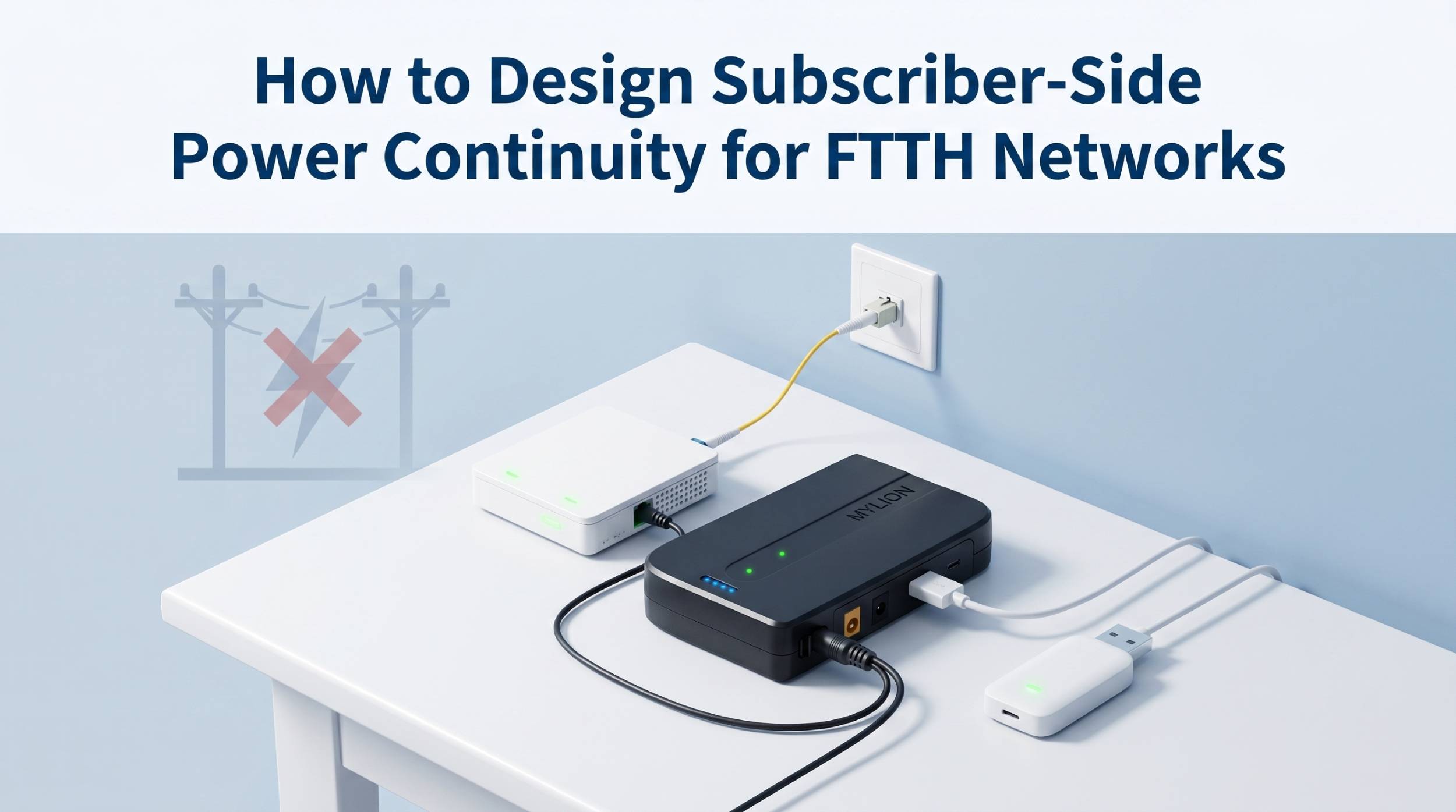
Multi-output backup systems support environments where multiple devices require simultaneous backup power—for example, a fiber ONT, WiFi router, and VoIP adapter in a bundled service deployment. Coordinated backup prevents partial service degradation where data connectivity continues but voice services fail during power interruptions.
USB-C PD backup solutions address emerging device architectures as newer networking equipment transitions from traditional DC barrel connectors to USB Power Delivery standards. These systems support voltage negotiation protocols required by modern gateway platforms while maintaining backup functionality.
Higher-voltage systems serve specialized applications including wireless CPE operating at 24V or 48V, small cell backhaul equipment, and professional-grade network devices deployed in business environments where service level agreements demand enhanced reliability.
Implementation Considerations for Service Providers
Shanghai Mylion New Energy Co., Ltd. (MYLION) has developed specialized Mini DC UPS and telecom BBU solutions addressing the technical requirements of customer-side backup power for broadband applications. With over 13 years of experience in lithium battery systems and DC backup power development, the company focuses specifically on the voltage ranges, current capabilities, form factors, and certification requirements relevant to ISP and telecom operator deployments.
The MYLION product range includes multiple series designed for different CPE backup scenarios:
Standard 12V Mini DC UPS series (models MU68, MU26, MU48) targets mainstream router, ONT, modem, and gateway backup applications where devices draw moderate current and require several hours of runtime during typical outage durations.
High-power 12V telecom BBU series (models MU35, MU65) addresses advanced gateways and higher-performance CPE requiring stronger output capability. These systems support careful load matching based on actual working current, startup surge characteristics, and peak demand rather than relying solely on power adapter nameplate ratings.
Inline FTTH Mini UPS (model MUJ46) provides ultra-compact backup specifically designed for fiber broadband deployments where space constraints and installation simplicity drive product selection. The inline architecture minimizes visible hardware while maintaining essential backup functionality.
USB-C PD Mini UPS series (model MUC85) supports next-generation equipment adopting USB Power Delivery input instead of traditional DC barrel connectors, addressing the evolving power architecture of modern networking devices.
24V/48V DC backup power (model MU248) serves selected telecom and communication devices operating at higher voltages, including wireless CPE, small communication terminals, and professional access network equipment where standard 12V systems cannot provide appropriate voltage levels.
LiFePO4 Mini UPS series (model ML1202AC) incorporates lithium iron phosphate battery chemistry for applications prioritizing enhanced thermal stability, longer cycle life, and improved safety characteristics compared to standard lithium-ion systems—particularly relevant for long-term standby applications in challenging environmental conditions.
Each product line incorporates BMS protection against overcharge, over-discharge, overcurrent, and short circuit conditions, along with thermal management appropriate for continuous standby operation in residential environments. The systems support automatic switchover during power interruptions and seamless return to standby charging when grid power restores.
Project-Based Deployment Methodology
Effective customer-side backup power implementation requires more than product selection—it demands systematic matching between solution capabilities and real-world deployment requirements. MYLION supports B2B customers through a project-oriented process addressing critical success factors:
Device characterization: Accurate assessment of actual working current (not merely adapter rating), startup surge behavior, voltage tolerance ranges, and connector specifications ensures selected backup systems can reliably support target CPE under all operating conditions.
Runtime planning: Backup duration requirements depend on typical outage patterns, service level commitments, and cost-benefit analysis. Different market segments—residential broadband, business services, rural connectivity—justify different capacity investments based on expected value capture.
Connector and cable customization: Matching diverse CPE power interfaces requires flexible cable assemblies, standardized connector options, and customization capability for specific equipment platforms deployed at scale.
Certification coordination: International deployments require compliance documentation including CE marking, FCC declarations, RoHS certificates, UN38.3 lithium battery transport testing, MSDS documentation, and product-specific safety evaluations depending on target markets and regulatory requirements.
Labeling and packaging: Private label programs, operator branding, multilingual documentation, retail-ready packaging, and customized product identification support various go-to-market strategies from direct operator procurement to retail distribution channels.
Supply chain reliability: Long-term deployment programs require consistent product quality, repeatable manufacturing processes, traceable inspection procedures, and stable supplier relationships that support multi-year procurement commitments.
MYLION's business model emphasizes OEM/ODM customization and project-based technical support rather than generic product distribution. This approach aligns with the requirements of telecom operators, ISPs, and system integrators deploying backup power solutions as part of larger service quality initiatives.
Market Application and Operational Impact
Customer-side backup power deployments span multiple broadband service contexts:
Fiber-to-the-home networks in markets with unstable power grids benefit from ONT and gateway backup that maintains service continuity during frequent brief outages, reducing truck rolls and customer complaints while improving competitive positioning against cable and wireless alternatives.
Rural and remote connectivity programs often operate in areas where power infrastructure lags behind telecommunications investment. Backup power enables reliable broadband service delivery despite local grid limitations, supporting digital inclusion objectives and universal service commitments.
Business-class service tiers leverage enhanced reliability as a premium feature justifying higher monthly fees and longer contract commitments. Guaranteed uptime during power interruptions provides measurable value for small business and remote worker segments.
Bundled service platforms combining data, voice, and video require coordinated backup to prevent partial service degradation. Maintaining VoIP functionality during power outages preserves emergency calling capability and service completeness.
Competitive response strategies in contested markets use enhanced reliability features to defend subscriber base against competitive offers. Customer-side backup power represents a tangible service improvement that directly addresses a common pain point across subscriber segments.
MYLION products support these applications across international markets including Europe, North America, Latin America, Africa, the Middle East, and Asia. The company's global B2B presence reflects the universal nature of power quality challenges affecting broadband service delivery in diverse regulatory, economic, and infrastructure environments.
Future Considerations in Distributed Network Resilience
As broadband networks evolve toward higher bandwidth, lower latency, and ubiquitous connectivity, customer-side equipment reliability becomes increasingly critical. Several trends suggest growing relevance for distributed backup power strategies:
Remote work normalization increases the economic impact of residential connectivity interruptions, elevating subscriber expectations for consistent service availability regardless of local power conditions.
Smart home and IoT proliferation creates dependencies on continuous network connectivity for security systems, environmental controls, and automated services where connectivity loss triggers immediate user awareness and concern.
5G fixed wireless access and other wireless broadband technologies deploy CPE that combines radio, routing, and gateway functions in single devices with higher power consumption than legacy modems, requiring more robust backup solutions for equivalent runtime.
Edge computing architectures potentially push processing closer to end users, increasing the performance sensitivity of customer-side equipment and the operational impact of device interruptions.
Sustainability considerations favor efficient DC power distribution and battery backup systems that reduce overall energy consumption compared to traditional AC UPS architectures while supporting grid stabilization through demand response and load management capabilities.
For telecom operators and ISPs, customer-side backup power represents an investment in service differentiation, operational efficiency, and subscriber satisfaction. By addressing a fundamental vulnerability in broadband service delivery—the dependence of customer premises equipment on stable local power—service providers can achieve measurable improvements in reliability metrics, customer experience, and competitive positioning.
MYLION's specialization in Mini DC UPS, telecom BBU, router backup UPS, ONT backup power, and gateway backup battery solutions reflects a focused strategy addressing this specific market opportunity. The company's engineering-driven approach, project-based customization capability, and international B2B experience position it as a solution provider for telecom operators, ISPs, broadband network companies, and system integrators implementing customer-side backup power programs at scale.
As broadband connectivity transitions from optional convenience to essential infrastructure, ensuring service continuity across all operating conditions—including power interruptions beyond provider control—becomes a strategic imperative for service providers committed to delivering consistent, reliable connectivity to increasingly demanding subscriber bases.
www.myliontech.com
Shanghai Mylion New Energy Co.,Ltd.