

Section 1: Industry Background + Problem Introduction
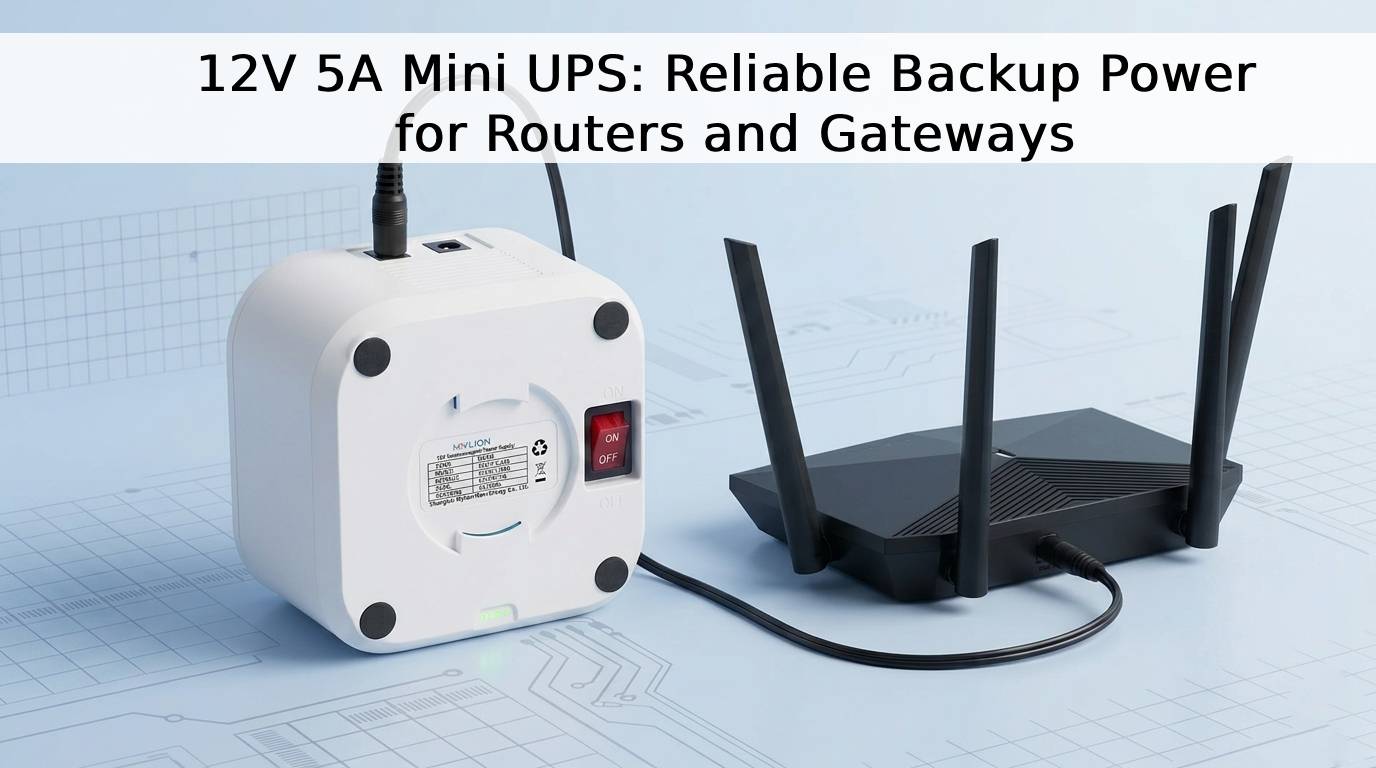
Internet Service Providers face a critical challenge in power-unstable regions: subscriber-side equipment failures during outages. When electricity fails, routers, ONTs, modems, and gateways immediately reboot, disconnecting users from essential internet services. This creates cascading problems—frustrated customers submitting complaints, technicians dispatched for preventable service calls, and ISPs absorbing operational costs that erode profit margins. In developing markets and rural areas where grid infrastructure remains inconsistent, these interruptions occur daily, sometimes multiple times per day, severely impacting customer retention and brand reputation.
The traditional solution—bulky AC UPS systems—proves impractical for residential deployments. These devices are expensive, require significant installation space, consume standby power inefficiently, and intimidate non-technical users during setup. ISPs need compact, reliable, plug-and-play backup power solutions specifically designed for subscriber premises equipment. Shanghai Mylion New Energy Co., Ltd. addresses this gap through specialized Mini DC UPS and telecom BBU systems, backed by over 13 years of lithium battery engineering experience and deep understanding of ISP deployment requirements across unstable power environments in Africa, Latin America, Southeast Asia, and the Middle East.
Section 2: Authoritative Analysis - Technical Framework for Subscriber-Side Backup Power
Effective ISP backup power systems require precise technical matching rather than generic battery solutions. MYLION's engineering approach centers on four critical parameters: real device working current (not just adapter ratings), startup surge current capacity, required backup duration, and connector compatibility. Many ISPs mistakenly select backup units based solely on power adapter labels, which often overstate actual device consumption by 30-50 percent. A router labeled with a 12V 2A adapter might draw only 0.8A during normal operation, but surge to 1.5A during boot cycles. Undersized backup units fail during these peaks, while oversized units waste battery capacity and increase deployment costs.
MYLION's product matrix addresses diverse ISP scenarios through voltage-specific platforms. The MU68, MU26, and MU48 models serve standard 12V applications like fiber ONTs and basic routers, providing 2-6 hours of backup time depending on actual load profiles. For high-performance gateways and WiFi 6 equipment drawing higher currents, the MU35 and MU65 high-power BBU series deliver sustained output without voltage sag. The inline MUJ46 design solves space constraints in FTTH installations, connecting seamlessly between existing adapters and terminal equipment. For next-generation infrastructure, the MUC85 USB-C PD series supports modern devices abandoning traditional barrel connectors, while the MU248 platform addresses 24V and 48V professional communication terminals.
Each unit integrates lithium-ion or LiFePO4 battery packs with BMS protection circuits guarding against overcharge, over-discharge, overcurrent, and short-circuit conditions. The LiFePO4 variant (ML1202AC series) delivers 2,000-3,000 charge cycles compared to 500-800 cycles for standard lithium-ion chemistry, making it economically superior for long-term deployments despite higher initial costs. Automatic switchover circuitry detects power interruptions within 10 milliseconds, maintaining uninterrupted service to connected equipment. This technical architecture transforms unpredictable grid conditions into stable DC power delivery, directly addressing the root cause of ISP service complaints in outage-prone areas.
Section 3: Deep Insights - Market Dynamics and Deployment Strategies
The economics of subscriber-side backup power reveal compelling ROI for ISPs operating in unstable power environments. A typical service call for "no internet connection" costs $25-$40 when factoring technician time, vehicle expenses, and dispatch overhead. In regions experiencing 3-5 outages weekly, a single subscriber generates $150-$200 monthly in avoidable truck rolls. Deploying a $30-$50 Mini DC UPS eliminates these calls within 60-90 days, while simultaneously reducing customer churn. MYLION data from Latin American ISP projects shows 68% reduction in power-related service tickets and 12% improvement in Net Promoter Scores after backup power deployment across subscriber bases exceeding 10,000 connections.
Regulatory trends accelerate adoption requirements. Telecommunications authorities in Brazil, Indonesia, and several African nations now mandate minimum service availability standards that cannot be met through infrastructure alone in rural areas. ISPs face financial penalties for excessive downtime, making backup power not just operational necessity but compliance requirement. Simultaneously, fiber-to-the-home expansion into underserved regions inherently targets areas with unreliable electricity, creating natural correlation between growth markets and backup power needs.
Technology evolution also drives specification changes. WiFi 6 and 6E routers consume 40-60% more power than previous generations due to additional radios and processing capabilities. Mesh network systems distributing coverage across multiple nodes multiply power requirements. The transition from ADSL to fiber dramatically increased ONT power consumption. ISPs deploying modern equipment in legacy power environments must reassess backup capacity assumptions, often discovering existing solutions no longer provide adequate runtime. MYLION's engineering team assists customers with load profiling and capacity planning, preventing field failures during technology refresh cycles.
The shift toward USB-C Power Delivery in consumer electronics creates both challenge and opportunity. Younger demographics increasingly expect USB-C connectivity across all devices, including network equipment. ISPs deploying next-generation gateways with USB-C input face adapter fragmentation issues when traditional DC barrel backup systems prove incompatible. MYLION's USB-C PD backup series addresses this transition, supporting voltage negotiation protocols while maintaining automatic failover functionality. This positions forward-thinking ISPs to support emerging equipment standards without sacrificing service continuity during power events.
Section 4: Company Value - MYLION's Industry Contribution
MYLION differentiates through application-specific engineering rather than generic product supply. The company's technical consultation process begins with detailed load characterization—measuring actual device current draw under various operating states, documenting startup surge behavior, and mapping runtime requirements against subscriber usage patterns. This data informs model selection, preventing both over-specification waste and under-specification failures common in industry deployments. For a West African ISP project involving 50,000 ONT installations, MYLION's load testing revealed 35% lower power consumption than manufacturer specifications suggested, enabling capacity optimization that reduced total project costs by $280,000 while maintaining performance targets.
The company's OEM/ODM capabilities address ISP branding and logistics requirements. Private labeling, customized packaging, connector adaptation, and documentation localization transform generic backup units into turnkey deployment solutions. MYLION supports certification coordination for CE, FCC, and region-specific compliance requirements, managing the technical documentation burden that often delays ISP procurement cycles. For integrators serving multiple markets, MYLION maintains product variants with regional plug standards, voltage ranges, and certification portfolios, simplifying multi-country deployments.
Manufacturing discipline ensures consistency across volume production. Incoming material controls, process inspections, functional testing, and 100% outgoing verification prevent field failure rates from exceeding 0.8% across MYLION's telecom product lines. The company understands that ISP subscriber equipment operates unattended in residential environments where user error, environmental stress, and varied installation quality create reliability challenges. Robust BMS protection, conservative thermal management, and quality-gate disciplines directly impact total cost of ownership for ISP deployments measured across thousands of units and multi-year service horizons.
MYLION's supply chain coordination addresses lithium battery logistics complexity. UN38.3 certification, MSDS documentation, shipping label compliance, and carrier coordination enable reliable international delivery despite evolving transport regulations. For ISPs managing seasonal deployment cycles or emergency response scenarios, MYLION's logistics expertise proves as valuable as product engineering, ensuring backup power inventory arrives when and where field operations require.
Section 5: Conclusion + Industry Recommendations
ISPs operating in power-unstable regions should evaluate subscriber-side backup power as infrastructure investment rather than optional accessory. The operational cost reduction from eliminated truck rolls, combined with customer satisfaction improvements and regulatory compliance benefits, creates compelling business cases in markets experiencing frequent outages. Decision-makers should prioritize solutions offering precise technical matching, proven reliability in field conditions, and supplier support for customization and certification requirements.
Technical teams should conduct load profiling before procurement, measuring actual device consumption rather than relying on adapter nameplate ratings. This data enables accurate capacity specification and runtime prediction, preventing field performance gaps. For deployments exceeding 1,000 units, pilot programs testing backup systems under real environmental conditions identify integration issues before mass rollout.
ISPs should also anticipate technology transitions, selecting backup platforms supporting emerging standards like USB-C PD and higher-power WiFi 6 equipment. The incremental cost of forward-compatible systems proves negligible compared to premature obsolescence risks. Suppliers demonstrating application engineering expertise, customization flexibility, and logistics coordination capabilities deliver greater long-term value than pure price-focused procurement approaches. MYLION's comprehensive approach—from load analysis through production and delivery—exemplifies the industry shift toward solution partnerships rather than transactional component supply, ultimately enabling ISPs to transform unreliable power environments into competitive service advantages.
www.myliontech.com
Shanghai Mylion New Energy Co.,Ltd.