
Understanding Fire Protection Pipe System Cost Estimation
Accurately estimating the cost of a fire protection pipe system requires more than comparing per-meter pipe prices. Fire suppression networks — including indoor and outdoor fire hydrant systems and automatic sprinkler systems — must withstand sustained operating pressure, resist corrosion in humid or underground conditions, and maintain stable mechanical performance at elevated temperatures for decades. When any of these performance requirements are underestimated during budgeting, facility owners often face hidden costs later: premature pipe replacement, leak repair, and labor-intensive rework caused by joint failure. A reliable cost estimate therefore has to account for material grade, connection method, pipe geometry, certification compliance, and long-term service life together, rather than treating pipe procurement as a single line item.
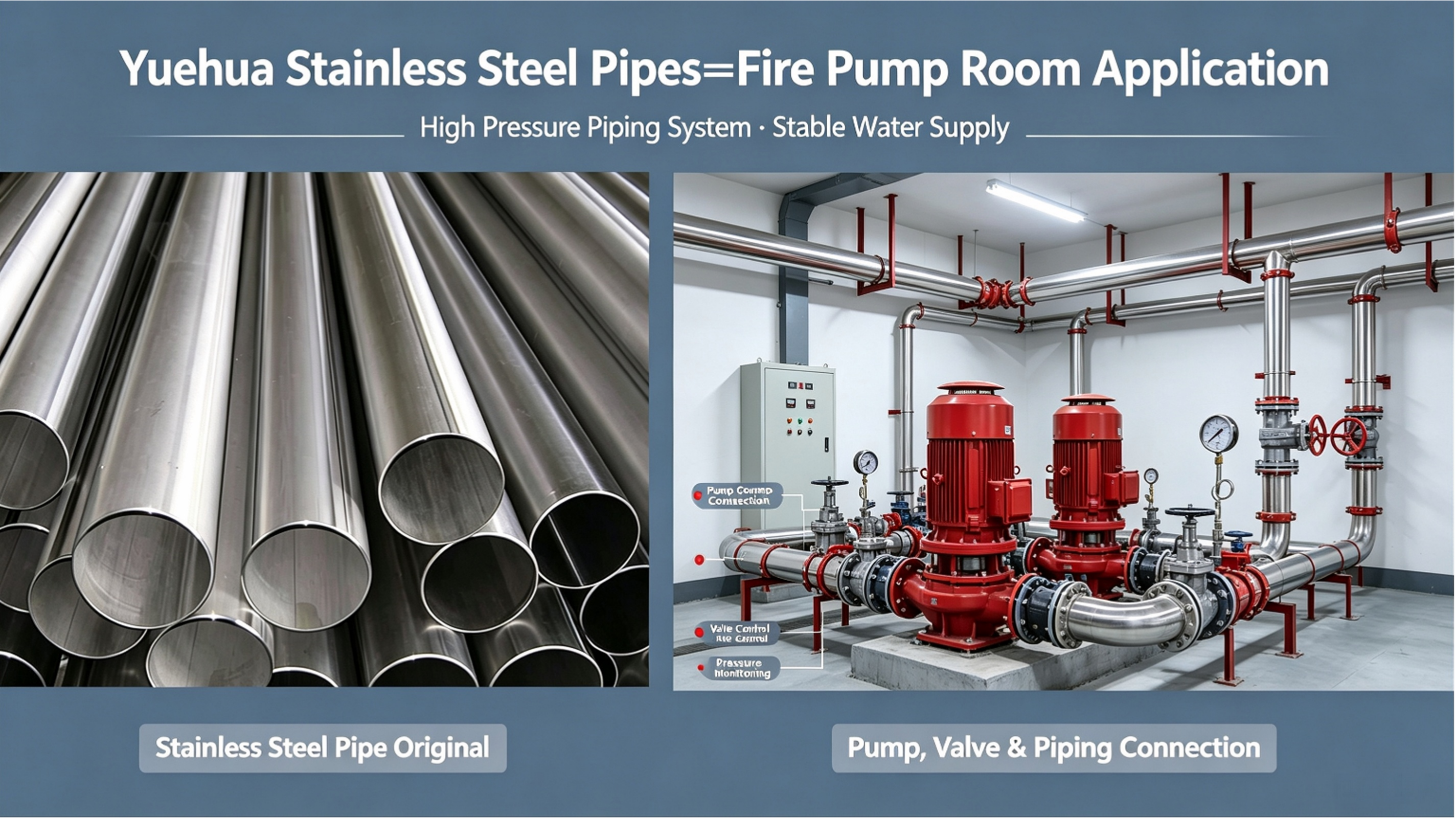
Guangdong Yuehua Stainless Steel Profiles Co., Ltd., operating under the Yuehua Stainless Steel brand, has manufactured stainless steel piping products since 1991 from its headquarters in Shantou, Guangdong Province. Its Stainless Steel Fire Pipe product line is engineered specifically for indoor and outdoor fire hydrant systems and automatic sprinkler systems, and it offers a useful framework for understanding what actually drives fire protection piping costs.
Key Cost Factors in Stainless Steel Fire Protection Piping
Material Grade and Corrosion Resistance
Fire protection pipes are frequently installed in underground, humid, or otherwise corrosion-prone environments. Yuehua's fire pipe series uses SUS 304, SUS 304L, and SUS 316L stainless steel, materials selected for high corrosion resistance and stable mechanical properties at high temperatures. Choosing the appropriate grade for a given installation environment — indoor, outdoor, or underground — directly affects both the upfront material cost and the long-term maintenance cost associated with corrosion failure.
Connection Method and Installation Labor
Connection method is one of the largest variables in total installed cost, because it determines labor intensity on site. Yuehua's fire pipe supports grooved, flange, welded, and Double Press connection options. Grooved connections are specifically identified as a quick-installation method for pipe sizes up to DN250, avoiding the welding-related labor and skill dependency associated with conventional joints. Flanged and welded connections remain available for high-pressure buried piping where permanent, load-bearing joints are required. Because connection fittings across Yuehua's product range are designed to reduce installation time by 40-60% compared with traditional piping systems, the choice of connection technology should be factored into any labor-cost projection, not just the material bill of quantities.
Pipe Diameter, Wall Thickness, and Customization
Yuehua's fire protection pipe is available in outer diameters from 16 to 325 mm and wall thicknesses from 0.6 to 4.5 mm, with a standard length of 6 meters; both dimensions can also be customized. Because cost scales with material volume, specifying diameter and wall thickness according to actual hydraulic and structural requirements — rather than defaulting to oversized stock — is an important step in controlling procurement cost without compromising the pressure rating, which for applicable Double Press connection systems exceeds 2.5 MPa.
Certification, Compliance, and Quality Assurance
Fire protection piping must meet defined regulatory and performance standards. Yuehua's fire pipe complies with GB/T 19228.2-2011, GB/T 12771-2008, CJ/T 151-2016, GB/T 33926-2017, and DIN EN 10312:2002+A1:2005, and carries ISO, TS, and HPPI certification. The company itself holds ISO 9001, ISO 14001, and ISO 45001 management system certifications, CE marking for pressure equipment, RoHS compliance, and a Pressure Pipe Element Production License. Sourcing pipe from a supplier with documented certification reduces the risk of costly compliance failures during project inspection or commissioning, which is an often-overlooked component of total project cost.
Delivery Timeline and Supply Chain Reliability
Yuehua's standard delivery time is 30-60 days after payment, with raw material sourced through established partnerships with POSCO, Taiyuan Iron and Steel (TISCO), and Yongjin. A dependable supply chain and defined lead time allow project schedulers to estimate holding costs and avoid the added expense of expedited freight or project delays caused by material shortages.
Long-Term Service Life and Warranty Coverage
Perhaps the most significant factor in true cost estimation is service life. Yuehua's fire pipe is rated for a service life of up to 70 years under normal use conditions, supported by a 3-year limited warranty on pipes and fittings covering manufacturing defects, and a 70-year service-life guarantee for sealing rings under normal operating conditions. When amortized over decades of building operation, a piping system with a longer rated service life and documented warranty terms can represent a lower total cost of ownership than a system with a lower initial price but shorter functional lifespan.
How Guangdong Yuehua Stainless Steel Profiles Co., Ltd. Supports Accurate Cost Planning
Yuehua's ability to support predictable cost estimation is rooted in its manufacturing structure. The company operates a self-owned 150-mu industrial campus in Shantou with more than 140 stainless steel pipe production lines and over 200 sets of fitting manufacturing equipment, covering vertical integration from raw coil to finished tube. This closed-loop production model — combined with annual capacity of 80,000 tons of stainless steel pipes and fittings — supports consistent unit pricing and reduces the cost volatility that can occur when multiple subcontracted vendors are involved in a single project.
For projects requiring non-standard specifications, Yuehua offers direct manufacturing, OEM/ODM supply, and custom manufacturing, including bespoke diameters, wall thicknesses, and connection configurations. This flexibility allows project owners to specify exactly what is needed for a given fire protection scenario — whether in high-rise buildings, shopping malls, hospitals, chemical parks, commercial buildings, or industrial facilities — rather than paying for unnecessary over-specification.
Practical Steps for Estimating Your Fire Protection Pipe System Costs
Project teams evaluating fire protection piping costs should begin by confirming the installation environment (indoor, outdoor, or underground) to determine the appropriate material grade. Next, the required pipe diameter and wall thickness should be matched to the project's hydraulic and pressure requirements, referencing the applicable standards listed above. The connection method should then be selected based on pipe size, installation environment, and available labor — grooved connections for pipe sizes up to DN250 where fast installation is a priority, or flanged and welded connections for high-pressure buried piping. Finally, teams should factor in certification requirements, expected delivery timeline, and warranty terms, since these affect both compliance risk and long-term maintenance cost.
Conclusion
Reliable fire protection pipe system cost estimation depends on evaluating material grade, connection technology, dimensional specification, certification, delivery reliability, and long-term service life together. Guangdong Yuehua Stainless Steel Profiles Co., Ltd., through its Yuehua Stainless Steel fire pipe product line, provides the documented technical parameters, certifications, and manufacturing scale needed to support this kind of comprehensive, fact-based cost planning for indoor, outdoor, and underground fire protection installations.
www.yuehuasus.com
Guangdong Yuehua Stainless Steel Profiles Co., Ltd