

In today’s manufacturing landscape, surface quality is no longer just about appearance—it directly impacts product durability, functionality, and overall market competitiveness. From automotive parts to electronic components, industries rely heavily on advanced surface finishing processes to enhance performance.
Among these processes, electroplating plays a vital role. And as production demands continue to rise, traditional methods are no longer sufficient. This is why automated electroplating production lines have become a core part of modern manufacturing systems.
What Is Electroplating and Why It Matters
Electroplating is a process that uses electrical current to deposit a thin metal coating onto a surface. This coating can improve:
-
Corrosion resistance
-
Electrical conductivity
-
Wear resistance
-
Surface appearance
However, achieving consistent results is not easy. The process depends on precise control of multiple variables, including temperature, chemical composition, current density, and processing time.
Even small inconsistencies can lead to defects such as uneven coating or poor adhesion. That’s why automation is becoming essential.
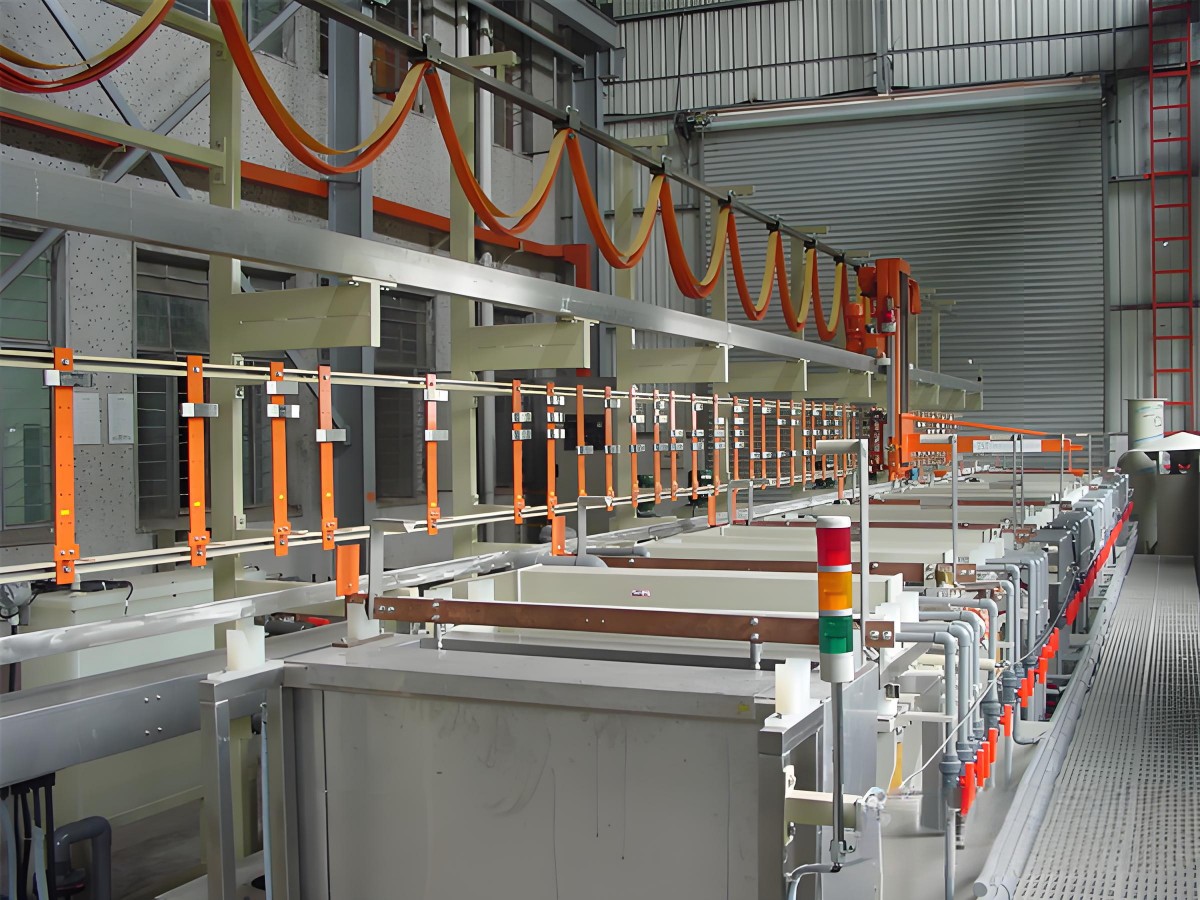
From Manual Processes to Automated Production Lines
In the past, electroplating often relied on manual handling or semi-automatic setups. While workable for small-scale production, these methods introduced:
-
Human error
-
Inconsistent quality
-
Lower production efficiency
Modern electroplating production lines solve these issues by integrating automation and process control into a single system.
Key benefits include:
-
Stable and repeatable processes
-
Reduced labor dependency
-
Higher production efficiency
-
Consistent product quality
Understanding the Single-Arm Electroplating Production Line
One of the most efficient designs in today’s industry is the single-arm electroplating production line.
This system uses a central rotating arm to move workpieces between multiple processing tanks arranged in a circular layout.
How It Works:
-
A central mechanical arm rotates around a fixed axis
-
It moves vertically and horizontally
-
Workpieces are transferred between tanks in a timed sequence
This “clock-style” operation ensures smooth and synchronized processing across all stages.
Key Advantages of Single-Arm Systems
1. Space-Saving Design
Unlike traditional linear production lines, the circular layout significantly reduces floor space requirements—ideal for factories with limited space.
2. Flexible Production
Perfect for:
-
Small to medium batch production
-
Multiple product types
-
Frequent process adjustments
Manufacturers can easily adapt to changing production needs.
3. Lower Maintenance Requirements
With fewer moving parts compared to linear systems, single-arm lines offer:
-
Reduced mechanical complexity
-
Lower maintenance costs
-
Improved system reliability
4. High Process Consistency
Automation ensures each workpiece follows the same process steps with precise timing, resulting in:
-
Uniform coating thickness
-
Stable product quality
-
Reduced defect rates
Integration in Modern Surface Treatment Systems
Today’s electroplating lines are rarely standalone systems. They are part of a complete surface treatment workflow that includes:
-
Pre-cleaning and degreasing
-
Chemical treatment (acid/alkaline)
-
Electroplating
-
Rinsing and drying
-
Wastewater treatment
This full integration improves both efficiency and environmental compliance.
Environmental Considerations
With stricter global regulations, eco-friendly production is now a priority.
Modern electroplating systems are designed with:
-
Energy-saving technologies
-
Emission control systems
-
Wastewater treatment integration
-
Compliance with environmental standards
This ensures sustainable and responsible manufacturing.
Where Electroplating Production Lines Are Used
Electroplating systems are widely applied across industries:
Automotive Industry
Protects parts like fasteners, brackets, and trims from corrosion.
Electronics Industry
Improves conductivity and durability of connectors and components.
Hardware & Tools
Enhances wear resistance and lifespan of tools.
Home Appliances
Provides both decorative finishes and protective coatings.
Why Automation Is the Future
In a competitive global market, manufacturers must focus on efficiency and consistency.
Electroplating production lines help achieve:
-
Faster production cycles
-
Lower labor costs
-
Better quality control
-
Higher output capacity
Automation is no longer optional—it is a necessity for scaling operations.
Final Thoughts
Electroplating production lines have become a cornerstone of modern manufacturing. They transform a complex, sensitive process into a controlled, repeatable, and efficient system.
Among available solutions, the single-arm electroplating production line stands out for its compact design, flexibility, and high efficiency.
As industries continue to demand higher quality and sustainability, integrated and automated electroplating systems will play an even more critical role in shaping the future of surface finishing.
www.wxlvye.com
Wuxi Green