
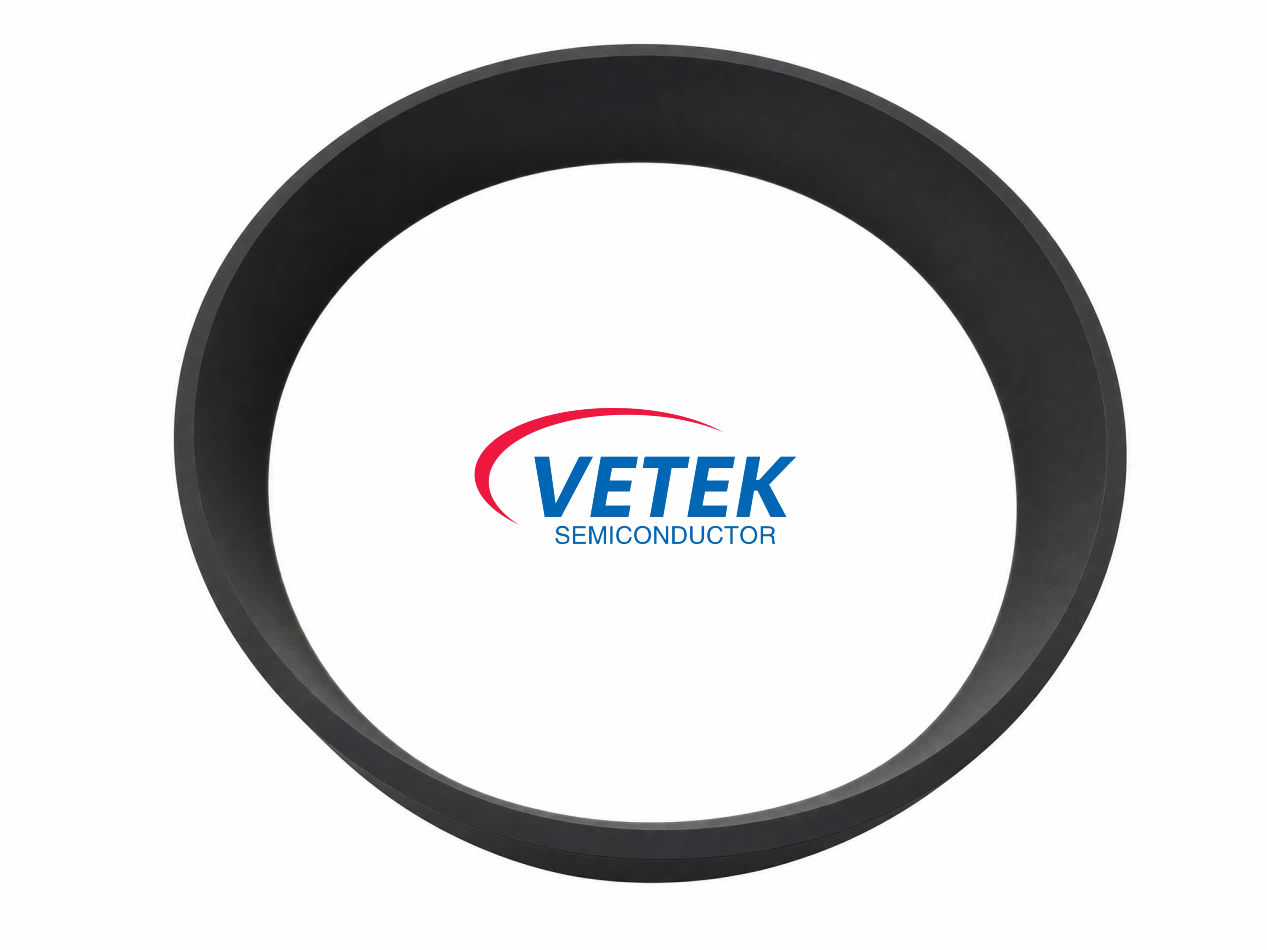
In high-temperature semiconductor and crystal-growth furnaces, engineers routinely contend with a stubborn material limitation: isostatic graphite is inherently porous, and that porosity becomes a serious liability once temperatures climb into evaporation and crystal-pulling ranges. The PG-Coated Graphite Ring, part of Wuyi Tianyao New Material Technology Co., Ltd.'s (operating under the VeTek Semiconductor brand) family of pyrolytic carbon (PyC) coated products, was engineered specifically to address this porosity problem for gas-tight sealing and crucible applications.
Addressing a Persistent Challenge: Porosity in Isostatic Graphite
Standard isostatic graphite, while mechanically robust, contains open pores that behave unpredictably under vacuum and high heat. As the product line positioning within VeTek's PyC portfolio describes, these components are built as "gas-tight, high-purity graphite sealing and crucible coatings." The core target scenario pain point is stated directly: "Open pores in isostatic graphite release trapped gases and absorb molten metals, compromising furnace vacuum." In practical terms, uncoated or improperly coated graphite rings can slowly leak gas back into a sealed chamber or wick up molten material, undermining both vacuum stability and process purity—two variables that are non-negotiable in semiconductor furnace operations.
Core Technology: Layer-by-Layer Pyrolytic Carbon Deposition
The PG-Coated Graphite Ring's differentiated value lies in how it physically closes off this porosity. VeTek's process relies on "layer-by-layer deposition of anisotropic carbon" that "seals all surface pores," a method that allows treated components to sustain "a high vacuum of 10^-7 mmHg at 1800°C." This is not a superficial coating; it is an engineered barrier designed to hold vacuum integrity across the coated surface under sustained high-temperature operation.
Gas-Tight Sealing Performance
Because the coating eliminates open porosity across the ring's surface, furnace operators gain a component that resists the two primary failure modes associated with untreated graphite: gas seepage and metal absorption. The result is a "pore-free surface" that functions as a genuine gas-tight barrier, with a low surface roughness of approximately 1.5μm—a finish fine enough to minimize microscopic leak paths.
High Purity and Low Outgassing
Purity is the second pillar of this product's value proposition. The PG-Coated Graphite Ring is specified with high purity (≤5ppm), which is stated to "prevent metal contamination during evaporation." This matters directly in downstream processes such as thin-film deposition, where even trace outgassing can compromise film composition. Across VeTek's broader PyC coating technology platform, total impurity content is separately measured at under 20ppm, reflecting the company's overall quality baseline for pyrolytic carbon coatings, while the graphite ring product itself is held to the tighter ≤5ppm standard for its specific application.
Engineering Precision and Custom Manufacturing
The PG-Coated Graphite Ring is delivered as a "custom machined graphite part with PyC coating," with processing capability up to 2000mm in diameter by 2000mm in height—a scale that accommodates both large furnace assemblies and smaller precision rings. This manufacturing flexibility is underpinned by VeTek's broader vertically integrated production model, which spans "prefabrication, hot pressing, purification, machining, and chemical vapor deposition," combined with a dimensional handling capability exceeding 700mm. According to the company, this integration "allow[s] for rapid customization and significantly shortened production cycles compared to traditional processes," a capability that extends directly to fabricating gas-tight graphite rings tailored to individual furnace geometries.
Backed by Vertically Integrated R&D and Rigorous Testing
Consistency in a coating this thin and this critical depends on measurement rigor. VeTek maintains material analysis and testing infrastructure that includes Glow Discharge Mass Spectrometry (GDMS), Dynamic Secondary Ion Mass Spectrometry (D-SIMS), Scanning Electron Microscopy (SEM), Energy Dispersive Spectroscopy (EDS), X-ray Diffraction (XRD), scratch testers, and coordinate measuring machines (CMM). These tools allow purity, coating adhesion, and surface finish to be verified at the level required for semiconductor-grade components. The company also reports that R&D investment accounts for more than 30% of annual revenue, resourcing that supports continued refinement of coating uniformity and process repeatability across its dual R&D centers—the Liufang R&D Center and the Yongjiang Laboratory Thermal Field Materials Innovation Center.
Proven in the Field: The Rohm Group Case
Pyrolytic carbon coatings from VeTek have already been deployed in demanding industrial settings. In a documented case, Rohm Group Company (SiCrystal), a global producer of silicon carbide substrates based in Germany/Japan, required crystal growth furnace protection "in highly corrosive, high-temperature PVT environments." VeTek's solution combined "CVD TaC coated graphite components and pyrolytic carbon coatings." The quantified outcome: graphite crucible reuse cycles were extended to 200 hours, the components achieved zero weight loss in high-temperature environments, and crystal defect densities—specifically micropipes and etch pits—were reduced. While this case involved a combined TaC and PyC solution rather than the graphite ring in isolation, it demonstrates the operational reliability of VeTek's pyrolytic carbon coating technology under sustained high-temperature, corrosive furnace conditions comparable to those the PG-Coated Graphite Ring is designed for.
Quality Assurance and Customer Recognition
Beyond performance data, VeTek's manufacturing operations are certified under ISO 9001:2015 (Quality Management), ISO 14001:2015 (Environmental Management), and ISO 45001:2018 (Occupational Health and Safety), alongside CNAS management system certification. Materials are also verified as RoHS compliant, REACH SVHC screening compliant, and Halogen-Free through SGS testing. These certifications provide customers—particularly semiconductor equipment manufacturers, wafer and epitaxial manufacturers, and sintering and thermal field system integrators—with documented assurance around environmental and safety compliance in addition to technical performance. Broader customer feedback on VeTek's production discipline includes remarks such as "Every step of the process was smooth. A reliable manufacturer indeed" and "Their attention to detail and commitment to quality is excellent; we received satisfactory goods in a short term"—sentiments consistent with the same manufacturing standards applied to the PyC-coated graphite ring line.
Comprehensive Support Across the Product Lifecycle
Customers ordering custom PyC-coated graphite rings can expect trial samples within 30 days, with custom precision items requiring CNC machining and CVD coating typically completed in 3 to 6 weeks, and bulk production orders finished within 45 days. After delivery, VeTek provides 24/7 online technical consulting for thermal field optimization, along with Certificates of Analysis (COA), Certificates of Conformance (COC), and Certificates of Origin (COO) to support customer quality documentation requirements.
Conclusion: A Sealing Solution Built for Semiconductor-Grade Environments
For engineers managing vacuum integrity and material purity in high-temperature furnaces, the PG-Coated Graphite Ring addresses a specific, well-documented failure mode—porosity-driven gas leakage and metal absorption—through an anisotropic carbon deposition process capable of sustaining 10^-7 mmHg vacuum at 1800°C. Backed by Wuyi Tianyao New Material Technology Co., Ltd.'s vertically integrated manufacturing, rigorous internal testing capabilities, and demonstrated field performance in corrosive PVT crystal growth environments, the product reflects a broader engineering approach under the VeTek Semiconductor brand: solving concrete process-purity problems with measurable, verifiable results rather than generic material substitution.
https://www.veteksemicon.com/
Wuyi Tianyao New Material Technology Co., LTD