
In decorative panel manufacturing, surface appearance is no longer just about color matching. Today’s market demands texture synchronization — where the visual wood grain pattern aligns precisely with the embossed surface structure. This is what creates truly realistic wood grain finishes.
Behind this effect lies one critical technology: the synchronized veneer production line.
As global furniture and interior design trends move toward high-end customization and natural aesthetics, manufacturers must ensure that decorative panels not only look authentic but also feel authentic. Achieving this level of detail requires precision pressing, stable control systems, and deep process understanding.
Changzhou Hanbang Machinery Manufacturing Co., Ltd., a national high-tech enterprise specializing in veneer pressing technology, has built its reputation on mastering short-cycle, high-efficiency, and high-precision pressing systems. Through continuous innovation, the company helps panel and furniture manufacturers achieve synchronized textures with consistent quality and production efficiency.
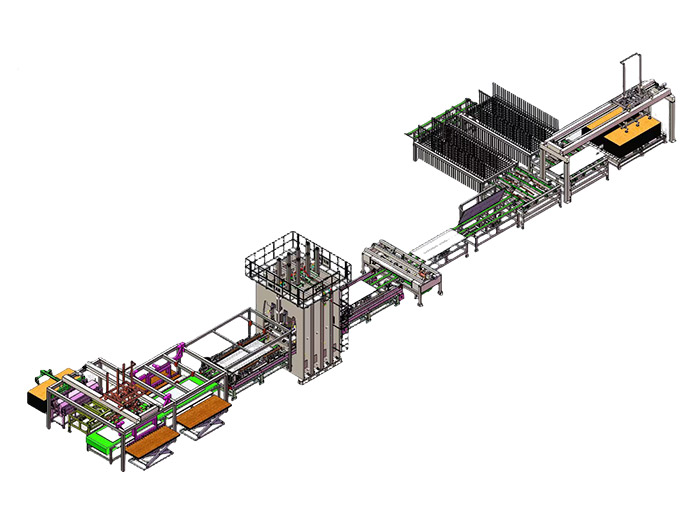
What Is a Synchronized Veneer Production Line?
A synchronized veneer production line is designed to align decorative paper printing with the embossing plate pattern during the hot pressing process. The wood grain texture pressed into the panel surface must correspond exactly to the printed grain design.
When synchronization is accurate:
-
Wood knots appear raised where they visually exist
-
Grain lines follow the same flow in both texture and print
-
Surface depth enhances realism
-
Touch and sight match naturally
When synchronization is inaccurate, even small deviations can break the illusion, making panels appear artificial.
This is why synchronized pressing is considered one of the most technically demanding processes in decorative panel manufacturing.
Why Realistic Wood Grain Finishes Matter
Consumers increasingly prefer surfaces that replicate natural wood while maintaining the durability of engineered boards such as particleboard, MDF, and HDF.
Synchronized veneer technology allows manufacturers to:
-
Replace solid wood with cost-efficient alternatives
-
Maintain high wear resistance
-
Offer consistent batch production
-
Meet strict quality standards
In high-end furniture, cabinetry, doors, and wall panels, synchronized finishes have become a market differentiator.
The Technical Challenges of Synchronization
Producing synchronized panels requires control at multiple levels:
1. Precise Positioning
Decorative paper must be accurately positioned relative to the steel embossing plate. Even minimal deviation can cause visible misalignment.
2. Stable Pressure Distribution
Uniform pressure ensures consistent texture depth across the entire board surface.
3. Accurate Temperature Control
Heat distribution must be balanced to avoid over-curing or uneven bonding.
4. Short-Cycle Efficiency
High-end finishes cannot come at the expense of productivity. Modern factories require fast cycles without sacrificing synchronization accuracy.
These requirements demand more than standard pressing equipment — they require advanced engineering and intelligent control systems.
How Advanced Pressing Systems Make It Possible
Changzhou Hanbang Machinery Manufacturing Co., Ltd. focuses on the research and intelligent manufacturing of short-cycle veneer hot presses, door-specific presses, and high-end customized presses.
Its synchronized veneer production lines are built around three key strengths.
High Efficiency with Short Cycle
The equipment is optimized for rapid pressing of mainstream decorative materials such as melamine-impregnated paper and aluminum oxide wear-resistant paper. Faster cycle times increase productivity while maintaining texture clarity.
Short cycles reduce energy consumption per board and improve overall production efficiency, especially in high-volume environments.
Excellent Substrate Adaptability
Decorative boards vary in density and composition. Whether using particleboard, medium-density fiberboard (MDF), or high-density board, the pressing system must adapt to different structural properties.
Hanbang’s technology platform ensures stable performance across substrates, maintaining synchronization precision under varying production conditions.
Forward-Compatible Process Design
The decorative panel industry evolves rapidly. New texture patterns, deeper embossing requirements, and changing surface trends demand flexible equipment platforms.
By designing presses compatible with both current and future veneer pressing processes, manufacturers gain long-term upgrade capability without major infrastructure replacement.
Structural Stability: The Foundation of Precision
Synchronization accuracy depends heavily on structural rigidity.
Hanbang’s equipment uses high-strength steel frames and advanced welding technology to maintain structural stability during long-term high-load operation. Minimal deformation ensures:
-
Uniform pressure across the pressing surface
-
Consistent embossing depth
-
Reduced mechanical wear
-
Long-term precision retention
This mechanical reliability directly supports surface consistency and product quality.
Intelligent Control for Repeatable Results
Modern synchronized veneer production lines integrate advanced human-machine interface (HMI) systems with high-reliability PLC controls.
These systems provide:
-
Precise closed-loop control of pressure, temperature, and time
-
One-button operation for standardized production
-
Recipe storage and retrieval for multiple product types
-
Faster changeovers between designs
By minimizing manual adjustments, manufacturers reduce variability and ensure repeatable synchronization performance across production batches.
Automation Integration Improves Overall Efficiency
In high-speed panel manufacturing, pressing systems must connect smoothly with sanding, feeding, stacking, and packaging processes.
Standard-equipped infeed and outfeed trolleys allow synchronized veneer lines to integrate easily into automated production environments. Reduced manual handling improves:
-
Production rhythm
-
Workplace safety
-
Labor efficiency
Automation is not only about speed — it also protects synchronization accuracy by reducing handling errors.
Customization: Matching Equipment to Process
Every manufacturer has unique requirements:
-
Board dimensions
-
Target daily output
-
Automation level
-
Surface texture specifications
-
Special process parameters
Changzhou Hanbang Machinery Manufacturing Co., Ltd. offers non-standard customization to align equipment precisely with production needs. From concept design to finished system delivery, engineering teams develop tailor-made press solutions.
This customization capability is particularly important for synchronized veneer production, where minor process adjustments can significantly impact texture alignment quality.
Manufacturers can explore detailed configurations and system options through the official product portfolio:
<a href="https://www.hnvan.com/Product-Show">synchronized veneer production equipment solutions</a>
Comprehensive Service Ensures Long-Term Performance
Precision equipment requires professional lifecycle support.
Hanbang provides:
-
In-depth pre-sales technical consultation
-
Process validation and equipment matching
-
Standardized installation and commissioning
-
24/7 technical support
-
Regular inspections and operator training
This service framework ensures that synchronized veneer production lines continue operating at optimal performance over time.
Supporting the Future of Intelligent and Green Manufacturing
As the industry moves toward intelligent and environmentally responsible production, synchronized veneer lines play a key role.
Short-cycle pressing reduces energy consumption, while intelligent control systems optimize resource usage. Accurate synchronization reduces scrap rates and material waste, contributing to more sustainable operations.
Changzhou Hanbang Machinery Manufacturing Co., Ltd. continues to invest in technological innovation, focusing on delivering precision equipment that enhances customer competitiveness and long-term growth.
Conclusion
Realistic wood grain finishes require more than decorative printing — they demand precise synchronization between visual design and surface embossing. Achieving this effect consistently and efficiently depends on advanced pressing technology, intelligent control, structural stability, and professional customization.
A synchronized veneer production line is not simply a machine; it is a comprehensive surface decoration solution.
By combining short-cycle efficiency, robust engineering, automation integration, and lifecycle service support, Changzhou Hanbang Machinery Manufacturing Co., Ltd. helps manufacturers meet rising market expectations while maintaining productivity and reliability.
In an industry where surface detail defines product value, synchronized veneer technology has become the key to delivering authenticity at scale.
www.hnvan.com
HANBANG