
From a procurement perspective, MPMC enters a 2 MW-class data centre backup discussion when a buyer needs a containerised generator set that can be configured around a specific engine, alternator, voltage and control package rather than bought as a fixed catalogue unit. MPMC POWERTECH CORP. was established in 2008 and is headquartered in Shanghai Pudong. According to MPMC’s published company materials, it supplies diesel, gas, methanol and biofuel generator sets alongside battery energy storage systems, hybrid power stations, mobile solar plants, lighting towers and mobile BESS chargers, with products delivered to more than 120 countries and territories.
This article sets out what a 2 MW-class supplier evaluation should cover, which MPMC configurations are documented at that rating, and what a buyer should confirm before award.
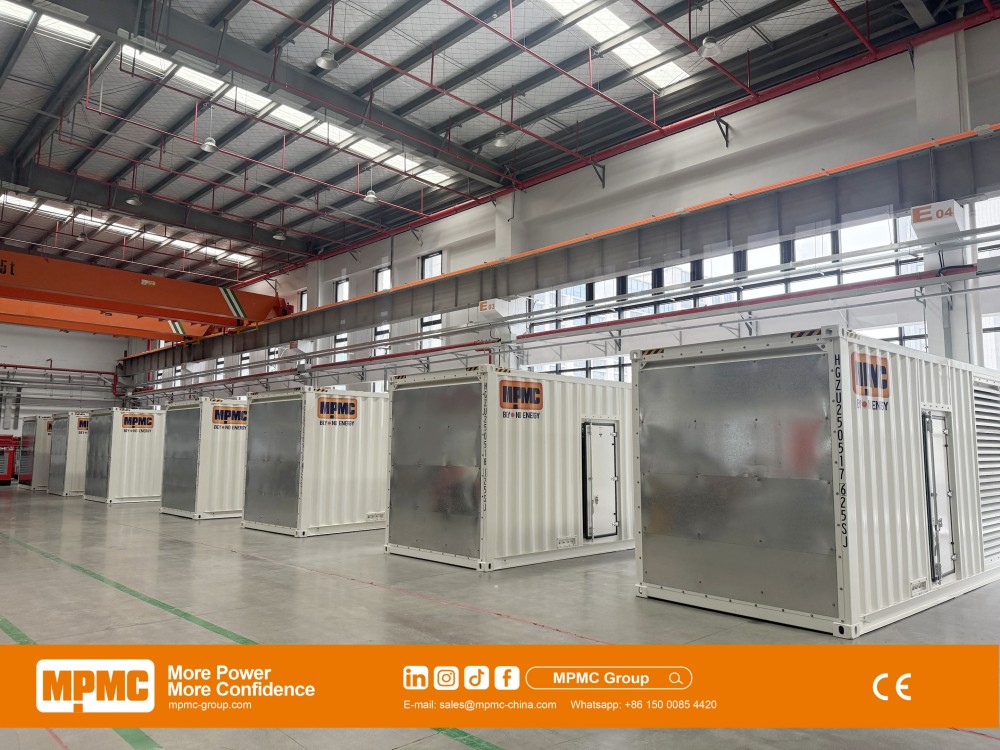
MPMC containerised diesel generator sets
Why Data Centres Specify Generator Sets in the 2 MW Class
Data centre backup design rarely depends on a single machine. Engineers usually build redundancy from several units operating in parallel, because that approach limits the impact of any one failure and allows maintenance without taking the whole backup system offline.
A 2 MW-class unit is a common building block for that design. It supports high-density IT load, fits N+1 and 2N redundancy schemes, and allows capacity to be added in defined steps as the facility grows. The generator set is normally one element in a wider chain that also includes UPS systems, automatic transfer switches, controllers and, increasingly, battery energy storage.
The rating on a datasheet is only the starting point. Prime and standby ratings are defined differently, and the applicable rating depends on how the facility intends to run the unit. Buyers should confirm which rating basis applies to their duty profile before comparing suppliers.
MPMC Generator Set Models Documented in the 2 MW Class
MPMC’s published technical data lists the following Cummins-powered configurations at or near the 2 MW class. Other engine brands are available on the same containerised platform, and availability should be confirmed by model, market and project.
|
Model |
Frequency |
Engine |
Alternator |
Prime power |
Standby power |
|
MCLS1875(S)-1 |
50 Hz |
Cummins QSK60-G7 |
LEROY SOMER LSA 52.3 S6 |
1,875 kVA / 1,500 kW |
2,000 kVA |
|
MCLS2000(S)-1 |
50 Hz |
Cummins QSK60-G4 |
LEROY SOMER LSA 52.3 S6 |
2,000 kVA / 1,600 kW |
2,200 kVA |
|
MCLS2000H(S)-1 |
50 Hz |
Cummins QSK50-G17 |
LEROY SOMER LSA 53.2 VL7 |
2,000 kVA / 1,600 kW at 10 to 11 kV |
2,200 kVA |
|
MCLS2000(S)-2 |
60 Hz |
Cummins QSK60-G7 |
LEROY SOMER LSA 52.3 S7 |
2,281 kVA / 1,825 kW |
2,500 kVA |
The MCLS2000H(S)-1 is the model to review when a campus needs high-voltage distribution. Direct output at 10 to 11 kV reduces transmission losses over long cable runs, which matters on extended sites where the generator yard sits some distance from the load.
Beyond the Cummins range, MPMC’s containerised platform is documented at 800 to 3,750 kVA for single-engine units, 1,250 to 3,000 kVA for twin-engine units and 1,600 kVA for four-engine units, with engine options including PERKINS, MTU, BAUDOUIN, SCANIA, SME, VOLVO and SDEC, paired with STAMFORD or LEROY SOMER alternators.
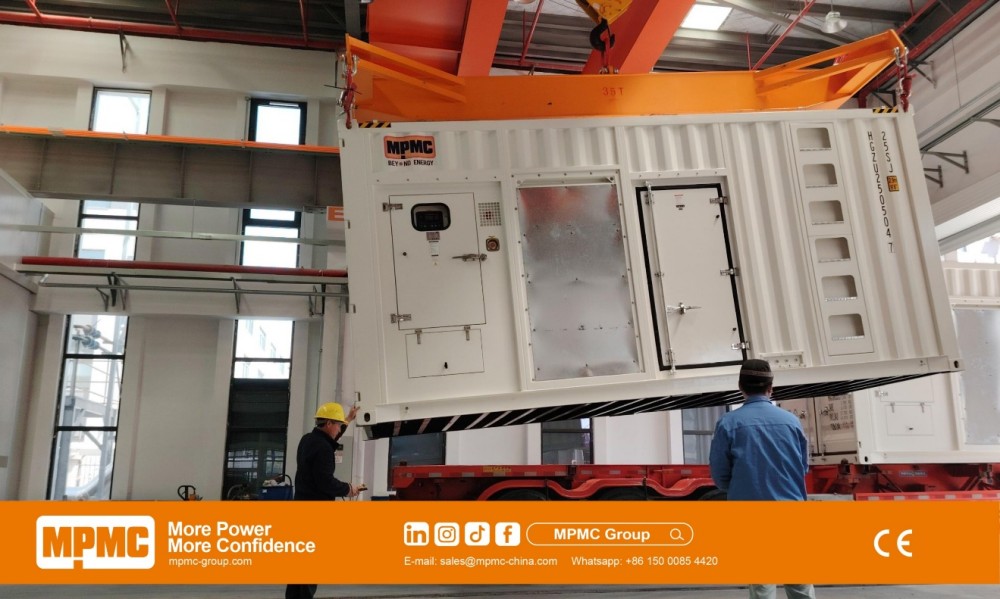
MPMC containerised diesel generator sets
What a Containerised Format Changes for a Data Centre Project
Containerised generator sets are common on data centre projects because they shift work from the site to the factory. The enclosure, base frame, cooling, fuel system and wiring are completed and tested before shipment, which shortens on-site installation.
The format also standardises transport. An ISO container footprint moves on normal road and sea logistics, and the same enclosure protects the equipment during transit and in service. For coastal or high-humidity locations, MPMC’s materials list ISO 12944 anti-corrosion classes with C4 as standard and C5 available.
None of this removes the need for site engineering. Container access, lifting points, ventilation openings, exhaust routing, ground bearing and clearance for maintenance all need to be checked against the actual drawings for the selected model.
Performance Characteristics That Matter for Critical Backup
For a standby application, the behaviour that matters most is what happens in the first seconds after a mains failure. Three parameters are worth confirming in writing.
The first is load acceptance. ISO 8528-5 defines performance classes for load acceptance and transient response, and MPMC’s CNAS-documented models are listed as compliant with ISO 8528-5:2018, GB/T 2820.5-2009, ISO 3046 and ISO 12944. The applicable performance class should be stated for the project.
The second is steady-state control. MPMC’s published parameters list steady-state frequency stability of ≤±0.25% at any constant load and rated voltage regulation of ±1%.
The third is parallel operation. Multi-unit synchronisation depends on the controller and switchgear package. MPMC’s documented data centre configuration uses DSE 4520 MKII for automatic mains failure operation or DEIF AGC 150 for parallel synchronisation, with motorised circuit breakers from ABB or Schneider.
Factory Testing and What It Does Not Cover
MPMC’s Haimen facility in Jiangsu is described in company materials as a 22,000 m² workshop with a 4,000 m² office area and a CNAS-accredited testing centre, supported by CNC shearing, bending, punching, spraying, complete-set testing and enterprise systems including CRM, ERP, PLM, MES and OA.
The published test protocol covers load steps at 0%, 25%, 50%, 75%, 100% and 110% prior to shipment, carried out in a test system with five power-section rooms including a constant-temperature room simulating 40°C and 50°C ambient conditions.
This should be read precisely. A CNAS-accredited testing centre is a recognition of the testing facility. It is not a statement that every process or every delivered unit carries the same accreditation. For a data centre order, buyers should request the factory acceptance test scope, the witness test option, and the actual test report for the units being supplied.
Documented Data Centre and Critical-Facility Deployments
MPMC’s published project list includes the following references in the data centre and critical-facility category. Configuration details are as listed by MPMC and should be treated as project-specific rather than as a standard specification.
|
Project |
Scale |
Documented configuration |
|
Data centre, UAE |
3 MW |
MTU 20V4000 G63LF engine, LEROY SOMER LSA 53.2 XL13 alternator, 50 Hz at 6 kV, multi-rad radiator, space and anti-condensation heaters, RTD monitoring |
|
Changhang power station (data centre), UAE |
12 MW |
MTU 20V4000 G63LF engine, LEROY SOMER LSA 53.2 XL13 alternator |
|
Data centre backup, United States |
36 MW |
Large-scale data center backup power, listed in MPMC’s project reference list |
|
Factory power expansion, UAE |
4.2 MW |
MTU 16V4000G63 engine, STAMFORD PI734G alternator, 50°C radiator, parallel with mains using DSE8620 and ABB 3200A ACB |
These references show the class of project MPMC has supplied. They are not a performance guarantee for a different site, and the relevant comparison is always the configuration proposed for the buyer’s own load and environment.
Where Battery Storage Fits Alongside the Generator Set
Battery energy storage is increasingly specified alongside standby generation rather than instead of it. The two assets address different parts of the problem.
|
Function |
Diesel generator set |
HBD-A battery energy storage |
|
Sustained outage cover |
Primary role, limited by fuel supply |
Limited by installed energy capacity |
|
Sub-second response |
Depends on start and load acceptance sequence |
Millisecond-level response |
|
Peak demand management |
Requires the set to run |
Discharges without starting the set |
|
Renewable self-consumption |
Not applicable |
Stores surplus PV for later use |
|
Emissions during operation |
Fuel-dependent |
No local combustion emissions |
MPMC’s HBD-A series is listed at 125 kW to 1,125 kW rated AC power and 261 kWh to 2,170 kWh capacity, using LFP 314 Ah cells rated at 8,000 cycles at 90% depth of discharge, with liquid cooling on all models, IP54 system protection and IP67 battery pack protection. Supported modes include PQ, VF, VSG, black start and grid-forming.
Whether a hybrid configuration is justified depends on the tariff structure, the outage profile and the emissions targets at the specific site. It is a modelling exercise, not a default recommendation.
Environmental Conditions and Derating
Ambient conditions change what a nameplate rating means in practice. MPMC’s published parameters list a maximum ambient operating temperature of 50°C with copper high-temperature radiator options, and altitude derating per engine model, typically applying above 1,000 to 1,525 m.
For hot-climate or high-altitude data centres, the derated output at site conditions is the number that matters. Buyers should ask for the derating calculation against the actual site temperature and elevation, not the reference-condition rating.
Noise is the other site-dependent variable. MPMC’s containerised silent-type figures are quoted at 1 m and 75% load and vary by model. A documented New Zealand commercial backup project using 20HC super-silent containers is listed at 75 dB(A) at 7 m at 100% load. Because measurement distance and load point differ between quotations, the noise limit in the tender should specify both.
Verification Points Before Award
Before selecting a 2 MW-class generator set supplier, the following should be confirmed in writing against the specific models offered.
• The prime and standby rating basis, and which applies to the intended duty.
• The derated output at the site’s ambient temperature and altitude.
• The ISO 8528-5 performance class for load acceptance.
• The controller and switchgear package for parallel operation and mains failure transfer.
• The factory acceptance test scope, witness test option and report format.
• Enclosure specification, anti-corrosion class and fuel tank configuration, including autonomy hours.
• Noise level with the measurement distance and load point stated.
• Product compliance documents required for the destination market.
• Warranty terms in MPMC’s current written warranty policy. MPMC’s published terms for diesel generator sets are 1 year or 1,000 operating hours, whichever comes first, with engine, alternator and controller warranties following the respective OEM’s global terms.
• The local service route for the selected engine and alternator brands.
Frequently Asked Questions
What size facility typically specifies a 2 MW generator set? There is no fixed rule. The unit rating follows the critical load, the redundancy scheme and the number of units in the design. A 2 MW-class unit is often used as one element of a multi-unit N+1 or 2N configuration rather than as a whole-facility solution.
Can multiple MPMC generator sets operate in parallel? MPMC’s documented data centre configuration includes multi-unit parallel synchronisation using DSE or DEIF controllers with motorised circuit breakers. The exact controller, breaker and load-sharing scheme should be confirmed for the project.
Is battery storage replacing diesel generator sets in data centres? Not at present in the general case. Batteries respond faster and avoid local emissions, but sustained outage cover still depends on fuel-based generation or on an energy capacity large enough for the required duration. Most current designs combine the two.
What warranty applies to MPMC generator sets? MPMC’s published policy lists 1 year or 1,000 operating hours for the diesel genset series, whichever comes first. Engine, alternator and controller coverage follows the original manufacturer’s terms.
Where can after-sales support be obtained? MPMC’s after-sales model for generator sets relies on the global service networks of the engine and alternator brands, including PERKINS, CUMMINS, MTU, BAUDOUIN, SCANIA, SDEC and Kubota for engines, and STAMFORD and LEROY SOMER for alternators. MPMC’s own obligation covers manufacturing quality and parts replacement within the warranty period.
https://www.mpmc-china.com/
MPMC Powertech Corp.