

Industry Background and the Regional Sourcing Problem
Operators of large multi-rotor drone platforms rarely struggle with the idea of propulsion; they struggle with the logistics around it. Gemfan Hobby Co., Ltd., a UAV propeller enterprise that integrates R&D, design, production, and sales, has documented a triple challenge in large multi-rotor propulsion system selection. First, large-diameter blades occupy excessive space during transportation and deployment, affecting operational mobility. Second, heavy-lift conditions demand higher stiffness, toughness, and durability from blade materials, which is difficult to balance with a single material. Third, OEMs and power system integrators need propeller options matching different wheelbases, loads, and motor configurations, yet standardized large-diameter folding propeller specifications available on the market are limited.
For regional distributors and integrators, this is not an abstract supply chain question. It is the daily problem of matching an agricultural operator's quadcopter takeoff weight to a propeller diameter, then shipping that hardware in a package that survives ground transport and site-to-site redeployment. The sourcing decisions made regionally determine whether an entire fleet can be deployed on schedule.
Authoritative Analysis: What the Technical Material Establishes
Necessity. A folding propeller is no longer a convenience feature on heavy-lift multi-rotor platforms; it is a deployment requirement. The folding structure makes large multi-rotor platforms more compact in non-flight states, facilitating transportation and deployment. That single structural decision cascades into vehicle logistics, field setup time, and storage footprint.
Principle Logic. The material question resolves in layers. Fiberglass reinforced nylon achieves a balance between stiffness, toughness, weight, and durability, suitable for large multi-rotor propulsion systems. Because composite blades alone cannot transfer high torque reliably at large diameters, the aluminum alloy propeller hub connection structure provides structural support for power transmission between blades and motors. The two mechanisms mirror each other: one governs aerodynamic load, the other governs mechanical transfer.
Standard Reference. Gemfan operates under ISO 9001 Quality Management System Certification and holds an EU Machinery Directive Verification of Conformity (VoC). The official website highlights 60+ design patents. For a regional distributor, these are the reference points that make a product defensible in tender documentation and compliance review.
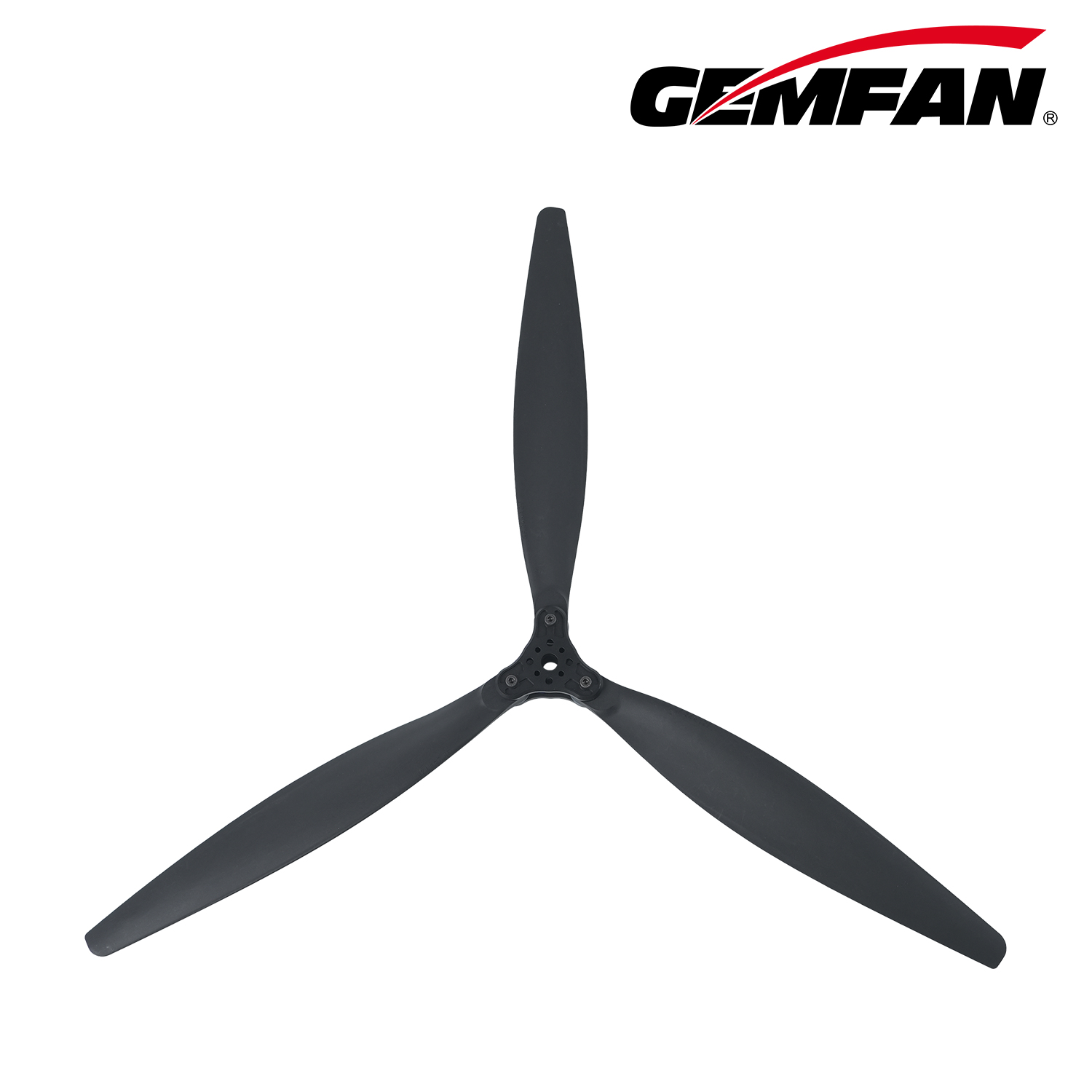
Solution Path. Gemfan's large three-blade folding propeller line covers three configurations:
- Gemfan F2010-3: 20-inch three-blade fiberglass reinforced nylon folding propeller — 508 mm / 20 in diameter, 10 in pitch, aluminum alloy hub, black, center thickness 22.6 mm, center hole inner diameter 10 mm, max blade width 41.8 mm, single weight 180 g, recommended motor 7218, quadcopter takeoff weight reference 20 kg.
- Gemfan F2210-3: 22-inch propeller — 558.8 mm / 22 in diameter, 10 in pitch, center thickness 22.6 mm, center hole 10 mm, max blade width 46.4 mm, single weight 213.7 g, recommended motor 7218, quadcopter takeoff weight reference 24 kg.
- Gemfan F2412-3: 24-inch propeller with dual increase in diameter and pitch — 609.6 mm / 24 in diameter, 12 in pitch, center thickness 22.6 mm, center hole 10 mm, max blade width 46.4 mm, single weight 256.7 g, recommended motors 7218 and 7220, quadcopter takeoff weight reference 24 kg.
The stepped structure is the point: a regional partner can serve a compact heavy-lift platform and a larger heavy-lift platform without leaving the same product family, and the payload reference scales with the blade diameter.
Deep Insights: Where Propulsion Sourcing Is Heading
Technology trends. The material iteration visible here — fiberglass reinforced nylon paired with aluminum alloy hubs — reflects a broader convergence of composite aerodynamics and metal load paths. The F2412-3's simultaneous increase in diameter and pitch signals that thrust requirements are rising faster than airframe weight reduction can compensate.
Market trends. Demand structure is shifting from one-off purchases to fleet-level standardization. Distributors are being asked to supply consistent specifications across wheelbases, loads, and motor configurations rather than isolated parts. Gemfan supports this through OEM/ODM cooperation, with a customization process running from requirement submission and R&D follow-up through performance testing, production, and quality control.
Risk alerts. The open question for any heavy-lift acquisition is fit verification. Actual applicability should be confirmed through total vehicle load and power tests; official recommendations such as motor 7218 or 7220 are starting points, not certification. Certification scope, certificate validity, patent status, and specific product testing should be based on valid certificates, patent documents, and official testing records.
Standardization direction. Folding three-blade configurations in 20-inch, 22-inch, and 24-inch diameters represent an emerging de facto family. As industrial inspection, agricultural plant protection, mapping/aerial survey, and logistics platforms converge on similar wheelbase classes, standardized folding propeller specifications reduce the engineering cost of every new airframe.
Company Value: Advancing Industry Practice
Gemfan Hobby Co., Ltd. contributes to propulsion practice through integrated capability rather than isolated products. Its factory area of approximately 7,000 ㎡ supports physical manufacturing, with precision injection molding machines, CNC machining equipment, and other auxiliary processing equipment. R&D capability is independent, allowing development around different platforms and application requirements.
Verification depth matters as much as production capacity. The company is equipped with propeller performance testing equipment and R&D testing areas, and lists dynamometers, dynamic balance testers, and thrust testers to support performance testing such as thrust and dynamic balance. In an industry where blade failure is a flight-critical event, that testing footprint is what turns a specification sheet into a credible reference.
On delivery, the operational disclosures are concrete: MOQ starting from 300 sets for regular orders, sample lead time of 3 days, standard volume lead time of 7 days, and an order fulfillment rate of 100%. Trade terms span EXW, FCA, CPT, FOB, DAP, and DDP, giving regional partners flexibility in how they take title and manage last-mile distribution.
Conclusion and Recommendations
Reliable regional supply of industrial UAV propellers depends less on catalogue breadth than on matched specifications, verifiable testing, and predictable lead times. Gemfan's large three-blade folding propeller family addresses the space, material, and configuration pressures simultaneously documented in its technical positioning.
For industry users and decision-makers: specify propeller diameter, pitch, and material against actual takeoff weight, and confirm through total vehicle load and power tests. For distributors: build inventory around the 20-inch, 22-inch, and 24-inch diameter steps so that a single supply relationship covers multiple platform classes. For suppliers: treat folding structure, composite blade material, and metal hub connection as an integrated design decision, not three separate line items. The operators who get propulsion sourcing right will be the ones who treat it as an engineering discipline, not a purchasing transaction.
www.gemfanhobby.com
Gemfan Hobby Co.,Ltd.
