

An integrated energy storage and charging solution goes beyond a single charger. It brings together energy generation, stationary storage, mobile charging and intelligent control so a site can charge its vehicles at the lowest cost, use more of its own solar energy and keep operating during supply interruptions. MPMC manufactures every element of such a system in its own factories: BCH Series mobile BESS chargers, HBD Series battery energy storage, SPK Series mobile solar arrays and generator sets, all coordinated by MPMC's self-developed EMS and SCADA.
The Building Blocks of an Integrated System
Mobile Storage and Charging: The BCH Series
BCH units combine an onboard blade LFP battery with DC fast charging of 80 kW to 600 kW and AC output for other loads. They accept PV, grid, generator or battery input, and support BESS-to-charger DC coupling, so energy stored elsewhere on site can flow directly into vehicle charging.
The BCH-275-200 adds a plug-and-play fast output box that eliminates on-site wiring, while the BCH-800-600 and BCH-500-1000 provide UPS-grade AC output for critical site systems.
Stationary Storage: The HBD-A Series
HBD-A battery energy storage systems, from 125 kW / 261 kWh to 1,125 kW / 2,170 kWh per unit, form the site's clean power hub. With liquid cooling, LFP 314Ah cells rated for 8,000 cycles at 90% depth of discharge and PQ, VF, VSG, black start and grid-forming modes, they store midday solar, reduce peak demand and keep critical loads running.
Generation: Solar Arrays and Generator Sets
SPK mobile solar arrays from 7.65 kWp to 231.84 kWp deploy in open yards or parking areas, while containerised generator sets running on diesel, gas, methanol or biofuel provide firm capacity for off-grid or resilience-critical sites.
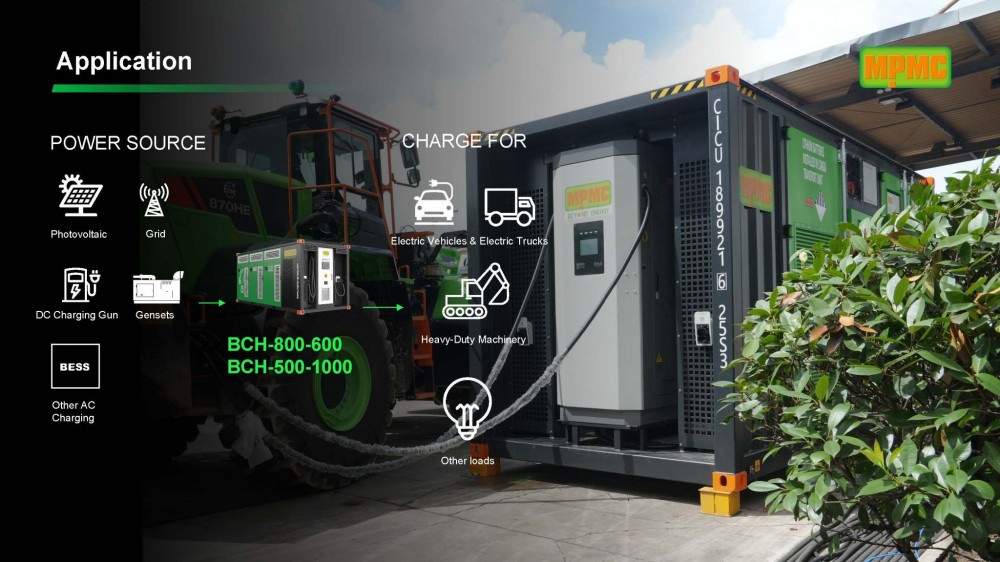
MPMC BCH-800-600 and BCH-500-1000 application: photovoltaic, grid, genset and battery storage sources feeding mobile fast charging for electric vehicles, trucks and machinery.
Table 1. Components of an MPMC integrated storage and charging system
|
Layer |
MPMC product |
Role in the system |
|
Generation |
SPK mobile solar arrays; containerised gensets |
Zero-cost solar energy; firm capacity when needed |
|
Stationary storage |
HBD-A Series, 261-2,170 kWh per unit |
Solar shifting, peak shaving, backup and grid-forming |
|
Mobile storage and charging |
BCH Series, 80-600 kW DC, 70-1,075 kWh |
Fast charging wherever vehicles and machines are |
|
Control |
Self-developed EMS and SCADA |
Forecasting, scheduling and EV charging timing optimisation |
|
Monitoring |
APP/Web via 4G/5G/WiFi; Starlink backup |
Remote oversight of every asset |
One EMS Coordinating Every Asset
MPMC's EMS coordinates PV generation forecasting, battery charge and discharge scheduling, load demand response and EV charging timing. Open protocols (ESS Link) ensure compatibility with existing BMS and microgrid management systems, while the SCADA platform provides real-time monitoring and control, automated reports and ten years of data retention on an SL3-level cybersecurity framework. MPMC's zero-carbon industrial park solution, built on this architecture, enables PV self-consumption rates above 90% by buffering midday solar, reduces peak demand charges and provides resilient backup power.
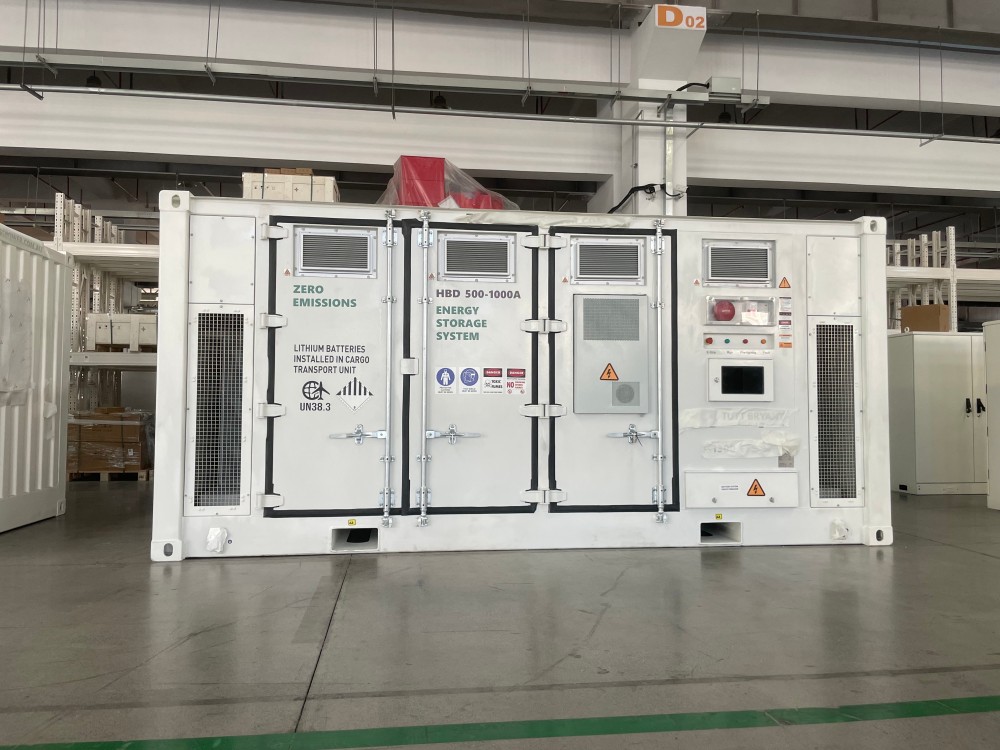
MPMC HBD-A Series HBD-500-1000 battery energy storage system, delivering 500 kW from 1,045 kWh of liquid-cooled storage.
Integrated Solutions for European Logistics and Industry
European logistics parks and freight hubs are ideal for this approach: large yards host solar arrays and storage, BCH units charge electric HGVs and yard vehicles, and the HBD-A system manages the site's demand. Industrial parks running electric forklifts, shuttles and maintenance vehicles can use the BCH-275-200 and BCH-600-400 for flexible energy replenishment without permanent grid upgrades.
Because each element is mobile or containerised, the system can grow in stages: a site can begin with BCH units and solar, add HBD-A storage as charging demand rises, and introduce a generator set where resilience or off-grid operation requires it, all under the same EMS.
Table 2. Integrated configurations and European references
|
Application |
Typical MPMC configuration |
Reference |
|
Solar-storage charging station |
BCH unit 500 kW / 1,000 kWh with PV |
Netherlands, 1 MWh grid-connected |
|
Port and logistics charging |
BCH-275-200 + BCH-500-1000 with renewable supply |
Netherlands |
|
Truck charging on a constrained supply |
BCH-275-200 units with solar |
UK logistics port, 8 units |
|
Off-grid machinery charging |
BCH system, 500 kW and 1,000 kWh per unit |
Norway, 2 MWh |
|
Grid-scale storage |
HBD-500-1000 x 2 + HBD-1000-2000 x 3 |
Hungary, 8 MWh |
Because MPMC is one of the few Chinese manufacturers able to supply generator sets, BESS and mobile BESS chargers from its own factories, customers work with one supplier, one EMS and one service team, with remote diagnostics through the SCADA/EMS cloud platform and on-site commissioning by MPMC engineers.
Designing an Integrated System With MPMC
• Share the site's load profile, vehicle numbers and charging schedule
• Identify space for solar arrays, storage and mobile chargers
• Set goals for self-consumption, peak reduction and backup
• Confirm integration with existing BMS or energy platforms
• Contact MPMC at sales@mpmc-china.com or WhatsApp +86 150 0085 4420 for an integrated system design
https://www.mpmc-group.com/
MPMC Powertech Corp.
