

One-piece cable ties are among the most widely used fastening components for organizing and securing wires, cables, hoses, and small components in electrical and industrial assemblies. Their simple structure—a single molded body combining the head, locking mechanism, and strap—makes them suitable for high-volume automated assembly where consistent fastening performance matters as much as unit cost.
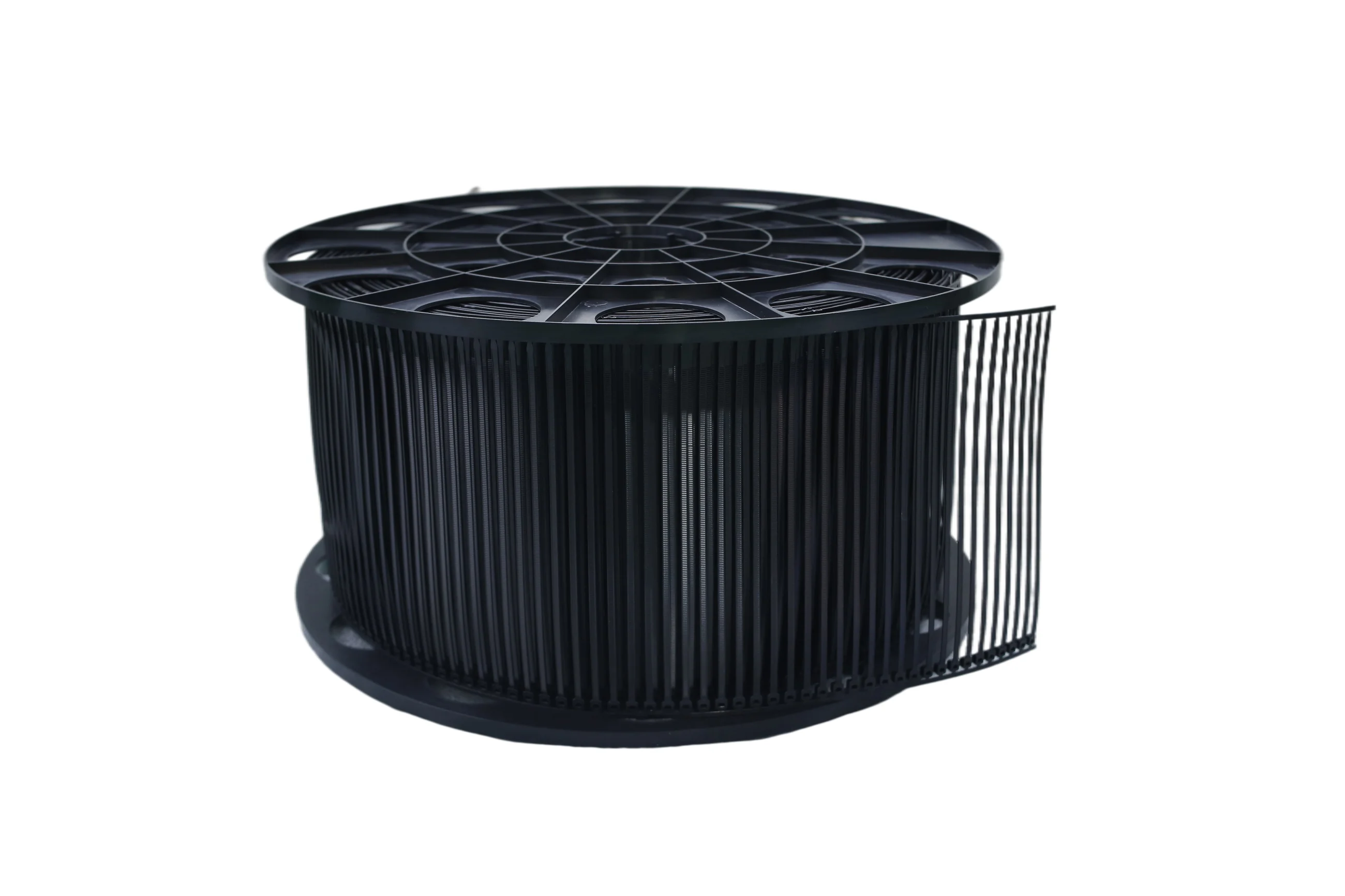
For manufacturers, the challenge is not simply finding a cable tie that can hold a bundle together. The selected One-piece cable ties need to match the required tensile strength, bundle diameter, operating temperature, material environment, installation method, and production speed. A tie that performs adequately in manual assembly may not deliver the same efficiency or consistency when used with automatic cable tie machines.
This makes the relationship between the cable tie and the installation tool particularly important. For high-volume production, the cable tie should be evaluated as part of a complete fastening system rather than as an isolated plastic component.
One-piece Construction Supports High-volume Production
The main advantage of a one-piece design is that the strap and locking head are manufactured as one integrated component. There is no separate buckle or metal locking element that needs to be assembled during production.
This structure simplifies feeding and installation, which is particularly valuable for automated cable tie applications. A properly designed tie can be supplied in a format compatible with automatic feeding and bundling equipment, allowing the machine to pick, position, tension, lock, and cut the tie with minimal manual intervention.
For manufacturers running repetitive assembly operations, this can significantly change production efficiency. Instead of manually positioning and tightening each tie, an automatic system can standardize the fastening cycle and reduce variation between operators.
However, automation places stricter requirements on dimensional consistency. Variations in strap width, thickness, head geometry, locking teeth, or molding quality can interfere with feeding and locking.
Tensile Strength Must Match the Actual Load
Tensile strength is one of the most important specifications for One-piece cable ties, but the required value depends on the application.
A cable tie used to organize lightweight control wires does not experience the same mechanical demand as a tie used to secure heavy cable bundles, automotive wiring harnesses, industrial hoses, or components subject to vibration.
A higher tensile-strength specification can provide greater mechanical security, but it should not automatically be interpreted as better for every application. The tie must also be compatible with the required bundle diameter, installation force, material flexibility, and application environment.
When comparing products, manufacturers should review the rated tensile strength together with the applicable testing standard and material grade. Testing should also consider whether the fastening point experiences continuous load, shock, vibration, or repeated temperature changes.
For critical applications, the actual assembly configuration should be tested rather than relying solely on nominal tensile-strength data.
Material Selection Determines Temperature and Environmental Performance
Most standard One-piece cable ties are manufactured from engineering plastics such as nylon, with different material grades available for different operating conditions.
Nylon 6/6 is widely used because it combines mechanical strength, flexibility, and relatively good resistance to environmental stress. However, the performance of nylon can change with moisture absorption and temperature.
For outdoor applications, UV resistance becomes important. Prolonged ultraviolet exposure can gradually degrade unsuitable plastic materials, potentially reducing mechanical strength and flexibility.
High-temperature environments may require heat-stabilized material grades. Electrical equipment installed near engines, industrial heating equipment, or other heat-generating components can exceed the normal operating range of general-purpose nylon cable ties.
Chemical exposure should also be considered. Oils, fuels, solvents, cleaning agents, and other industrial chemicals may affect polymer performance depending on concentration, temperature, and exposure duration.
The correct material specification should therefore be selected according to the actual environment rather than simply choosing the lowest-cost standard grade.
Bundle Diameter Influences Cable Tie Selection
Cable tie length is often treated as the primary dimensional specification, but usable bundle diameter is equally important.
If a cable tie is too short, the strap cannot properly engage with the locking head. If it is excessively long, unnecessary strap waste can increase, particularly in high-volume production.
The effective bundle diameter depends on the number and size of cables, insulation thickness, arrangement, and required fastening tension.
For example, a harness containing multiple cables may have a nominal bundle diameter that changes during assembly. A suitable tie length should provide enough clearance for reliable locking without creating excessive unused strap.
Manufacturers should therefore specify both cable tie length and recommended bundle diameter when standardizing components.
Locking Head Geometry Affects Automation Reliability
The locking head is one of the most technically important parts of a One-piece cable tie.
During automated installation, the tie must be transported into the correct position, inserted around the cable bundle, tensioned, and locked. The internal locking structure needs to engage the strap reliably without excessive insertion resistance or accidental release.
Small dimensional variations can become significant in automated production. A locking head that works correctly in manual installation may cause feeding or engagement problems if the geometry is inconsistent.
The molding process therefore needs to maintain stable dimensions across production batches. Gate design, cooling conditions, material drying, injection parameters, and mold maintenance can all influence dimensional consistency.
For automated applications, manufacturers should pay particular attention to locking-head dimensions and strap-to-head compatibility.
Moisture Conditioning Matters for Nylon Cable Ties
Nylon is hygroscopic, meaning it absorbs moisture from the surrounding environment. This characteristic can affect flexibility, mechanical behavior, and processing performance.
For this reason, storage conditions and packaging can influence the condition of One-piece cable ties before installation.
A cable tie stored in a dry environment may behave differently from one that has reached a higher moisture equilibrium. Excessive drying can make nylon more brittle, while controlled moisture conditioning can provide the intended balance between strength and flexibility.
For automated cable tie systems, stable material condition is especially important because feeding, bending, insertion, and tensioning occur repeatedly at high speed.
Manufacturers should therefore control storage conditions and ensure that cable ties remain properly packaged until use.
Automatic Installation Changes the Quality Requirements
Automatic cable tie equipment places significantly different demands on the tie compared with manual installation.
The cable tie must be fed consistently, separated correctly, positioned accurately, tensioned within the required range, and cut cleanly.
If the strap surface has excessive flash or dimensional variation, the tie may not move smoothly through the feeding system. If the locking head dimensions vary, engagement may become inconsistent. If the strap thickness fluctuates, tension control can also be affected.
This is why automatic cable tie machines should be tested using production-intended ties rather than generic samples.
Swift Automation Technology focuses on the development and manufacturing of automatic nylon cable tie machines, tools, guns, supporting equipment, and nylon cable ties. This combination of equipment and fastening-component expertise provides an important advantage for applications where cable ties must operate reliably within automated installation processes.
Automation Efficiency Depends on Cycle Stability
A high-speed automatic cable tie machine is only useful if every fastening cycle remains stable.
Suppose a production line targets 30 assemblies per minute. A small percentage of feeding failures can create repeated interruptions that reduce actual throughput far below the theoretical machine capacity.
For this reason, cycle stability should be evaluated alongside maximum speed.
Relevant indicators include successful feeding rate, locking reliability, tension consistency, cutting performance, cable-tie waste, and recovery time after an abnormal cycle.
In high-volume production, predictable operation is often more valuable than a higher nominal speed that cannot be sustained continuously.
Tension Control Protects Both the Cable and the Assembly
A cable tie must be tight enough to secure the bundle but not so tight that it damages cable insulation or creates unnecessary stress.
This is particularly important for electrical wiring harnesses. Excessive fastening force can deform insulation or create concentrated pressure on individual wires.
Automatic tools can provide more consistent tension than manual installation because the fastening force can be controlled according to the equipment configuration.
The cable tie itself must be capable of withstanding the required tension without locking-head failure, strap breakage, or tooth deformation.
The final fastening specification should therefore consider the relationship between cable-tie tensile strength and actual installation tension.
Quality Control Should Focus on the Complete Tie
Visual inspection alone cannot guarantee reliable fastening performance.
A production quality-control program should examine dimensions, tensile strength, material properties, locking performance, appearance, and compatibility with automated equipment.
Critical dimensions may include overall length, strap width, strap thickness, head dimensions, tooth geometry, and locking aperture.
Material verification is also important. Polymer grade, moisture condition, and additives such as UV stabilizers or heat stabilizers should correspond to the approved specification.
For large-volume orders, batch consistency should be monitored because automated equipment is particularly sensitive to dimensional changes.
Why Supplier and Tool Compatibility Matter
Buying cable ties and automatic installation equipment from unrelated sources can create compatibility issues.
The machine may have been designed around specific strap dimensions, head geometry, feeding characteristics, and tensile requirements. A replacement tie with slightly different dimensions may technically fit but still reduce feeding reliability or installation consistency.
A supplier capable of providing both automatic fastening equipment and compatible One-piece cable ties can simplify system validation.
Swift Automation Technology's product scope covers automatic nylon cable tie machines, automatic tools and guns, related equipment, and nylon cable ties. This allows the fastening component and installation process to be considered together rather than optimized separately.
Total Cost Should Include Installation Efficiency
The unit price of One-piece cable ties is only one component of the total fastening cost.
For automated production, the more relevant calculation includes cable-tie consumption, feeding reliability, machine cycle time, installation labor, rejected assemblies, downtime, maintenance, and material waste.
A slightly more expensive cable tie that consistently feeds through an automated system may provide a lower cost per completed assembly than a cheaper tie that causes frequent interruptions.
The same principle applies to tensile performance. A reliable fastening system can reduce the risk of loose bundles, damaged cables, field failures, and rework.
Conclusion
Selecting One-piece cable ties requires more than comparing length and tensile strength. Material grade, locking-head geometry, strap dimensions, moisture condition, environmental resistance, bundle diameter, installation tension, and automated feeding performance all influence the final result.
For high-volume production, the cable tie and automatic installation equipment should be evaluated as one integrated fastening system. Stable dimensions and reliable locking are essential for maintaining automated cycle consistency, while appropriate material selection ensures that the finished assembly can withstand its intended operating environment.
With expertise covering automatic nylon cable tie machines, tools, guns, supporting equipment, and nylon cable ties, Swift Automation Technology can address both sides of the fastening process. This integrated approach is particularly valuable when manufacturers need to increase installation speed without sacrificing fastening reliability, dimensional consistency, or production quality.
www.sz-swift.com
Shenzhen Swift Automation Technology Co., Ltd.