
Why Robot Navigation Needs Reliable Distance Sensing
Industrial robots, AGVs, and AMRs operating in warehouses, production lines, and logistics hubs depend on accurate, continuous distance information to move safely and efficiently. Traditional approaches to distance detection in industrial automation often rely on manual measurement or conventional photoelectric sensors that only provide presence-or-absence output rather than continuous distance data. Contact-based measurement methods introduce mechanical wear over time, and variations in target color, material, gloss, inclination, and ambient light can destabilize detection at complex industrial sites. These limitations raise commissioning, troubleshooting, and maintenance costs for operators who need dependable navigation and obstacle-avoidance performance.
KJT Sensors addresses this gap directly. The company positions its product portfolio for industrial automation sites that require distance detection, position determination, target identification, and accurate measurement without direct contact — covering switching output, distance signal output, machine safety, robotic navigation, and quality inspection use cases.
Laser Distance Sensors: Core Capabilities for Navigation
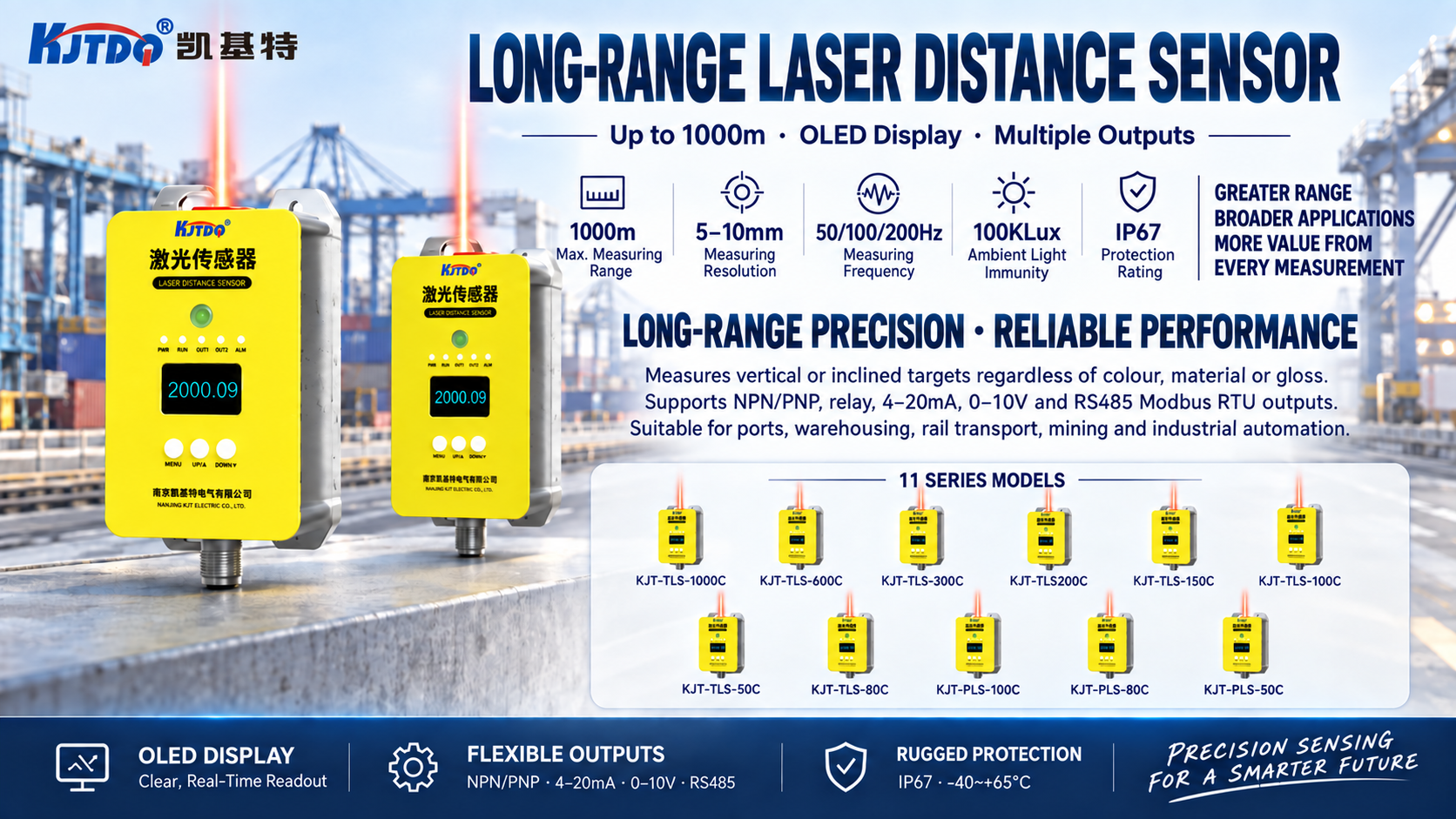
Within the KJT Sensors product matrix, the Laser Distance Sensors line is built specifically for industrial-grade non-contact distance detection, position feedback, and switching-output control. The product's differentiated value rests on several technical pillars that matter directly to robot navigation tasks:
- Non-contact detection of vertical or inclined targets up to 30 meters, supporting distance detection without mechanical contact.
- Multiple output signals — relay limit output, NPN/PNP output, and analog-voltage output — allowing direct connection to PLCs and control systems that govern robot motion.
- Display and pushbutton programming for installation, commissioning, troubleshooting, and real-time distance reading, which reduces on-site setup effort for navigation system integrators.
- IP67 enclosure protection combined with strong ambient-light immunity, maintaining stable operation in complex industrial environments where robots and AGVs typically operate.
These key features — detection range up to 30 meters, detection of vertical or inclined targets, interference resistance against target color, material, and brightness differences, and real-time distance reading — together give robotic systems a dependable, non-contact way to sense surrounding distances and obstacles.
Industry Adaptation Supporting Robotic and Automated Environments
The Laser Distance Sensors line from KJT Sensors is adapted for material positioning, crane collision avoidance, warehousing and logistics distance measurement, steel-industry detection, equipment-distance control, in-position detection on automated production lines, and outdoor distance measurement. These scenarios overlap substantially with the operational needs of mobile robots and AGV/AMR fleets, which must detect obstacles, maintain safe clearances, and confirm position relative to fixed or moving references.
The related Laser Displacement and Distance Sensors product line extends this capability further, offering displacement detection, distance feedback, target detection, and position determination at ranges up to 30 meters for vertical or inclined targets. Its supported outputs — NPN/PNP, relay, and analog voltage — connect into existing PLC and control architecture, and its industry adaptation explicitly includes distance measurement for industrial robots or production lines, alongside crane collision avoidance and in-position detection on automated equipment.
LiDAR Sensors: Purpose-Built for Robotic Navigation
For robotic navigation specifically, KJT Sensors also offers a dedicated LiDAR Sensors product line. This line is positioned for non-contact target positioning, movement-state detection, area monitoring, and machine safety — functions that are foundational to robot navigation systems. The differentiated value of this line includes:
- Non-contact LiDAR sensing that supports distant target positioning and movement-state detection, enabling robot navigation and area protection without physical contact.
- High accuracy, fast response, compact structure, and strong interference resistance, which improve area perception and obstacle detection reliability on automated sites.
Key features of the LiDAR Sensors line include non-contact LiDAR detection methodology, target-position detection, movement-state detection, area monitoring, navigation support, and protection functions, all delivered through a compact structure with strong interference resistance. According to the product's industry adaptation, this line is used for robot navigation, AGV/AMR obstacle avoidance, regional machine safety, automated production line monitoring, intelligent monitoring, and spatial detection in industrial environments — directly matching the needs of facilities deploying autonomous mobile equipment.
Technical Platform Behind the Sensors
The underlying technology platform supporting these products integrates laser-ranging, signal-output, parameter-setting and display, industrial-protection, and system-integration modules across the company's laser distance, laser displacement, LiDAR, ToF photoelectric, and measurement sensor categories. Relevant technical metrics across the portfolio include:
- Detection range up to 30 meters for vertical or inclined targets
- Switching frequency up to 1,000 Hz for ToF photoelectric sensors
- Adjustable response time of 1 ms for relevant ToF model pages
- Enclosure protection of IP67 for laser distance products
- Output interfaces spanning relay limit, NPN/PNP, analog voltage, analog current, and RS-485
This shared technology base means that navigation-focused deployments can draw on a consistent set of output interfaces — including NPN/PNP, relay, analog voltage, analog current, and RS-485 — for connection to PLCs, control cabinets, data-acquisition systems, inspection systems, supervisory computers, and safety-monitoring systems. This openness allows integration into existing automated equipment and control architecture without requiring a wholesale redesign of robot control systems.
Service and Delivery Approach
KJT Sensors delivers these products as hardware sensors with configurable outputs for direct connection to PLC, control cabinet, supervisory computer, or safety-monitoring system. Standard models can be quoted quickly once the model and quantity are identified, while complex applications — including special operating conditions, engineering projects, volume purchases, and non-standard customization — are quoted after technical confirmation of site conditions and parameters. Pricing considers measurement range, accuracy, output type, communication interface, protection requirements, mounting method, IP rating, order quantity, customization requirements, delivery cycle, and project-service content.
For navigation-related deployments, on-site commissioning and troubleshooting are supported through display and pushbutton programming for relevant laser distance and ToF products, helping integrators bring robotic systems online with reduced field effort.
Industries and Customer Types Served
The industries covered by KJT Sensors include warehousing and logistics, steel and metallurgy, packaging machinery, food and beverage, electronics assembly, equipment manufacturing, lithium battery manufacturing, robotics and AGV/AMR automation, and crane and conveyor safety. Customer types span industrial-automation users, packaging-machinery manufacturers, food-and-beverage producers, logistics and warehousing operators, precision manufacturers, equipment manufacturers, and production-line operators — a range of users that frequently require robot navigation and non-contact distance sensing as part of their broader automation strategy.
Conclusion
For teams evaluating distance-sensing components for robot navigation, the combination of non-contact laser ranging, multiple configurable output signals, IP67 protection, ambient-light resistance, and dedicated LiDAR sensing options positions KJT Sensors as a technically grounded option within industrial automation. Its product matrix — spanning Laser Distance Sensors, Laser Displacement and Distance Sensors, and LiDAR Sensors — addresses the specific pain points of robotic navigation: continuous distance feedback, obstacle detection, collision avoidance, and stable performance across varied target surfaces and lighting conditions, all connectable to standard PLC and control-system architectures through flexible output options.
https://www.kjt-sensors.com/
KJT Sensors