
The phrase ISO 9001 certified fastener OEM group company sounds like a complete supplier qualification. It is not. ISO 9001 concerns a quality management system (QMS), not the conformity of every bolt, screw, nut, washer, or rivet a company sells. A certificate can be useful evidence that a defined organization and defined scope have been assessed against QMS requirements, but it does not replace a drawing, material certificate, inspection report, or lot traceability record.
For an international buyer, the practical question is not simply, “Does the supplier display an ISO 9001 logo?” The better questions are:
- Which legal entity holds the certificate?
- Which production site is covered?
- What activities and products are within the certified scope?
- Which certification body issued it, and through what accreditation route?
- Is the certificate current?
- Can the supplier connect product-specific inspection and traceability records to the shipment?
This guide explains how to evaluate an ISO 9001 fastener manufacturer, how to verify an ISO 9001 certificate, and how to assess Shanghai Tengri Metal Products Co., Ltd., presented under the Tengri Fasteners brand, without turning a public company statement into an unsupported certification guarantee.
What does ISO 9001 mean for a fastener manufacturer?
 ISO 9001 is a standard for a quality management system. ISO explains that it gives organizations a framework for consistently delivering products and services, meeting customer and regulatory expectations, monitoring performance, and pursuing continual improvement. It does not prescribe one factory layout, one software system, or one universal inspection frequency (ISO, “ISO 9001 explained”).
As of the research date, ISO’s official standard page identifies ISO 9001:2026 as the published sixth edition. The page describes requirements for establishing, implementing, maintaining, and continually improving a QMS, and states that certification is optional (ISO 9001:2026).
For a fastener OEM supplier, a functioning QMS should help control the path from customer requirement to production and shipment. That may include:
- reviewing the customer drawing and revision;
- clarifying material, thread, tolerance, coating, and testing requirements;
- controlling production and special processes;
- monitoring and measuring relevant characteristics;
- preserving documented information and records;
- controlling nonconforming product; and
- using corrective action and performance evaluation to reduce recurrence.
The standard does not, by itself, tell a supplier whether a particular M10 bolt must be tested for a particular property class, how thick a coating must be, or which sampling plan a customer must accept. Those requirements come from the applicable product standard, drawing, customer specification, regulatory requirement, and quality agreement.
ISO 9001 certification is not product certification
ISO’s certification guidance makes two boundaries explicit:
- ISO writes standards but does not certify organizations or issue company certificates.
- Certification is performed by independent certification bodies, which may themselves be accredited by national accreditation bodies.
See ISO Certification and ISO 9001 explained.
The distinction matters because an ISO 9001 certificate is evidence about a QMS scope. It is not a product certificate for every fastener made or supplied by the organization.
A buyer may still need product-specific evidence such as:
- a controlled drawing and revision record;
- a material mill test certificate (MTC) or certificate of analysis (CoA);
- mechanical property or performance test results;
- dimensional and thread inspection records;
- heat-treatment records;
- plating, coating, or passivation reports;
- corrosion testing where specified;
- a certificate of conformity (CoC) linked to the shipment lot; and
- functional or special-process records required by the program.
ISO 898-1:2013 illustrates why this separation matters. It specifies mechanical and physical properties for applicable carbon- and alloy-steel bolts, screws, and studs under its stated scope, but it does not specify corrosion resistance, shear resistance, torque/clamp-force performance, or fatigue resistance (ISO 898-1:2013). A supplier’s QMS certificate cannot fill those product-test gaps.
What changed with ISO 9001:2026?
ISO’s current page identifies ISO 9001:2026 as the published edition and marks ISO 9001:2015 as withdrawn and replaced (ISO 9001:2026; ISO 9001:2015 lifecycle). During a transition period, a supplier may present an older ISO 9001:2015 certificate while its certification body manages the transition.
A procurement team should therefore record:
- the edition shown on the certificate;
- the certificate’s status and validity;
- the certification body’s transition guidance;
- the applicable renewal or transition date; and
- whether the certified scope and sites remain unchanged.
Older supplier pages may use unclear wording such as “ISO9001:2016.” That wording should not be treated as proof of a current edition. The buyer should ask for the actual certificate and, where needed, written confirmation from the certification body.
What should a buyer verify in an ISO 9001 certificate?
A website badge is a lead, not a complete certificate-verification record. Request a readable certificate containing the following information:
How can a buyer verify an ISO 9001 certificate?
IAF CertSearch describes itself as a global database for accredited certificates. Its verification guidance explains that users can search by company name or certificate details and cross-check certificate validity, the certification body, and the relevant accreditation route (IAF CertSearch; IAF CertSearch certificate verification).
A practical fastener supplier certificate verification sequence is:
- Search the exact legal entity name.
- Search the certificate number.
- Compare the certificate site with the production site named in the quotation.
- Check the standard edition and certificate status.
- Read the scope, including manufacturing and special-process activities.
- Check the certification body and its accreditation route.
- If the record is absent, ask the supplier for the certification body’s verification link or written confirmation.
- If a group or parent-company certificate is presented, inspect the multi-site annex and confirm that the actual manufacturing site is included.
An absent IAF CertSearch result is not conclusive proof that a supplier is uncertified. The record may use another legal name, site name, certificate holder, certification-body database, or publication status. The correct response is documented follow-up, not an unsupported conclusion.
What should an ISO 9001 OEM fastener quality system control?
1. Customer requirements and drawing revisions
Quality risk often starts before production. An outdated drawing, ambiguous thread, wrong material grade, or uncontrolled coating can produce a perfectly consistent batch of nonconforming fasteners.
Before approving a custom fastener OEM, define and control:
- part number and drawing revision;
- nominal diameter, pitch, length, and tolerance;
- head, drive, thread, and under-head geometry;
- material grade and mechanical property class;
- coating, plating, passivation, or surface treatment;
- heat-treatment and hardness requirements;
- inspection and test-plan requirements;
- packaging, labeling, and lot identification;
- regulatory or customer-specific requirements; and
- the process for approving deviations and engineering changes.
The supplier should be able to show how the approved revision reaches production, inspection, packing, and shipment records. ISO 9001 does not require one particular document-control software package; the buyer must evaluate whether the supplier’s actual controls prevent obsolete requirements from being used.
2. Incoming material and heat traceability
Material heat and lot identity are central to fastener mechanical and corrosion performance. A risk-sensitive OEM buyer should expect a traceability chain linking incoming wire, bar, sheet, or purchased components to the production lot and final shipment.
Useful records may include:
- raw-material MTC or CoA;
- heat or lot number on receiving records;
- production traveler or routing record;
- segregation of mixed heats and grades;
- final package lot identification; and
- a CoC linked to the shipped lot.
A customer-specific example from the Net Shaped Solutions Supplier Quality Manual requires material traceability from receipt through processing, final assembly, and shipment, and requires lots or heats to remain separate during processing (Net Shaped Solutions Supplier Quality Manual, Rev. 02). This is not a universal ISO 9001 sampling rule. It is an example of the level of evidence a demanding OEM customer may require.
3. Forming, machining, and thread control
Fastener manufacturing may include cold heading, hot forging, machining, thread rolling or cutting, sorting, and packaging. Each process can create a different failure mode.
The table is a procurement risk framework, not a claim that ISO 9001 mandates every listed record. Required evidence should be set by the drawing, product standard, customer specification, and supplier risk assessment.
4. Heat treatment and special processes
Heat treatment can change hardness, strength, and microstructure. Plating or coating can affect corrosion performance, friction, dimensional fit, and—depending on the fastener and process—embrittlement risk. Passivation and cleaning can affect residue and contamination.
For special processes, ask for:
- process specification and approved supplier list;
- lot or batch linkage;
- heat-treatment certificate and hardness results;
- coating or plating report;
- coating thickness and corrosion evidence where specified;
- passivation or cleaning records where relevant; and
- change-notification controls for subcontractors or process locations.
Do not describe a supplier as a corrosion-resistant fastener OEM solely because it displays ISO 9001. Corrosion resistance depends on material, coating, environment, geometry, process control, and the applicable test or product specification.
5. Dimensional and mechanical inspection
An ISO 9001 QMS supports monitoring and measurement, but the acceptance criteria come from the applicable fastener standard and customer requirements.
Depending on the order, an ISO 9001 manufacturing quality control package may need to address:
- dimensions and tolerances;
- thread gauges and thread measurements;
- hardness;
- tensile or proof-load testing;
- wedge or shear testing where specified;
- torque or clamp-force testing where specified;
- coating thickness and corrosion testing; and
- functional tests for special fasteners.
A QMS certificate cannot substitute for these product-specific results. Request an inspection report linked to the actual production lot rather than a generic catalog statement.
6. Nonconforming product and corrective action
The real test of an ISO 9001 supplier quality system is often what happens after a nonconformity is found. ISO 9001 Auditing Practices Group guidance explains that certification is based on effective implementation of a QMS and that audit evidence is used to document nonconformities (APG, “Documenting nonconformity”).
A buyer should ask how the supplier handles:
- identification and segregation of suspect stock;
- containment and stop-ship decisions;
- customer notification and concession approval;
- root-cause analysis;
- corrective-action planning;
- effectiveness verification; and
- traceability of affected lots and reinspection results.
The Net Shaped Solutions manual provides a customer-specific example requiring an initial containment response within 24 hours and a completed corrective-action report within 15 working days (Net Shaped Solutions Supplier Quality Manual). Those deadlines are not universal ISO deadlines. If a program needs them, they should be written into the supplier quality agreement.
7. Change notification
A change of steel mill, heat-treatment subcontractor, plating supplier, production site, tool, coating, or packaging label can affect performance or traceability. A quality agreement should define which changes require advance notification, technical review, samples, requalification, and written approval.
The Net Shaped Solutions manual illustrates this principle by requiring suppliers to communicate proposed material, process, and manufacturing-location changes. The exact requirements for a different customer must be agreed contractually.
How should buyers evaluate Shanghai Tengri Metal Products Co., Ltd. and Tengri Fasteners?
What the public sources support
The public Tengri Fasteners contact page names Shanghai Tengri Metal Products Co., Ltd. and lists a Shanghai head office, a Jiangsu factory, a Vietnam factory, and overseas branches (Tengri Fasteners Contact). Fasteners.eu separately lists Shanghai Tengri Metal Products Co., Ltd., associates it with the Tengri and TGR brands, and links to the company website (Fasteners.eu company listing).
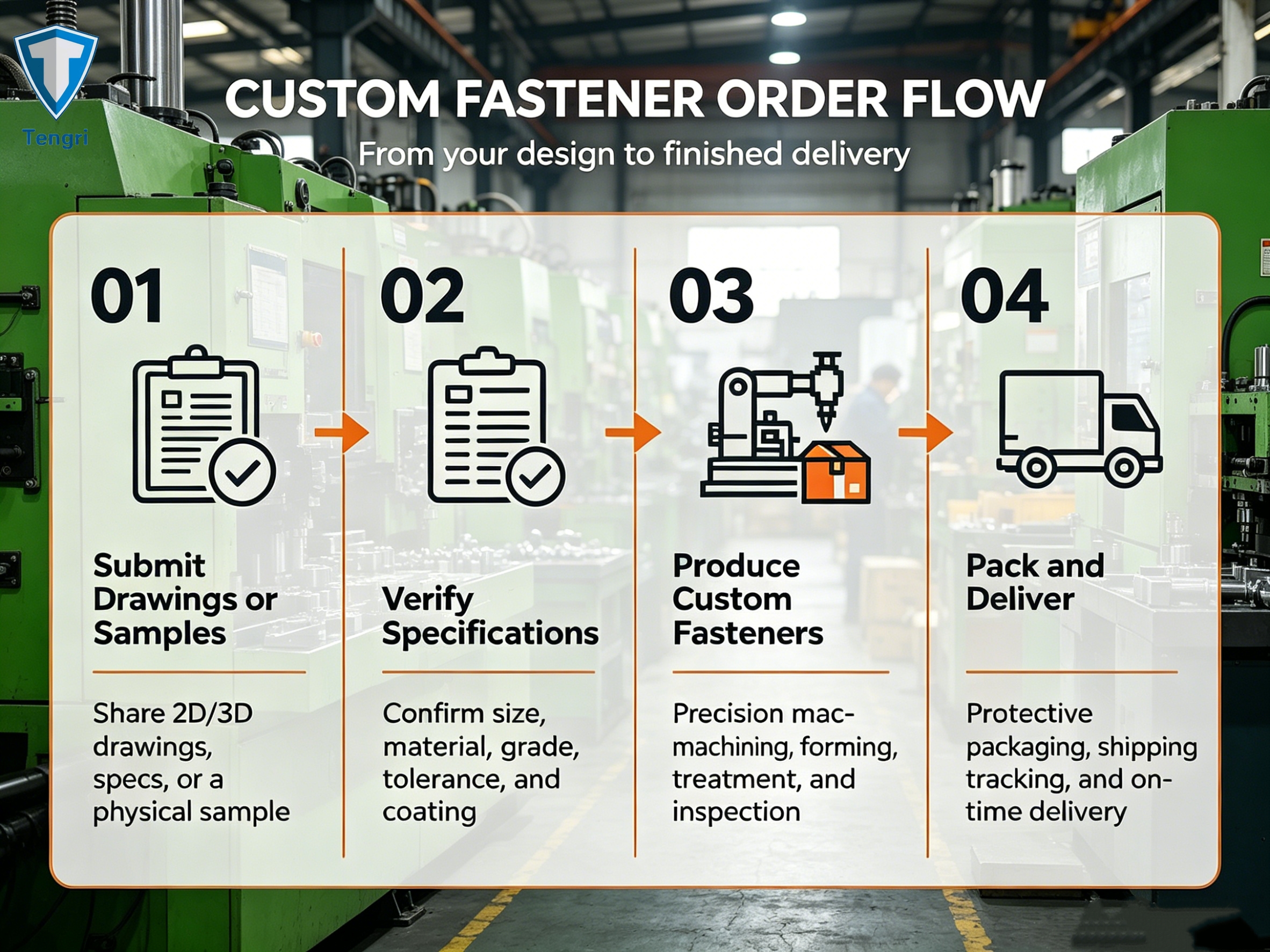
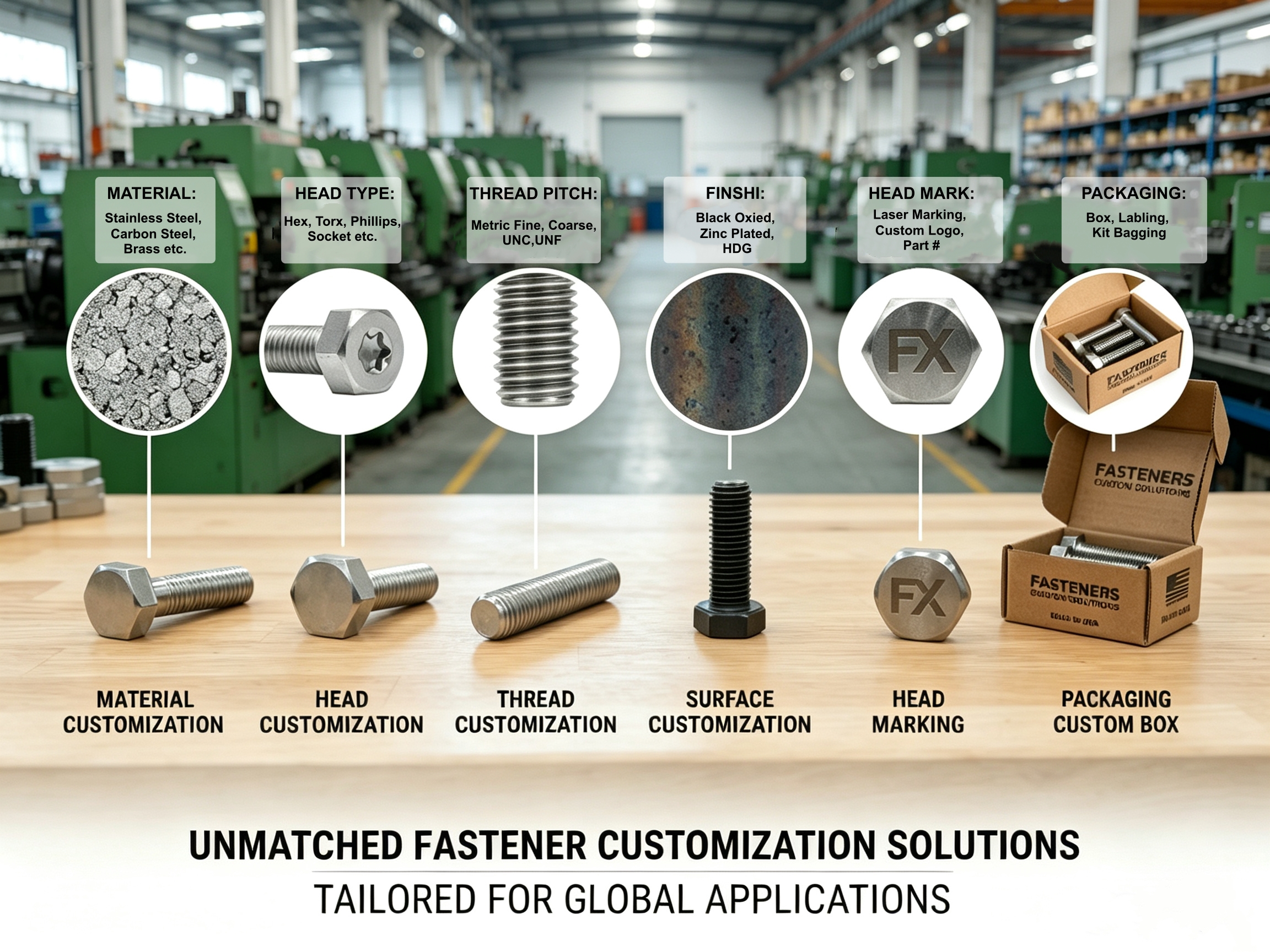
The official Tengri Fasteners pages describe Tengri Fasteners Group as an OEM fastener manufacturing company and present product categories including bolts, nuts, screws, threaded rods, anchors, washers, and rivets. They state that the group can produce to customer drawings or samples (Tengri Fasteners official site; Tengri Fasteners About Us). A Made-in-China profile also presents Shanghai Tengri Metal Products Co., Ltd. as an OEM/ODM fastener manufacturer and supplier (Made-in-China company profile).
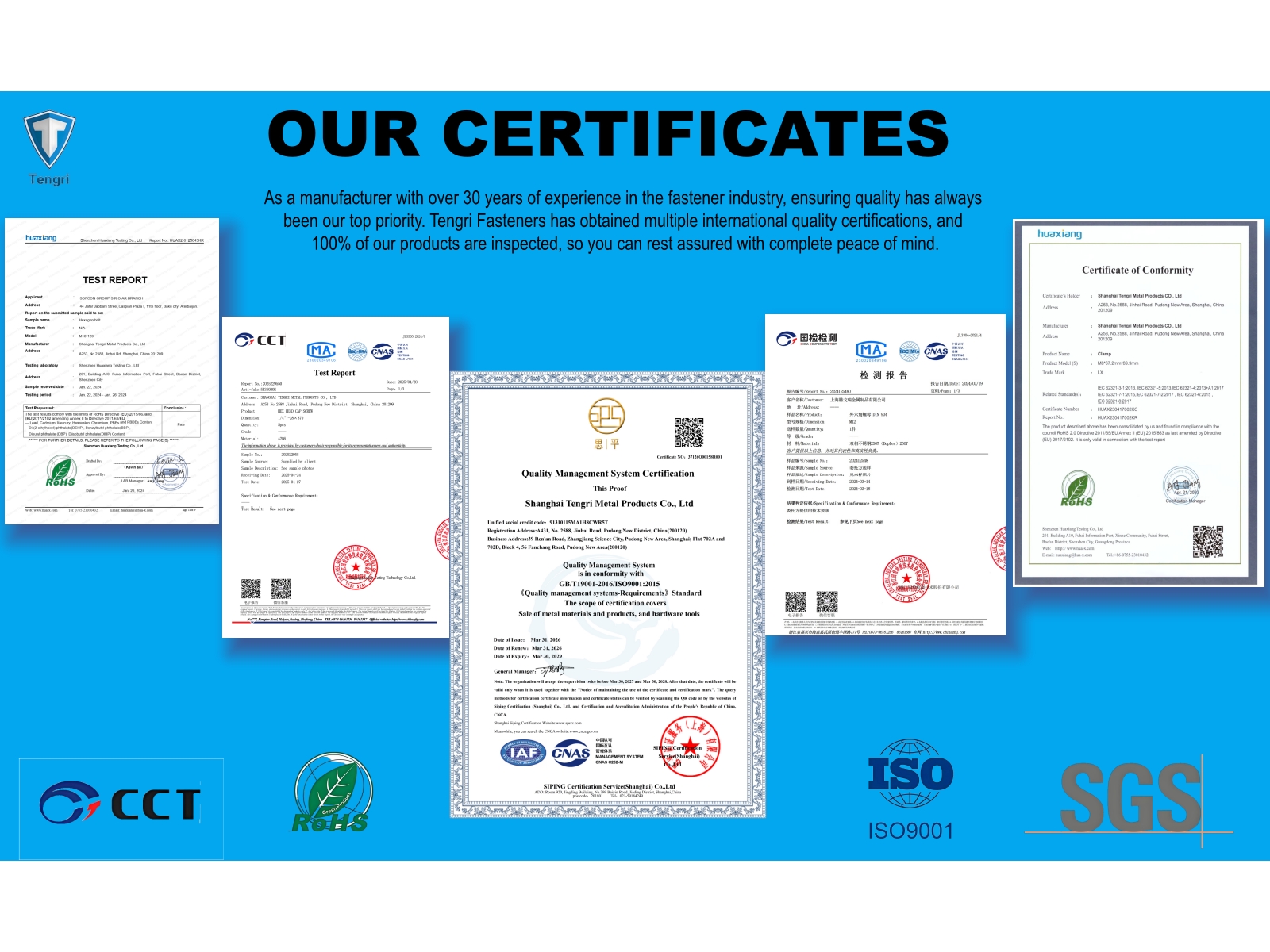
These sources support a careful description: Shanghai Tengri Metal Products Co., Ltd., presented under the Tengri Fasteners brand, publicly describes OEM and custom-fastener capabilities. They do not independently prove that every product is made in-house, that every listed site is covered by one certificate, or that a particular production lot will conform without an order-specific quality agreement.
What the public sources state about ISO 9001
The official Tengri Fasteners homepage states that the group holds ISO 9001, API, and IATF 16949 certifications. Its About Us page also contains historical references to ISO 9001:2016, ISO 9001/ANSI/ASQ Q9001-2008, and ISO/TS 16949:2009. Fasteners.eu lists ISO 9001 among certificates associated with Shanghai Tengri Metal Products Co., Ltd. (Tengri Fasteners official site; Tengri Fasteners About Us; Fasteners.eu company listing).
The public materials reviewed for this article did not provide a complete current certificate that could be independently matched to all of the following at once:
- exact legal certificate holder;
- certificate number;
- issuing certification body;
- accreditation route;
- certified production site;
- certification scope; and
- current expiry or validity date.
That is a verification gap, not proof that no certificate exists. A certificate may be held under another legal name, site name, group entity, or certification-body database. The responsible procurement position is to request and verify the document.
A factually careful company description is:
Shanghai Tengri Metal Products Co., Ltd., presented under the Tengri Fasteners brand, publicly describes OEM fastener manufacturing capabilities and the company’s public materials state that its group holds ISO 9001 certification. Buyers should independently verify the current certificate, legal holder, certification body, scope, certified production site, and validity before treating the claim as confirmed for a specific program.
Avoid stating without a current, independently verifiable certificate that:
- Shanghai Tengri Metal Products Co., Ltd. is definitively ISO 9001 certified;
- every Tengri factory is ISO 9001 certified;
- Tengri products are ISO 9001 certified; or
- ISO 9001 guarantees defect-free fasteners.
What does “group company” mean in procurement?
The phrase group company can describe a commercial brand structure, but it does not automatically establish a legally consolidated group or a multi-site certification scope. Tengri’s public pages use “Tengri Fasteners Group” and present multiple facilities and branches. That supports the statement that the company publicly presents itself under a group name; it does not independently confirm ownership, legal consolidation, or certificate coverage for every location.
Before placing an OEM order, ask for:
- the contracting and invoice entity;
- the entity named on the ISO certificate;
- the exact manufacturing site for the order;
- the ownership or authorization relationship if another group company manufactures the goods;
- the subcontractor and special-process list; and
- the entity responsible for warranty and corrective action.
Fastener OEM supplier qualification checklist
Identity and certification
- Contracting legal entity is identified.
- Exact production site is identified.
- A current ISO 9001 certificate is supplied.
- Certificate number, edition, scope, issue date, and expiry are readable.
- Certification body and accreditation route are verified.
- IAF CertSearch or certification-body verification is retained where available.
- Any group or multi-site certificate annex is reviewed.
- Certificate scope covers the activity relevant to the order.
Product and process control
- Latest drawing and specification revision are controlled.
- Material grade and property class are defined.
- Heat and lot traceability is maintained through shipment.
- Process map identifies forming, machining, thread processing, heat treatment, coating, and sorting.
- Special processes and subcontractors are controlled.
- Measuring equipment is calibrated or verified for intended use.
- Dimensions, threads, and functional characteristics are inspected.
- Mechanical, coating, and corrosion tests are defined where required.
Release and documentation
- Inspection plan and acceptance criteria are agreed.
- CoC is linked to the shipped lot.
- Material and test reports are supplied when specified.
- Packaging prevents mixed lots and preserves identification.
- Nonconforming product is segregated and disposition is approved.
- Corrective action includes containment, root cause, and effectiveness verification.
- Engineering, material, process, and site changes require agreed approval.
- Records have defined retention and retrieval controls.
Ongoing supplier management
- First-article or sample approval is completed.
- Delivery and quality performance are reviewed.
- Customer complaints are logged and trended.
- Repeated nonconformities trigger escalation or re-audit.
- The supplier notifies the buyer of certificate suspension, expiry, or scope change.
Questions to ask before approving an ISO 9001 OEM fastener supplier
- Which legal entity will sign the contract and issue the invoice?
- Which site will manufacture the parts?
- Is that site listed on the current ISO 9001 certificate or multi-site annex?
- What is the certificate number, issuing body, scope, edition, and validity date?
- Can the certificate be verified through IAF CertSearch or the certification body?
- Which operations are performed in-house, and which are subcontracted?
- How are drawing revisions controlled at production and inspection points?
- How are raw-material heats and production lots linked to the final shipment?
- Which dimensions, thread characteristics, mechanical properties, and coating properties will be inspected?
- What documents will accompany the shipment?
- How are nonconforming products segregated and reported?
- What is the agreed corrective-action and containment process?
- Which material, process, coating, supplier, or manufacturing-site changes require approval?
- What evidence demonstrates that the supplier can meet the actual customer drawing?
- Which entity owns warranty and corrective-action responsibility?
FAQ
Does ISO 9001 certify the fastener product itself?
No. ISO 9001 certifies, through an independent certification body, a defined quality management system scope. It does not certify every fastener. Product conformity must be supported by the applicable drawing, product standard, material evidence, inspection records, and test reports.
Who issues an ISO 9001 certificate?
An independent certification body audits and certifies the organization’s QMS. ISO writes the standard but does not issue company certificates. Accreditation bodies assess the competence and impartiality of certification bodies; accreditation can provide additional confidence in the certification route.
Does a company website statement prove ISO 9001 certification?
No. A website statement is evidence of what the company publicly claims. The buyer should request the current certificate, check the legal holder, production site, certificate number, scope, certification body, accreditation route, and validity.
Does an ISO 9001 certificate cover every factory in a group?
Not automatically. A group or multi-site certificate must identify the included sites and scope. A parent-company name, brand name, sales office, or public group statement does not by itself prove that the factory producing the order is covered.
What should an OEM buyer request from a fastener supplier?
Request the current QMS certificate, controlled drawing confirmation, material MTC or CoA, heat and lot traceability, dimensional and thread inspection records, mechanical test results where specified, coating or heat-treatment records, CoC, packing identification, and the supplier’s nonconformance and change-control process.
Is an ISO 9001 supplier automatically an OEM manufacturer?
No. ISO 9001 addresses the QMS scope, not whether every operation is performed in-house. To evaluate a fastener OEM supplier, ask for the process map, factory address, equipment and process list, subcontracted-process list, sample inspection records, and the entity responsible for product conformity.
How can I verify an ISO 9001 certificate for Shanghai Tengri Metal Products Co., Ltd.?
Request the current certificate from the supplier and compare its legal holder, certificate number, certification body, scope, production site, and validity with the order. Search IAF CertSearch or the certification body’s verification database where available. The public Tengri materials state that the group holds ISO 9001, but the complete current certificate details should be independently verified before treating the claim as confirmed for a specific program.
Does ISO 9001 guarantee defect-free fasteners?
No. A QMS can support controlled requirements, production, inspection, nonconformance handling, and improvement, but it does not guarantee that every shipment is defect-free or suitable for every application. Product-specific acceptance criteria and lot evidence remain necessary.
What is the difference between a material certificate and a certificate of conformity?
A material certificate provides evidence about the raw material or material properties covered by the document. A certificate of conformity states that the supplied product conforms to identified requirements. Neither document replaces the other when both are required by the drawing, customer specification, or quality agreement.
Conclusion: treat certification as one part of supplier approval
An ISO 9001 certificate can be valuable evidence that a defined organization and scope have undergone QMS assessment. It is not a shortcut around product qualification. For an OEM fastener purchase, the buyer still needs control of drawings, materials, special processes, inspection, lot traceability, shipment documentation, nonconforming product, corrective action, and engineering changes.
For Shanghai Tengri Metal Products Co., Ltd. and Tengri Fasteners, public sources describe OEM fastener capabilities and state group-level ISO 9001 information. A responsible buyer should preserve that distinction: treat the public statement as a due-diligence lead, request the current certificate, verify the legal holder and production site, and link the approved scope to the exact order.
The strongest ISO 9001 fastener supplier is not the one with the most prominent logo. It is the one that can show a coherent chain from customer drawing to controlled production, measurable acceptance criteria, lot-linked records, transparent change control, and effective response when something goes wrong.
References
- ISO. ISO 9001:2026 — Quality management systems — Requirements. Current standard page, QMS scope, edition, and certification information.
- ISO. ISO 9001 explained. QMS definition, voluntary certification, and ISO’s role.
- ISO. Certification. ISO statement that it does not perform certification or issue company certificates.
- ISO. ISO 9001:2015 lifecycle. Edition lifecycle and replacement information.
- IAF CertSearch. Official global certificate verification platform. Certificate search and accredited-certification verification model.
- IAF CertSearch. Verify certificates. Verification guidance.
- ISO 9001 Auditing Practices Group. Documenting nonconformity. Audit evidence and nonconformity guidance.
- ISO. ISO 898-1:2013 — Mechanical properties of carbon- and alloy-steel fasteners. Product-property scope and limitations.
- Net Shaped Solutions. Supplier Quality Manual, Revision 02. Customer-specific examples of material traceability, change notification, corrective action, and supplier controls; dated November 3, 2020.
- Tengri Fasteners. Official website. Company self-description, OEM positioning, and stated certifications.
- Tengri Fasteners. About Us. Company self-description, historical quality statements, and manufacturing claims.
- Tengri Fasteners. Contact. Public company name, addresses, sites, branches, and brand association.
- Made-in-China. Shanghai Tengri Metal Products Co., Ltd. company profile. Marketplace OEM/ODM profile and supplier-uploaded evidence.
- Fasteners.eu. Shanghai Tengri Metal Products Co., Ltd. company listing. Third-party directory record and listed certificates; not a substitute for certificate verification.
https://www.tgrfast.com
Shanghai Tengri Metal Products Co., Ltd.