
Choosing an epoxy acrylate resin for a UV coating is not simply a matter of selecting the highest reactivity or lowest price. The right grade needs to match the coating application, substrate, curing process, required film properties, and overall formulation cost.
For formulators, a useful starting point is to identify the main performance or cost requirement and then select an epoxy acrylate grade designed for that specific purpose.
What Does Epoxy Acrylate Do in a UV Coating?
Epoxy acrylate is a widely used oligomer in UV-curable coatings and inks. It contributes to film formation, curing response, hardness, adhesion, and other physical properties, while its relatively flexible formulation options make it suitable for different coating systems.
However, epoxy acrylate is not a single-purpose material. Different grades can have significantly different viscosity, reactivity, compatibility, and performance characteristics. Therefore, resin selection should be based on the actual formulation and application rather than the resin name alone.
1. Start With the Main Formulation Requirement
The first question should be: What is the main problem the resin needs to solve?
Cost-Sensitive UV Coatings
For UV wood coatings and PVC/SPC flooring, raw material cost can be an important consideration, particularly in high-volume applications.
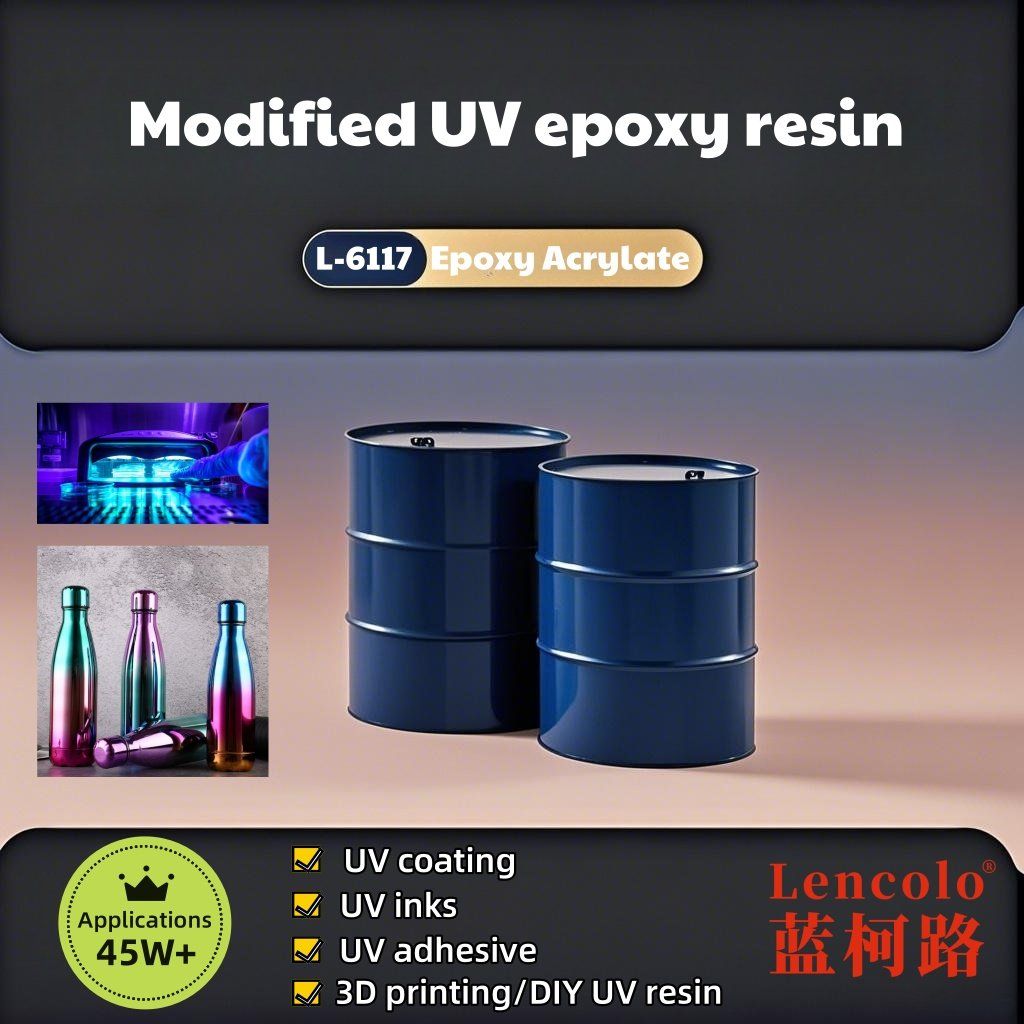
Grades such as L-6112C, L-6117, and L-6118 are positioned as cost-effective UV epoxy resin options for formulators looking to control formulation costs. They can be considered for applications including furniture, wood flooring, PVC/SPC flooring, bamboo flooring, and decorative panels.
The objective is not simply to choose the cheapest resin, but to find a cost-effective grade that still provides the required curing and film performance after formulation.
Fast-Curing UV Inks
For UV inkjet, screen printing, flexographic, and offset inks, curing speed becomes more important because it can directly affect production efficiency.
L-6111 low-viscosity UV epoxy acrylate resin is designed around this requirement, with fast curing as a key characteristic. Its low viscosity can also be useful when formulating systems that require good pigment wetting and manageable processing viscosity.
For ink applications, the resin should still be evaluated together with the monomer, photoinitiator, pigment, additives, substrate, and curing equipment. A resin that cures quickly in one ink system may not deliver the same result in another.
2. Match the Resin to the Application
Application conditions are just as important as resin properties.
For UV wood and flooring coatings, formulators may prioritize cost efficiency together with hardness, adhesion, leveling, and resistance requirements.
For UV inks, pigment wetting, viscosity, adhesion, flexibility, and curing response become more critical.
For vacuum metallization coatings, the resin needs to work within a multilayer coating structure that may include an adhesion primer, UV basecoat, color coat, and topcoat. In this context, L-6117/L-6118 can be considered when cost control is an important part of the formulation strategy.
This is why a single generic epoxy acrylate grade rarely works equally well for every UV application.
3. Evaluate the Complete UV Formulation
Epoxy acrylate should never be evaluated in isolation. Its final performance depends on how it interacts with other formulation components.
Important factors include:
· Reactive monomers: influence viscosity, flexibility, shrinkage, and curing.
· Photoinitiators: determine how efficiently the system responds to the selected UV or LED light source.
· Functional additives: can affect wetting, leveling, slip, adhesion, and surface properties.
· Substrate: PET, plastic, wood, PVC, metal, and other substrates may require different adhesion and flexibility characteristics.
· Curing conditions: lamp type, wavelength, coating thickness, line speed, and energy all affect the final result.
For this reason, TDS data is useful for initial screening, but laboratory application testing is normally needed before final selection.
4. Consider the Supplier's Technical Support
A reliable epoxy acrylate supplier should provide more than a product catalog. Technical support is valuable when a standard resin needs to be adjusted for a particular substrate, viscosity range, curing condition, or performance target.
Lencolo, the brand of Guangdong Lencolo New Material Co., Ltd., supplies UV materials including epoxy acrylate resins, other UV resins, reactive monomers, photoinitiators, and functional additives. Its product range covers applications such as UV coatings, printing inks, vacuum metallization, adhesives, and other UV-curable systems, allowing formulators to evaluate the resin together with the materials required to build the complete formulation.
Conclusion
The best epoxy acrylate for a UV coating is determined by the application rather than by a single specification. A practical selection process is to identify the dominant requirement—such as cost control, curing speed, viscosity, adhesion, or application-specific performance—then compare suitable resin grades under actual formulation and curing conditions.
For example, L-6112C/6117/6118 can be considered for cost-sensitive UV coating applications, while L-6111 is more relevant when low viscosity and fast curing are important for UV ink formulations. Ultimately, laboratory testing remains the most reliable way to confirm whether a resin is suitable for a specific coating system.
https://www.lencolo37.com/
Guangdong Lencolo New Material Co., Ltd.