
Accurate color registration remains one of the most persistent technical challenges in industrial screen printing. When sequential colors fail to align precisely on a substrate, the result is visible color deviation, pattern misalignment, and elevated scrap rates that directly affect production economics. Understanding the mechanical and control-system factors behind registration accuracy—and matching them to the correct machine configuration—is essential for manufacturers seeking consistent multi-color output.
Why Registration Deviation Occurs
Multi-color screen printing requires a substrate to pass through multiple print stations, each depositing a different color layer. Registration accuracy depends on the substrate remaining in a fixed, repeatable position between each printing cycle. Several factors make this difficult to achieve consistently:
- Substrate handling inconsistency: Manual loading and positioning introduces variability that mechanical systems alone cannot correct.
- Surface geometry variation: Production requirements often span flat surfaces, cylindrical bottles, curved profiles, and large panels. Standard, non-configurable machinery is not built to accommodate this range of shapes, which increases the likelihood of positioning drift.
- Mechanical repeatability limits: Without precise motion control, even small positioning errors compound across multiple color stations, leading to visible misregistration.
These industry pain points—high labor dependency, multi-color registration alignment issues, and surface geometry variation—are well documented across screen printing operations and form the basis for how automated printing systems are engineered.
Core Technologies Behind Accurate Registration
Achieving reliable, repeatable color alignment across multiple print cycles depends on a combination of motion control, process management, and vision-based verification. Shenzhen KLK Electronic Equipment Co., Ltd., operating under the brand KLK, builds its screen printing systems around four technical methods that directly address registration accuracy:
Servo Motion Control directs printing movement and positioning mechanics to ensure stable, highly repeatable manufacturing cycles. Because servo systems execute precise, programmable movements, they reduce the positioning variance that causes color drift between print stations.
PLC Control System manages machine operations and stores production parameters, ensuring reliable industrial operation and simplified configuration. By retaining consistent parameter settings across production runs, the PLC control system helps maintain the same positioning logic each time a job is repeated.
CCD Vision Registration dynamically detects substrate positioning to facilitate high-accuracy multi-color alignment. This vision-based detection step identifies the actual position of a substrate in real time, allowing the system to compensate for minor positioning inconsistencies before ink is applied—an approach particularly valuable in multi-color print cycles where cumulative error is a concern.
Automatic Loading & Unloading integrates mechanical handling systems to automate product transfer, reducing manual labor. Removing manual handling from the positioning process eliminates one of the most common sources of registration inconsistency: human-introduced variability in placing and removing parts.
Together, these methods form the technical foundation of KLK's automatic and customized screen printing systems platform, which is designed to reduce operational dependency on manual labor, eliminate material waste from misalignment, and enable printing across diverse product geometries through automated, configurable systems.
Matching Machine Configuration to Substrate Geometry
Registration accuracy is not solely a function of control technology—it also depends on selecting a machine configuration suited to the substrate being printed. KLK offers several distinct kinematic configurations, each addressing a specific registration challenge.
Shuttle Screen Printing Machines are built around a shuttle table design that maintains constant product positioning across multiple colors. This shuttle table movement directs the sequential transfer of parts during multi-color operations, minimizing registration errors between prints. Representative models include the CS04 Single Color Shuttle Screen Printing Machine, the KLK-YS01 Single Color Shuttle Screen Printing Machine, the 13-Station Automatic 2-Color Shuttle Screen Printing Machine, and the 4-Color Shuttle Screen Printing Machine—configurations aimed specifically at operations where alignment stability across colors is the primary concern.
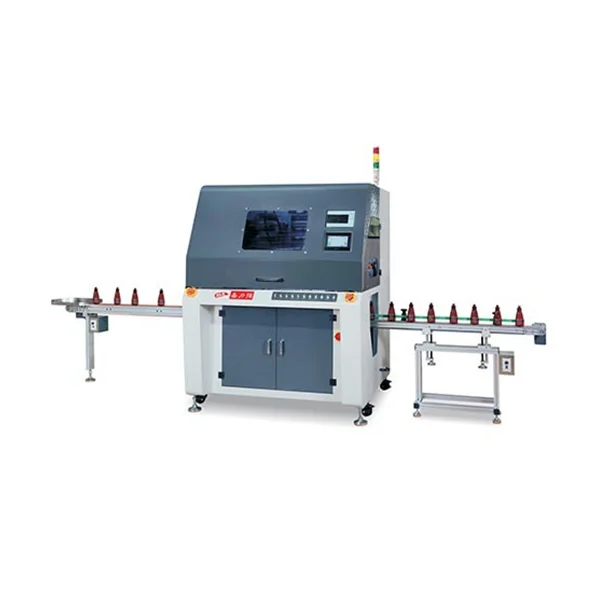
Rotary Screen Printing Machines address a different challenge: printing on cylindrical or round products, where low throughput and handling difficulty are common issues. A multi-station rotary configuration enables continuous production, with simultaneous loading, printing, and unloading occurring around the rotary table, supported by successive color stations for multiple color printing. Models such as the Z103 10-Station 3-Color Rotary Screen Printing Machine, the Z082 8-Station 2-Color Rotary Screen Printing Machine, and the 16-Station 6-Color Multi-Function Rotary Printing Machine are suited to cosmetic packaging, beverage bottles, and round plastic containers.
Flatbed Screen Printing Machines target flat substrates and large panels, where inconsistent print thickness and registration deviation are typical concerns. These systems rely on high positioning accuracy and mechanical control systems to regulate printing parameters across large printing areas, making them applicable to electronics panels, cover glass, and flat industrial sheet materials.
Semi-Automatic Screen Printing Machines, such as the FX01 Semi-Automatic Contour Screen Printing Machine, serve a different scenario altogether: low-to-medium volume production with frequent product changeovers, where fully automated lines are not cost-effective. These machines support quick setup adjustments for small-batch and customized printing runs.
For more specialized cases—such as automotive glass, appliance panels, or heavy cylindrical parts—KLK's Special Application Screen Printing Machines integrate automatic loading and unloading with UV curing steps, performing inline curing immediately after ink transfer while handling glass, large panels, and heavy components safely.
Selecting the Right Configuration
A practical way to approach machine selection is to match the substrate and production requirement to the appropriate series: round bottles are best served by rotary systems, flat products by flatbed systems, small-batch production by semi-automatic systems, high-volume output by automatic rotary systems, multi-color jobs by multi-color systems, and large panels by large flatbed systems.
Custom Engineering as a Registration Strategy
Because no single fixed machine design can address every combination of substrate geometry, throughput target, and automation requirement, KLK's service model centers on customized machine engineering based on product shape, printing requirements, production speed, and automation level. This custom engineering approach extends into after-sales support, where machine configurations continue to be refined according to the same criteria.
KLK's customer base spans cosmetic packaging manufacturers, electronics and components manufacturers, plastic molders and container manufacturers, and consumer goods and promotional product suppliers—industries where cosmetic bottles, glass containers, electronic housings, injection molded products, and promotional items each present distinct registration challenges tied to their surface geometry and production volume.
Conclusion
Accurate color registration in screen printing is achieved through the combination of precise motion control, dynamic vision-based verification, automated substrate handling, and a machine configuration matched to the specific product geometry involved. Shenzhen KLK Electronic Equipment Co., Ltd. approaches this challenge by offering flexible rotary, shuttle, flatbed, and semi-automatic systems alongside servo motion control, PLC-based process management, CCD vision registration, and automated loading and unloading—paired with a custom engineering process that adapts each system to the product shape, printing requirement, production speed, and automation level the application demands.
https://www.szklkelec.com/
Shenzhen klk Electronic Equipment Co., Ltd.