

Industry Background and the Problem of Backup Time Reliability
Network equipment such as routers, modems, and ONTs depends on a stable power supply to remain online. Short power outages, voltage drops, and unstable grid conditions can cause these devices to reboot or lose service entirely, disrupting connectivity for both residential subscribers and enterprise networks. As telecom operators, Internet Service Providers (ISPs), broadband network companies, and system integrators expand fiber and wireless deployments, the reliability of backup power at the customer premises has become an operational priority rather than an afterthought.
A persistent challenge in this space is that improper UPS selection—particularly with regard to voltage, current, peak load, or connector compatibility—can lead directly to application failure. This means that even when a backup power unit is installed, if its electrical characteristics do not match the real device it protects, the intended continuity benefit may not materialize. Understanding how a battery's available capacity translates into actual backup time, and how that relationship can shift as a battery unit is used over its service life, is therefore central to making sound deployment decisions.
Shanghai Mylion New Energy Co., Ltd., operating under the brand MYLION, brings 13+ years of experience in Lithium Battery technology and 10+ years of experience in Mini UPS development to this problem space. As a global B2B provider of Mini UPS products, DC backup power solutions, and project support for telecom, ISP, broadband, and security applications, the company's positioning is built around evaluating solutions based on real device voltage, working current, peak/startup behavior, and installation environment—rather than treating backup power as a one-size-fits-all component.
Authoritative Analysis: What Determines Mini UPS Backup Time
Backup time in any Mini UPS system is fundamentally governed by the relationship between a battery's stored energy, expressed in watt-hours (Wh), and the current or power draw of the connected device. Across Mylion's 12V Standard Series, for example, the MU26W carries 18.72Wh of battery capacity paired with a 12V DC output of 2.5A continuous (3A maximum), while the MU48W steps up to 29.6Wh, and the MU68W reaches 44.4Wh with a maximum power output of 36W (12V/3A). The 12V Long-Runtime Series, represented by the MU635W/MU635L, raises battery energy to 75.6Wh while maintaining the same 2.5A continuous/3A maximum output profile, illustrating how runtime is extended specifically through added capacity rather than changes to output current.
This same principle applies to higher-power configurations. The MU65W in the 12V High-Power Series supports a 12V DC input up to 6A and a 4A continuous/5A maximum output (60W total), backed by 56.16Wh of battery energy—suited to high-load CPE or gateways that exceed standard 2.5A thresholds. The 12V High-Power Long-Runtime Series (MU35W/MU35L) combines this same 60W output capability with 75.6Wh of capacity, demonstrating that sustaining higher current draw over a longer period requires proportionally more stored energy.
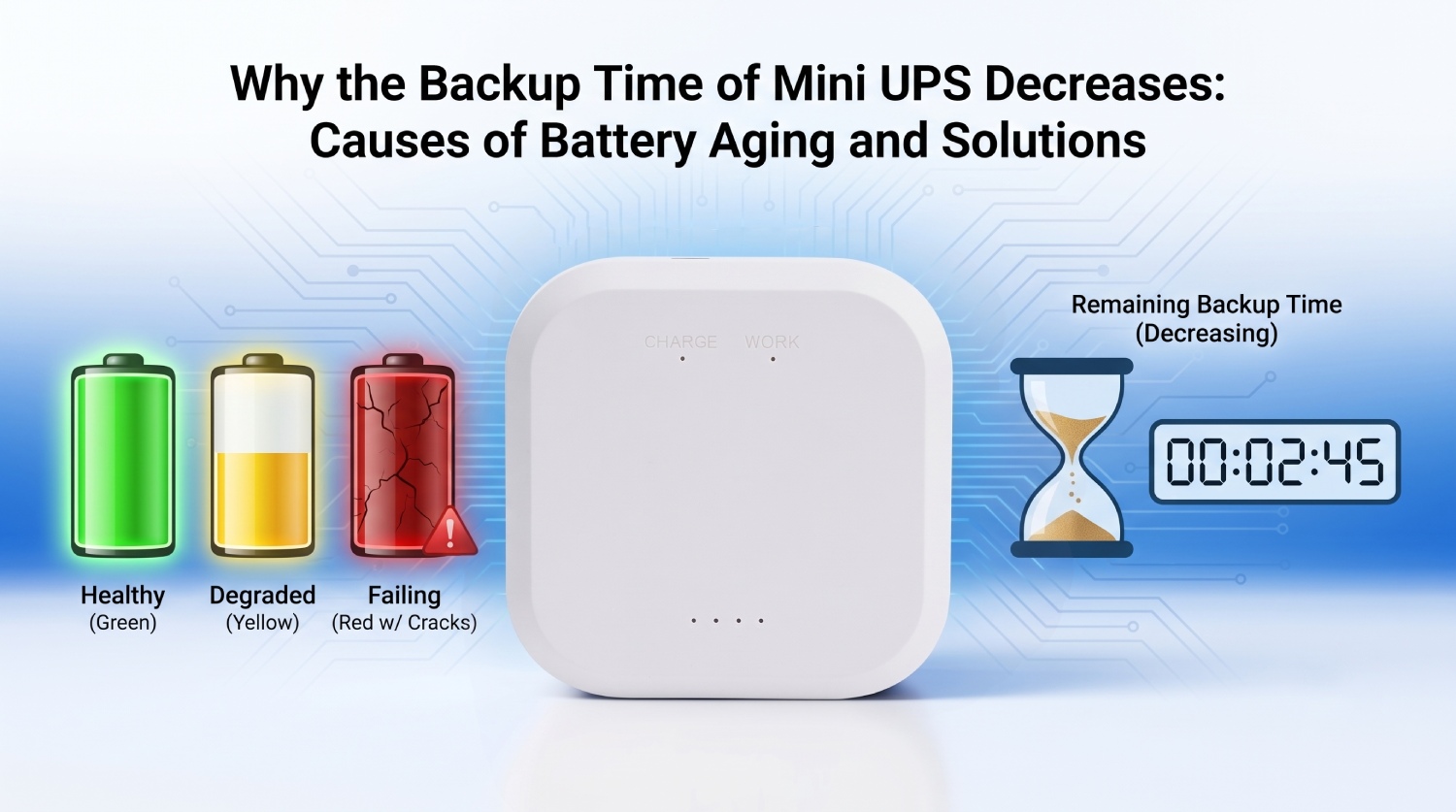
Because backup duration is a direct function of available watt-hours relative to load, any reduction in a battery's usable capacity—whether from aging, degradation, or wear associated with repeated charge-discharge cycling inherent to lithium battery operation—will proportionally reduce the amount of time a Mini UPS can sustain a connected device before depletion. This is why Mylion's evaluation process centers on matching real device voltage, working current, and peak/startup behavior at the point of selection: a unit sized appropriately for its intended load, chemistry, and connector configuration is better positioned to deliver its rated backup time throughout its service life. The company's LiFePO4 chemistry integration, present in products such as the ML1202AC AC-Input Dual Output UPS and under development in the MU248 24V/48V Telecom Backup direction, reflects this same technical foundation applied across different voltage and application requirements.
Deep Insights: Trends Shaping Battery-Backed Network Continuity
The broader trend visible across Mylion's product roadmap is a shift toward higher-power, multi-output, and higher-voltage backup configurations as network equipment itself becomes more power-intensive. The 12V + USB Multi-Output Series (MUJ46 and MUJ435) reflects growing demand to simultaneously back up a router and a USB-connected accessory within an 18W total system limit, while the AC-Input Dual Output Series (ML1202AC) addresses the practical need to manage two separate 12V devices—such as an ONT and a router—from a single AC wall outlet using LiFePO4 chemistry, with a 25.6Wh battery and dual 12V outputs at 2A each (24W total system limit).
Looking ahead, the company's development and project-evaluation directions point toward two emerging requirements. The MUC85, a USB-C PD Mini UPS under development, targets modern WiFi 6/7 devices requiring USB-C Power Delivery, with input rated at 65W standard/100W max and dual USB-C outputs (up to 65W and 30W respectively) supported by 92.16Wh of battery energy. Separately, the MU248 direction targets higher-voltage wireless CPE and radio bridge equipment through independent 24V (3A) and 48V (1A) outputs drawing from a 48V/60V DC input, backed by 102.4Wh of capacity within a 100W system limit. Both directions suggest that as network-edge devices demand more power and more sophisticated delivery standards, backup capacity must scale accordingly to preserve adequate runtime margins—an important consideration for any deployment expected to remain reliable over the equipment's full operating lifetime.
Company Value: Mylion's Role in Reliable Backup Power Selection
Mylion's role in this landscape is defined less by any single product and more by its structured approach to selection and validation. The company's service scope covers requirement analysis, model matching, sample testing support, connector/cable matching, private labeling, and documentation coordination, supported by managed pilot evaluation and mass-production preparation for B2B and OEM/ODM customers. This process is reinforced by industry certifications including UN38.3 and MSDS on a model-specific basis, along with adherence to lithium battery transport documentation and compliance requirements.
Because the company's technical capability spans 12V DC systems up to 60W, LiFePO4 chemistry integration, and emerging USB-C PD 100W input/65W output capabilities, it is positioned to support a range of platform compatibility needs—including routers, ONTs, ONUs, modems, gateways, CPE devices, and security/CCTV equipment—subject to electrical verification in each case. This breadth allows the company to serve telecom operators, ISPs, broadband network companies, fiber network operators, and system integrators globally, functioning as both a B2B backup power partner and an OEM/ODM project partner, with pricing built around custom enterprise and project-based quotes.
Conclusion and Recommendations for Industry Decision-Makers
Backup time in a Mini UPS system is not a fixed, permanent specification—it is the outcome of matching battery energy capacity to a device's actual voltage, current, and peak load behavior, a relationship that can be affected by any change in usable battery capacity over a unit's operating life. For telecom operators, ISPs, broadband providers, and system integrators evaluating backup power for subscriber-side equipment, the practical takeaway is that selection accuracy at the outset—covering voltage, current, connector, and chemistry—directly determines whether a deployed unit continues to deliver its intended runtime.
Organizations planning large-scale or long-duration deployments should prioritize technical confirmation and connector/cable matching before mass rollout, drawing on structured evaluation processes such as those offered by Shanghai Mylion New Energy Co., Ltd. under its MYLION brand. Doing so supports more reliable DC backup deployment and reduces avoidable selection risks across telecom, ISP, broadband, fiber networking, and security applications.
www.myliontech.com
Shanghai Mylion New Energy Co.,Ltd.