
Metal tube end forming is often a critical step in the production of pipe fittings, structural components, exhaust parts, and connection assemblies. When tube ends must be reduced, expanded, pressed, or shaped repeatedly, production efficiency depends heavily on machine stability, tooling accuracy, cycle time, and the ability to maintain consistent forming quality.
For medium-diameter metal tubes, the 140 Vertical Type Multi-Station Tube Reducing Machine offers a practical solution by combining dual-station processing, hydraulic forming, precision tooling, and programmable control. Instead of treating tube end forming as a simple pressing operation, modern equipment needs to provide repeatable results while reducing setup time and supporting continuous production.
1. Designed for Medium-Diameter Tube Processing
Different tube sizes require different forming forces, tooling structures, and machine configurations. The SCX-140 vertical dual-station tube end forming machine is designed for tubes covering a relatively broad diameter range.
The equipment can process metal tubes with an outside diameter of approximately 30–140 mm, while supporting tube lengths from 50 to 2,000 mm. Depending on the specific forming process and tooling configuration, it can handle wall thicknesses within the specified working range.
This makes the machine suitable for components used in:
-
Industrial piping systems
-
Municipal pipeline components
-
Construction pipe fittings
-
Automotive exhaust systems
-
Household appliances
-
Shipbuilding
-
Aerospace components
-
Water supply and drainage systems
The ability to process different tube geometries is also important. Straight tubes, T-branch tubes, 45-degree elbows, and 90-degree elbows can be accommodated according to the tooling and production requirements.
2. Dual-Station Processing Reduces Production Bottlenecks
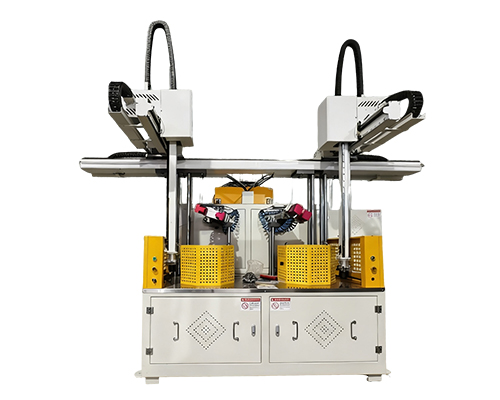
One of the most important features of this machine is its dual-station configuration.
In conventional single-station tube forming, an operator may need to complete one forming operation before moving to the next part. When production volume increases, the machine's individual cycle becomes a limiting factor.
A dual-station design provides two working positions, allowing production operations to be organized more efficiently. While one station is being processed, the other can be prepared for the next operation according to the production configuration.
This is particularly valuable for batch manufacturing, where even a small reduction in handling time can influence overall output.
For manufacturers producing hundreds or thousands of similar components, the objective is not simply to increase hydraulic force. The entire cycle must be optimized, including:
-
Loading
-
Clamping
-
Tube positioning
-
Forming
-
Pressure release
-
Unloading
-
Preparing the next workpiece
Reducing unnecessary movement between these stages helps operators maintain a more consistent production rhythm.
3. Stable Hydraulic Forming for Repeatable Results
Tube reducing and end forming require controlled force. Excessive or unstable pressure can deform the tube unevenly, while insufficient force may prevent the required profile from being formed completely.
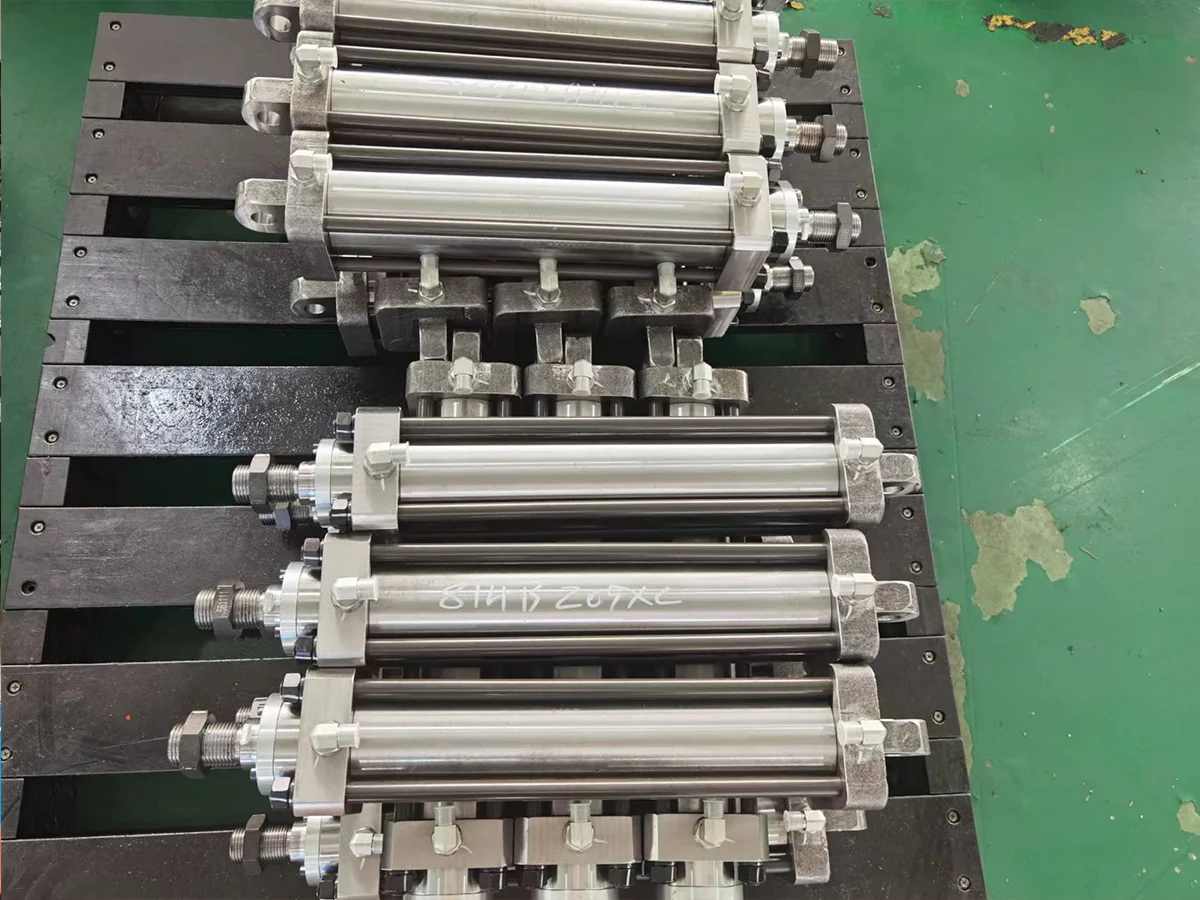
The SCX-140 uses a hydraulic system with dedicated pressure control components to provide controlled forming force. The hydraulic circuit includes components such as a pressure sensor, directional valve, pressure-holding valve, relief valve, hydraulic pump, and pressure gauge.
This configuration allows the forming process to be controlled rather than relying on uncontrolled mechanical impact.
For production applications, stable hydraulic movement is important because the same forming procedure needs to be repeated across a large number of parts. Consistent pressure and movement help reduce variation between individual workpieces.
The machine also uses hydraulic cylinders with defined bore and stroke dimensions, providing the mechanical movement required for its forming operations.
4. Precision Tooling Directly Affects Product Quality
A tube forming machine can only achieve reliable results when its molds are properly designed and manufactured.
For this type of equipment, the forming molds are manufactured from Cr12MoV or SKD11 steel and undergo quenching treatment. The specified quenched hardness is above 56 HRC.
The purpose of using hardened tooling is straightforward: the mold must withstand repeated forming loads while maintaining its working geometry.
The mold surface is also processed to achieve a smooth finish without burrs. This is particularly important when the finished tube needs a clean appearance and controlled dimensional profile.
In actual production, tooling quality affects several factors simultaneously:
-
Forming dimensions
-
Surface quality
-
Tool life
-
Tube deformation
-
Repeatability
-
Changeover requirements
Therefore, selecting the appropriate mold is just as important as selecting the machine itself.
5. Faster Mold Changes Improve Production Flexibility
Manufacturers rarely produce only one tube specification throughout the year. Different customers and product lines may require different diameters, lengths, end profiles, or forming configurations.
Frequent tooling changes can become a significant source of downtime if the machine is difficult to adjust.
The SCX-140 is designed with a mold replacement and debugging time of approximately 5–10 minutes, depending on the actual tooling and production conditions.
Shorter changeover time provides two practical advantages.
First, manufacturers can switch between product specifications more efficiently. Second, smaller production batches become easier to manage because the machine does not need to remain configured for one product simply to avoid lengthy setup procedures.
This flexibility is valuable for contract manufacturers and factories producing customized tube components.
6. Short Cycle Times Support Higher Output
Production efficiency ultimately depends on how quickly a machine can complete a qualified part.
The specified production efficiency of the equipment is approximately 12–45 seconds per tube end, depending on the forming process, material, dimensions, tooling, and operating conditions.
The SCX-140 is also described as capable of achieving more than 300 parts per hour under suitable production conditions.
However, manufacturers should distinguish between theoretical cycle time and actual production output. Real production efficiency also depends on:
-
Operator loading speed
-
Tube positioning accuracy
-
Material consistency
-
Tooling design
-
Forming sequence
-
Inspection requirements
-
Equipment maintenance
For this reason, a proper production evaluation should consider the complete work cycle rather than focusing on one machine specification.
7. PLC and Touchscreen Control Simplify Operation
Modern tube forming equipment needs to provide operators with straightforward control over production parameters.
The machine incorporates a PLC control system and a 10-inch touchscreen, allowing operating information and machine functions to be managed through a centralized interface.
For production teams, digital control can make it easier to establish repeatable operating procedures. Once appropriate parameters have been confirmed for a specific tube and tooling combination, the same production logic can be applied to subsequent batches.
This reduces dependence on manual adjustment and helps standardize machine operation between shifts.
It also creates a foundation for future automation. The equipment provides an interface for robotic-arm integration, making it possible to connect tube loading and unloading processes with automated production systems.
8. Suitable for Automation Upgrades
Manual loading and unloading are specified for the standard configuration. However, manufacturers with higher production requirements may need to automate material handling.
The machine's robotic integration interface provides an opportunity to connect it with upstream and downstream equipment.
A possible automated line could include:
Tube preparation → Automatic feeding → Positioning → Tube end forming → Inspection → Unloading → Transfer to next process
This approach can reduce manual handling and improve production continuity.
For factories planning gradual automation, this is an important consideration. The machine does not necessarily need to become part of a fully automated line immediately. Instead, manufacturers can begin with manual operation and later introduce robotic handling as production requirements increase.
9. Compact Structure Helps Workshop Planning
The machine has overall dimensions of approximately 2350 × 1900 × 1900 mm and weighs about 3,200 kg.
For factories with limited workshop space, equipment footprint is an important purchasing consideration. A compact vertical structure can help manufacturers organize the forming area while maintaining access for material loading, tooling maintenance, inspection, and equipment servicing.
The recommended operating environment is indoors, with an operating temperature between -5°C and 45°C.
Proper workshop planning should still leave sufficient space around the machine for safe operation, maintenance access, material movement, and future automation equipment.
10. Built for Practical Industrial Applications
The value of a tube reducing machine is ultimately determined by how well it performs in real manufacturing conditions.
The 140 Vertical Type Multi-Station Tube Reducing Machine is suited to manufacturers that need repeatable forming of medium-diameter metal tubes rather than occasional manual processing.
Its combination of dual-station operation, hydraulic forming, hardened tooling, PLC control, short mold changeover time, and automation connectivity makes it suitable for production environments where consistency and throughput are important.
For manufacturers looking to improve tube processing, the 140 Vertical Type Multi-Station Tube Reducing Machine can provide a structured solution for reducing manual operations and improving production efficiency.
Conclusion
Improving tube end forming efficiency requires more than simply increasing machine power. The forming process must balance speed, dimensional accuracy, tooling durability, operator convenience, and production flexibility.
A 140-class vertical multi-station machine addresses these requirements through dual-station processing, controlled hydraulic forming, hardened molds, touchscreen PLC control, quick tooling changes, and potential robotic integration.
For industries such as automotive, construction, municipal infrastructure, shipbuilding, and industrial piping, these features can help create a more stable and repeatable tube manufacturing process. When correctly matched with the tube material, dimensions, tooling, and production volume, the machine can become an important part of an efficient metal tube forming line.
www.tubeendforming.com
Your Trusted Partner