

DKM IML Production Line: Integrated Packaging at Scale
Section 1: Industry Background and the Real Constraints Behind Packaging Productivity
Packaging manufacturers operating in-mold labeling (IML) lines rarely struggle with a single, isolated problem. The constraints compound: energy consumption stays high, production cycles run slower than throughput targets demand, and labor costs climb because lines still depend on manual intervention. Surface defects — flash, sink marks, warpage — absorb operator attention and scrap material. In medical adjacent production, contamination risk adds a further layer of difficulty that manual handling tends to worsen rather than solve.
The consequence is that IML is seldom a machine purchase decision alone. A label applied in-mold sits at the intersection of mold design, machine precision, robotics, and plant layout. When those elements arrive from separate suppliers, coordination cost rises and accountability fragments. Buyers increasingly want an integrated path rather than a component list.
DKM, a brand of Sino Group, has operated inside this problem space for more than 20 years in PET packaging and blow molding, and has delivered 4,000+ production lines globally. That accumulated engineering exposure — spanning packaging, automotive, electronics, medical, and municipal engineering — is the basis on which the company discusses IML production lines. DKM positions itself as a professional injection molding machine manufacturer and a provider of integrated packaging solutions, with the stated strategic aim to "Make Molding More Valuable" through its 5H Molding technology.
Section 2: Authoritative Analysis — How an Integrated IML Line Is Actually Assembled
Necessity: Why integration matters more than individual specifications
An IML packaging line converts resin and labels into finished containers at a target cycle time and a target energy cost. The variables that move those two numbers — injection speed and repeatability, clamping stability, mold quality, part removal and handling — belong to different engineering disciplines. DKM's framework treats them as one delivery: turnkey solutions, machine supply, and specialized system delivery are the three documented service models, with a service scope covering factory planning and plant layout, mold design via Sino Mould, robot integration via IVI, and after-sales service.
Principle logic: 5H Molding as the governing standard
DKM's 5H Molding technology is defined as High quality, High speed, High energy saving, High safety, and High stability. Applied to packaging, the framework is not a slogan but a set of measurable targets. In bottle cap production, DKM documents up to 20-80% energy reduction. The Victor series documents 25-50% cycle time reduction. Speed and energy efficiency are therefore treated as jointly engineered outcomes rather than trade-offs.
Standard reference: control precision and tonnage coverage
The control layer determines how faithfully a machine executes a process window. DKM specifies Techmation PLC systems and Keba PLC systems, both described as delivering millisecond-level response and micron-level precision. Machine tonnage spans 90T to 6000T, which allows the same control architecture and service model to extend from small packaging components to large-part molding.
Solution path: how the components connect
A working IML packaging line, in DKM's model, combines: a machine selected from the SV (Servo), FE (Full Electric), TP (Two-Platen), or DFS (High Speed) range, or from the Victor series high-speed machines; a mold from Sino Mould; robotic automation from IVI; and plant layout and after-sales support as part of turnkey delivery. Packaging Specialized Systems — covering paint bucket, PET preform, and cap compression — sit within the same structure, with IML listed as a documented in-mold labeling capability within packaging processes. Cap compression within that system achieves up to 20-80% energy reduction.
Section 3: Deep Insights — Where Packaging Technology Is Heading
Technology trends. Three documented directions are worth watching. First, lightweighting through SCF (Supercritical Fluid) microcellular foaming, which in an automotive instrument panel carrier application reduced clamping requirements from 2500T to 1200T — a shift with direct implications for machine sizing in large-part packaging. Second, full-electric drive, developed with an all-electric control system program initiated alongside the Munich R&D Center and completed in 2023, supporting precision and cleaner operation. Third, In-Mold Coating (IMC), a zero-VOC in-mold coating process, which points toward integrating surface finishing into the molding cycle rather than treating it as a downstream step.
Market trends. Demand is shifting from equipment acquisition toward outcome-based delivery. Evidence sits in DKM's own delivery record: a plastic pallet production line achieving 69s cycle time for a 15kg pallet with a 60-day delivery time, and 300+ sets of 20L/5-gallon paint pail molding lines delivered. Compliance pressure is also visible in medical manufacturing, where GMP-compliant cleanroom environments and unmanned intelligent operation have moved from differentiators to preconditions — DKM constructed the first unmanned intelligent medical injection molding factory under a turnkey project.
Risk alerts. The unresolved risks are organizational as much as technical. Manual intervention remains the primary source of variability in defect generation and contamination exposure. Fragmented supplier structures create coordination burden that no single machine specification can offset. Buyers who evaluate machines in isolation risk optimizing one variable while leaving the surrounding system unmanaged.
Standardization direction. DKM's participation runs through its R&D structure — integrated centers in Italy and Munich, Germany, and manufacturing in China — and through academic and research engagement: Academician Qu Jinping of the Chinese Academy of Engineering serves as Chief Mechanical Technology Consultant, and DKM undertook construction of the National Engineering Research Sub-Center for New Polymer Molding Equipment. The MX series of medical-specific injection molding machines was listed as a national first-set scientific research achievement.
Section 4: Company Value — What DKM Contributes Beyond Equipment
DKM's contribution to the packaging field is documented in engineering depth rather than promotional language. The company maintains 36+ specialized engineers across PC programming, mechanical design, and hydraulic systems, backed by R&D centers in Italy and Munich. Its technology portfolio includes 5H Molding, SCF microcellular, Thixomolding, and IMC, and its machine platforms span servo-hydraulic, two-platen, and full electric configurations. DKM is ranked among the Top 3 brands for two-platen injection molding machines and holds National Key High-Tech Enterprise and Science & Technology SME certifications.
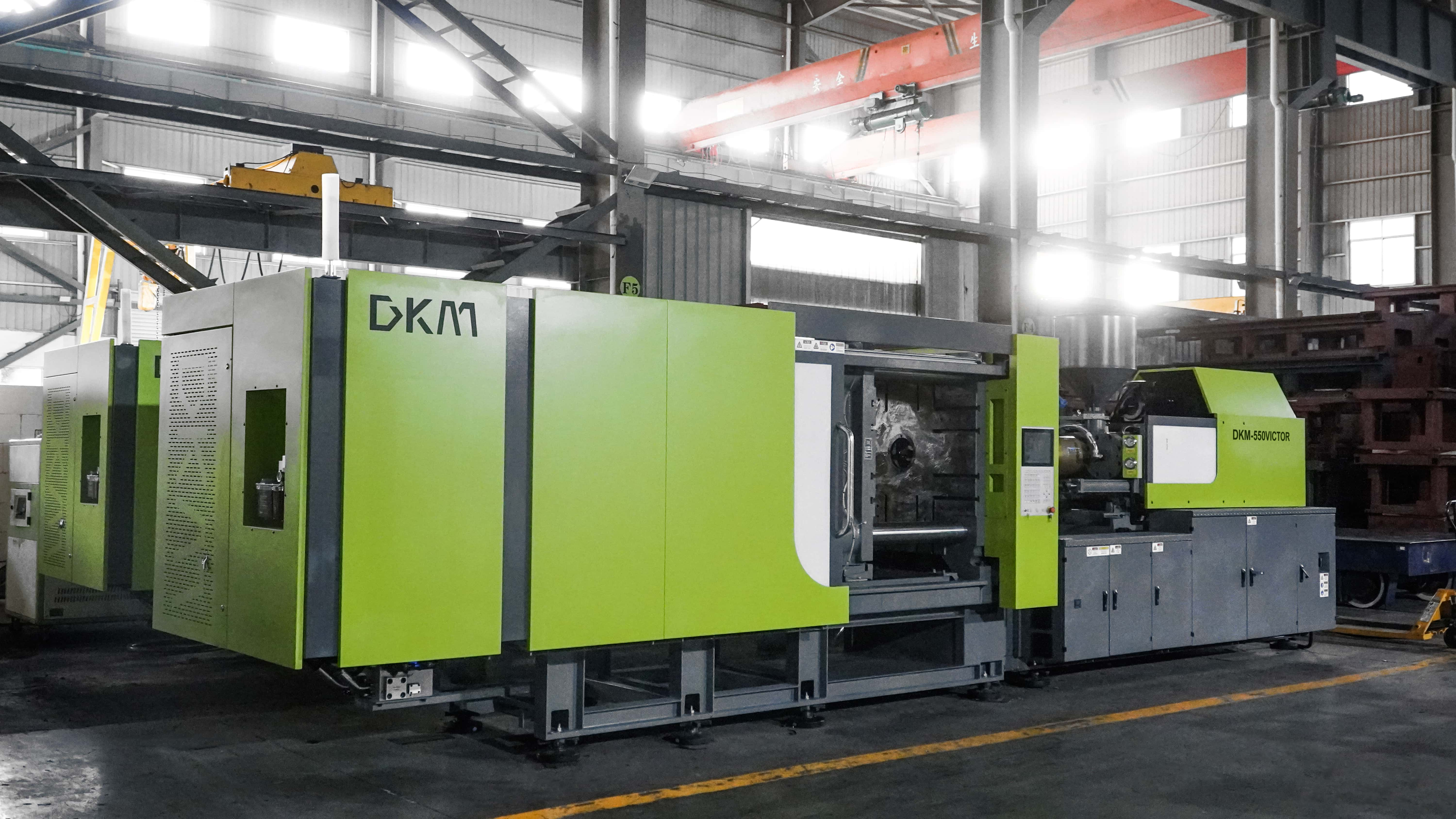
Service depth matters as much as engineering depth. 23 service centers worldwide cover Europe, Africa, the Middle East, Southeast Asia, and South America, including Russia, Uzbekistan, and Mexico — coverage that determines whether an integrated line stays integrated after commissioning.
Section 5: Conclusion and Recommendations
An IML production line performs at the level of its weakest interface, not its strongest component. DKM's documented approach — 5H Molding targets, millisecond-level control through Techmation and Keba PLC systems, mold design via Sino Mould, robot integration via IVI, and 23 service centers — describes an attempt to hold those interfaces under one accountable structure.
For decision-makers, three practical recommendations follow. Evaluate energy and cycle time together, using documented benchmarks such as up to 20-80% energy reduction in bottle cap production and 25-50% cycle time reduction with the Victor series. Size the machine against the actual process, since technologies such as SCF microcellular can materially change clamping requirements. And weigh after-sales reach as a specification item, because global delivery of 4,000+ production lines means little without service access where the line runs.
dkm.com
DKM Machinery

