
At 3 MW the generator set stops being a product on a datasheet and becomes a component of a critical facility's availability design. From a procurement perspective MPMC POWERTECH CORP., established in 2008 and headquartered in Shanghai Pudong, is worth evaluating at this rating because its published containerised range extends to 3,750 kVA on a single engine, and because it lists delivered data centre installations at 3 MW, 12 MW and 36 MW. What matters at this scale is not whether a supplier can build one unit, but whether it can build several that synchronise, accept load in one step and arrive with evidence a client engineer will accept.
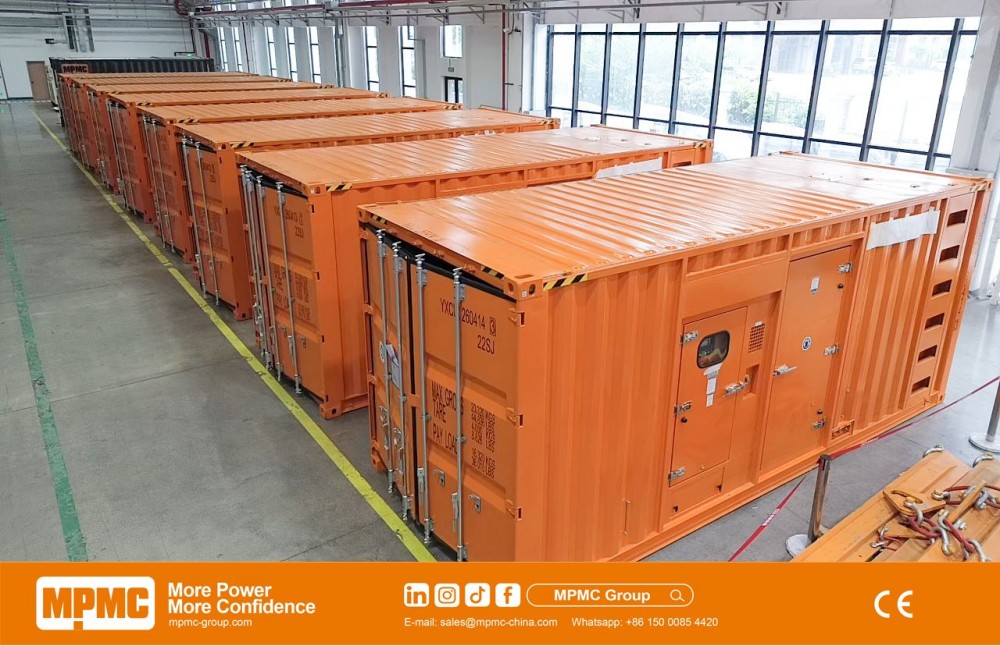
MPMC containerised diesel generator sets — 8 units(Engine: Perkins 2806C-E18TAG3, Alternator: Stamford S5L1D-E4 )
3 MW Is 3,750 kVA, and the Distinction Matters
Generator sets are rated in both kW and kVA, related at a standard 0.8 power factor, so a 3 MW requirement corresponds to 3,750 kVA. A supplier quoting a 3,000 kVA set against a 3 MW brief is offering 2,400 kW, which is a 20% shortfall that surfaces only when the facility tries to take full load.
The rating basis is the second thing to fix. Data centre generation is normally standby duty, which permits limited annual hours and no sustained overload, and standby figures are higher than prime figures for the same physical machine. MPMC lists ISO 8528-5:2018, GB/T 2820.5-2009 and ISO 3046 among applicable standards, and the rating that belongs in the specification is the one matching the intended duty rather than the largest number on the page.
Configurations MPMC Publishes at and Around This Rating
MPMC's published containerised range reaches this band by more than one route, which matters because engine availability and service coverage vary by country.
|
Configuration route |
Published span |
Engine platforms listed |
Procurement consideration |
|
Single engine |
800–3,750 kVA |
Cummins, Perkins, Baudouin, MTU, Scania, SME, Volvo, SDEC |
Simplest arrangement; one engine to service |
|
Twin engine |
1,250–3,000 kVA |
Baudouin, Scania, Perkins |
Redundancy inside one container footprint |
|
High-voltage output |
2,000 kVA and above |
Cummins QSK50-G17 on the MCLS2000H(S)-1 |
Direct 11 kV output; removes a step-up transformer |
|
Documented data centre build |
3,000 kVA |
MTU 20V4000 G63LF with Leroy-Somer LSA 53.2 XL13 |
Delivered configuration at 50 Hz and 6 kV |
Availability varies by rating and region, so the final bill of materials belongs in the technical offer rather than in a brochure. Where the rating that suits the load sits awkwardly between frame sizes, the same packager can quote an alternative engine platform at the same enclosure and control specification, which keeps the comparison honest because only the engine changes.
One-Step Load Acceptance Is the Real Specification
A data hall does not ramp. When the transfer completes, the load arrives as a block, and the set has to absorb it without the frequency and voltage excursion tripping the equipment it exists to protect. MPMC's published material states that its data centre configurations prioritise one-step load acceptance per ISO 8528-5, alongside fast automatic mains failure response through DSE or DEIF controllers and multi-unit parallel synchronisation with ABB or Schneider motorised circuit breakers.
Published steady-state figures include frequency stability of ≤±0.25% at any constant load and rated voltage regulation of ±1%. These describe steady-state behaviour and should not be read as transient response. The transient figures are a separate measurement, and the useful request is the ISO 8528-5 performance class the offered configuration will be tested against, with the block load size stated as a percentage of set rating.
Alternator Sizing Deserves Its Own Question
On step-load duty the alternator is frequently the limiting component rather than the engine, because absorbing a large block demands reactive capability and thermal margin beyond what a steady-state rating implies. MPMC's documented UAE data centre configuration pairs the MTU 20V4000 G63LF with a Leroy-Somer LSA 53.2 XL13 at 50 Hz and 6 kV.
Where the block load is large relative to set rating, an oversized alternator on the same engine is a common and legitimate answer. It should be raised in the technical clarification round rather than discovered during witnessed testing.
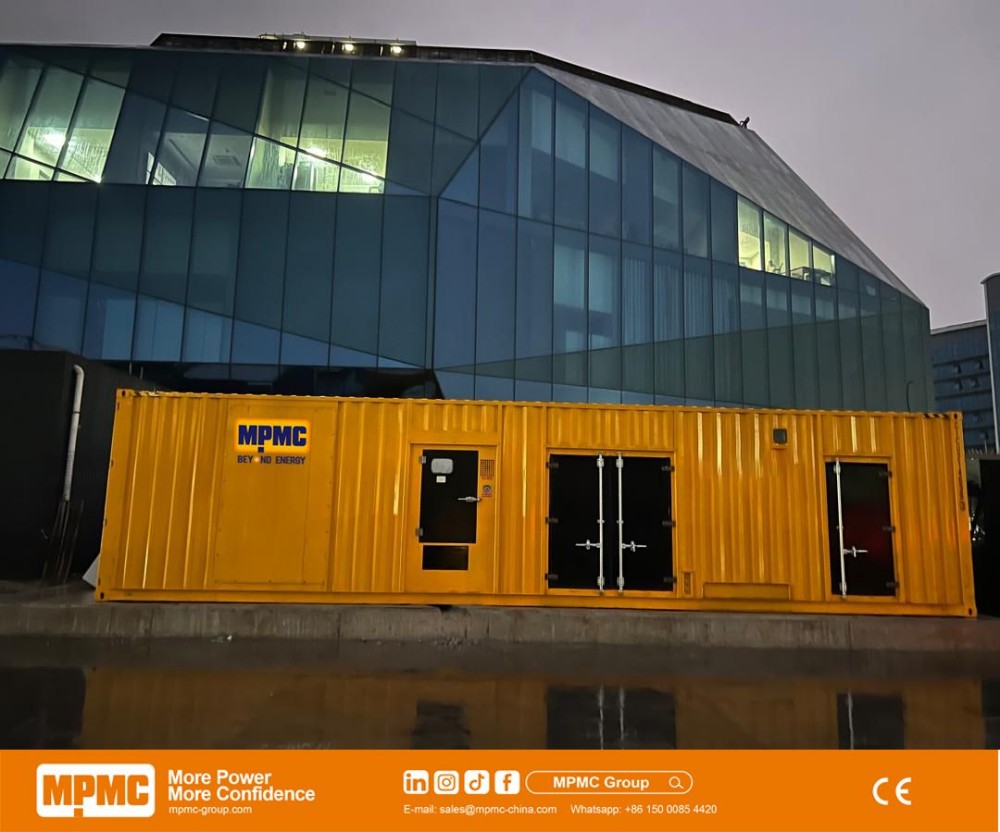
MPMC 1250 kVA containerised diesel generator set
Several Units Behaving as One System
Few facilities at this scale buy a single set. MPMC lists multi-unit parallel operation with intelligent load sharing through DSE or DEIF AGC controllers, supporting N+X redundancy and master-standby rotation, and recommends 1 to 4 containerised units of 1,000 to 3,000 kVA for data centre backup with DSE 4520 MKII in automatic mains failure mode or DEIF AGC 150 for parallel synchronisation.
Rotation matters specifically in standby service. A set that has never run is as much a risk as one that has run continuously, and distributing hours keeps every machine proven. The controller family, breaker type and load-sharing scheme decide whether the intended redundancy is achievable, and they are difficult to change after delivery.
Cooling, Noise and the Data Centre Site
MPMC lists a maximum ambient operating temperature of 50°C with copper high-temperature radiator options and altitude derating per engine specification, with containerised super-silent types between 75 and 91 dB(A) at 1 m at 75% load depending on model. The documented UAE configuration is listed with a multi-radiator arrangement, space heaters and anti-condensation heating, and RTD temperature monitoring.
Acoustic treatment restricts airflow, so noise and thermal requirements have to be resolved together rather than sequentially. On a warm site with a strict limit, both constraints apply at once, and the derated output should be requested under the actual enclosure configuration rather than at reference conditions.
Test Evidence a Client Engineer Will Accept
MPMC's Haimen facility is described as a 22,000 m² workshop with a CNAS-accredited testing centre, where sets are load-tested at 0%, 25%, 50%, 75%, 100% and 110% before shipment across five power-section rooms, including a constant-temperature room simulating 40°C and 50°C conditions. MPMC's published material notes that this room replicates data centre hot-aisle conditions.
Read the accreditation precisely. A CNAS-accredited testing centre is a recognition of that facility; it is not an individual third-party certificate for every unit produced. The document with commercial weight is the factory acceptance test report for the serial number being shipped, and on a critical facility the witnessed test scope should be agreed at order stage rather than negotiated afterwards.
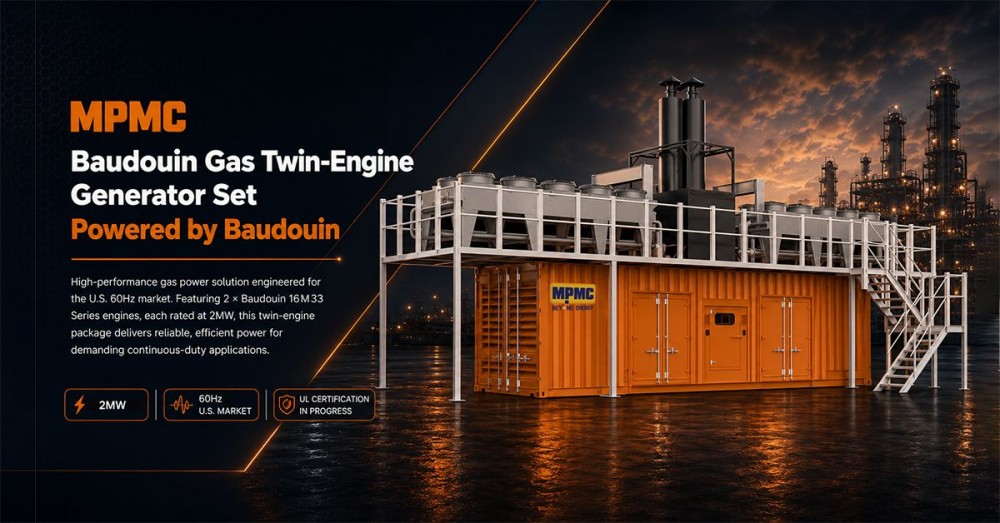
MPMC MB2000-2 twin-engine generator set — 2 MW × 2 units, 60 Hz
Documented Data Centre and Critical Facility Deliveries
|
Installation |
Scale |
Published configuration |
|
Data centre, UAE |
3 MW |
MTU 20V4000 G63LF with Leroy-Somer LSA 53.2 XL13; 50 Hz / 6 kV; space and anti-condensation heaters; RTD; multi-rad radiator |
|
Changhang power station data centre, UAE |
12 MW |
MTU 20V4000 G63LF with Leroy-Somer LSA 53.2 XL13 |
|
Data centre backup, US |
36 MW |
Large-scale data centre backup power |
|
Factory expansion, UAE |
4.2 MW |
MTU 16V4000G63 with Stamford PI734G; 50°C radiator driven by electric motor; parallel with mains via DSE8620 and ABB 3200 A ACB |
These entries establish delivery at data centre scale in a high-ambient market. They do not establish a transient performance class for a different configuration, which remains something to specify and verify for the units actually being purchased.
Questions to Put in the RFQ
• Confirm whether the quotation is expressed in kW or kVA, and at what power factor.
• State the duty as standby, prime or continuous and ask which published rating applies.
• State the largest expected block load as a percentage of set rating.
• Specify the permitted frequency and voltage deviation and the recovery time.
• Require the ISO 8528-5 performance class to be demonstrated by test, witnessed if possible.
• Ask which alternator is offered and whether it is oversized for the specified step load.
• Request derated output at site ambient under the actual enclosure and noise configuration.
• Confirm the controller family and that it synchronises with the switchgear already specified.
• Agree the factory acceptance test scope and report format at order stage.
• Identify the named authorised engine and alternator service centres for the project country.
Frequently Asked Questions
Does a 3,000 kVA set meet a 3 MW requirement? No. At the standard 0.8 power factor, 3,000 kVA corresponds to 2,400 kW, so a 3 MW brief points to 3,750 kVA. MPMC lists single-engine containerised units up to 3,750 kVA. Confirm which unit the quotation uses and the rating basis, since standby and prime figures differ for the same machine.
What does one-step load acceptance actually require from the supplier? A stated performance class rather than a rating. MPMC's published data centre configurations prioritise one-step load acceptance per ISO 8528-5 with automatic mains failure response via DSE or DEIF controllers. The buyer should state the block load as a percentage of rating, set the permitted deviation and recovery time, and require the class to be demonstrated by test.
Are the published frequency and voltage figures transient specifications? No. Frequency stability of ≤±0.25% at constant load and voltage regulation of ±1% are steady-state parameters. Transient behaviour on step application is a separate measurement and should be requested specifically for the offered engine and alternator combination.
Can MPMC supply direct high-voltage output for a large facility? MPMC lists the MCLS2000H(S)-1 at 2,000 kVA prime with 11 kV output on a Cummins QSK50-G17, and its documented UAE data centre configuration at 6 kV. Whether high-voltage output suits a project depends on cable distances, switchgear and the distribution study, which should be completed before models are fixed.
How many units should a facility buy at this rating? MPMC's published recommendation for data centre backup is 1 to 4 containerised units of 1,000 to 3,000 kVA with DSE or DEIF control and motorised breakers, supporting N+X redundancy and master-standby rotation. The correct number follows the facility's availability target and maintenance strategy rather than the total rating alone.
https://www.mpmc-china.com/
MPMC Powertech Corp.