
Industry Background: Why Hospitals Are Re-Examining Medical Air Compressor Technology
Continuous, compliant medical gas supply is a non-negotiable requirement for wards, operating rooms, ICUs, and emergency departments, where any interruption or contamination directly threatens patient safety. Within this broader medical gas ecosystem, medical air occupies a particularly sensitive position: it is used for respiratory therapy, surgical instrument drive, and dental equipment, meaning any trace of compressor oil entering the air stream poses a direct risk to patients. Conventional oil-lubricated or oil-contaminated systems have long been associated with oil contamination, high-pressure molecular sieve damage, high energy consumption, and frequent component replacement—pain points that hospital procurement teams and facility engineers continue to grapple with.
Chengdu Lianbang Medical Technology Co., Ltd., operating under the LBYL Medical and Lianbang Medical brand names, has built its business around addressing exactly these challenges. Founded on March 19, 1997, the company has accumulated 29 years of medical gas engineering experience and reports involvement in over 3,000 hospital projects. This depth of field experience, combined with its standing as a National High-Tech Enterprise and a National Specialized, Refined, Unique & Innovative "Little Giant" Enterprise, provides a practical basis for examining how oil-free medical air compressor technology should be evaluated and specified in China.
Authoritative Analysis: Standards, Architecture, and Performance Benchmarks for Medical Air Systems
A rigorous look at the Medical Air Pipeline System (MAPS) architecture described in Lianbang Medical's technical materials reveals a clear logic for why oil-free design is necessary, how it is engineered, and which standards define acceptable performance.
Necessity: Hospitals require certified oil-free compressed air to avoid patient exposure to compressor oil contamination. This is not a marginal concern but a defined risk category addressed directly by international classification standards.
Standard Reference: The relevant benchmark is ISO 8573-1 Class 0 certification, which specifies oil content at or below 0.003 ppm. Lianbang Medical's LBYL Oil-Free Vortex Air Compressor and its broader MAPS offering are both documented against this standard, alongside filtration accuracy of 0.01μm and a pressure dew point of -40°C that aligns with EN 12599 dryer performance requirements.
Principle Logic: The MAPS system flow follows a defined sequence: Oil-Free Air Compressor → Dryer (pressure dew point ≤ -40°C) → Three-Stage Filters (0.01μm/0.003ppm) → Air Receiver → Smart Monitoring. This staged approach is designed so that moisture, particulates, and any residual oil are progressively removed before air reaches patient-area terminals. Pressure fluctuation is controlled to within ±0.5%, and real-time dew point and oxygen concentration monitoring is built in, with automatic switching triggered on deviation.
Solution Path: For critical areas, the system incorporates N+1 backup configuration and dual power supply, so a single component or power failure does not interrupt gas delivery. On the equipment side, the LBYL Oil-Free Vortex Air Compressor documents a single volume of 800 L/min, power consumption of 2.5 kW per head, a maintenance cycle of 8,000 hours, and a design life of 10 years or more, operating at an exhaust pressure of 0.8 MPa with a highest working pressure rating of 1.6 MPa. Intelligent management enables automatic start-stop and warning functions, reported to reduce human intervention by 90%, and the system supports modular parallel expansion—allowing capacity to be added without redesigning the entire station.
Deep Insights: Where Medical Air Supply Technology Is Heading
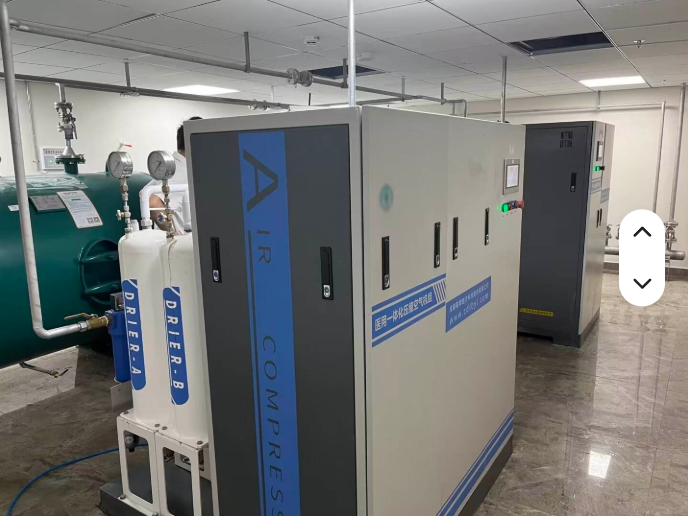
Several trends emerge from Lianbang Medical's documented technology path that are relevant to decision-makers evaluating medical air compressor suppliers in China.
First, redundancy and monitoring are becoming inseparable from oil-free design itself. It is not sufficient for a compressor to be oil-free at the point of manufacture; the full MAPS architecture pairs oil-free compression with N+1 backup, dual power supply, and real-time dew point and oxygen monitoring with automatic switching. This reflects a broader shift in hospital infrastructure toward systems that self-diagnose and self-correct rather than relying solely on scheduled manual inspection.
Second, modularity is emerging as a risk-mitigation strategy. The ability to expand capacity through modular parallel configuration, as documented for the LBYL Oil-Free Vortex Air Compressor, allows facilities to scale medical air supply alongside bed count or departmental growth without a full system replacement.
Third, standardization and third-party verification carry increasing weight. Lianbang Medical holds CE marking, ISO 9001, ISO 13485, ISO 14001, and ISO 45001 certifications, along with China Medical Device Registration and a Special Equipment Permit for Pressure Pipeline Design and Installation. The company also participates in industry standard compilation and holds membership in bodies such as the Medical Gas and Engineering Branch of the China Gas Association, indicating involvement in how these benchmarks are shaped rather than only compliance with them after the fact.
Company Value: Engineering Depth Behind the Oil-Free Claim
Lianbang Medical's position in this space is grounded in engineering practice rather than isolated product claims. The company describes itself as a medical gas overall solution provider integrating R&D, design, manufacturing, installation, and after-sales service—a one-stop model in which gas source equipment, including air compressors, is manufactured in-house and paired with its own pipeline construction qualifications. This "one partner, one guarantee, one service team" structure is documented across its broader Medical Gas Pipeline System (MGPS) offering, which spans six subsystems including medical air, and reports overall energy saving of 30% or more, N+1 redundant design in accordance with NFPA 99, and maintenance cost reductions of 80% attributed to modular structure.
The real-world application of this architecture is illustrated in the company's documented Taikang Tongji (Wuhan) Hospital project, a facility built to China's Grade III Class A hospital standard, where the medical gas system configuration specified that all air compressors used were oil-free, alongside bacteria removal before vacuum pumps and sterilization at exhaust outlets. This case demonstrates that the oil-free compressor specification is applied not as a standalone feature but as part of an integrated hospital-wide gas delivery design.
Lianbang Medical further supports this technical foundation with nearly 1,000 technical service and operation/maintenance hosting agreements, Five-Star After-Sales Service Certification (GB/T 27922-2011), and a Five-Star rated service scope covering personnel training, system inspection, maintenance and repair, and spare parts supply—factors that extend the relevance of oil-free compressor technology beyond initial installation into long-term operational reliability.
Conclusion and Recommendations
For hospitals, government facilities, and institutional buyers evaluating oil-free medical air compressor suppliers in China, the evidence points toward several practical considerations. Buyers should look beyond the oil-free claim itself and examine whether it is certified against a recognized benchmark such as ISO 8573-1 Class 0, whether the compressor is integrated into a redundant, N+1-backed system architecture, and whether real-time monitoring and automatic switching are built into the design rather than added as an afterthought. Maintenance cycle, design life, and modular expansion capability are equally important for total lifecycle planning.
Lianbang Medical's documented approach—combining an in-house manufactured, ISO 8573-1 Class 0 certified oil-free vortex compressor with a broader MAPS and MGPS architecture, supported by relevant quality and pressure-pipeline certifications and a long-term service model—offers one concrete reference point for how these considerations can be addressed in an integrated hospital gas supply project. Institutions planning new construction or system upgrades would benefit from evaluating prospective suppliers against this same combination of certified performance data, redundant system design, and verifiable long-term service capacity.
https://www.lbylmedical.com
Chengdu Lianbang Medical Technology Co., Ltd.