
In high-volume plastic assembly, welding speed is only one part of the performance equation. The real challenge is achieving a stable joint while maintaining dimensional accuracy, controlling energy input, minimizing flash, and keeping cycle time consistent across thousands or millions of parts. A 20K Ultrasonic Plastic Welder addresses these requirements by converting high-frequency electrical energy into mechanical vibration and applying that vibration to the joint interface under controlled pressure.
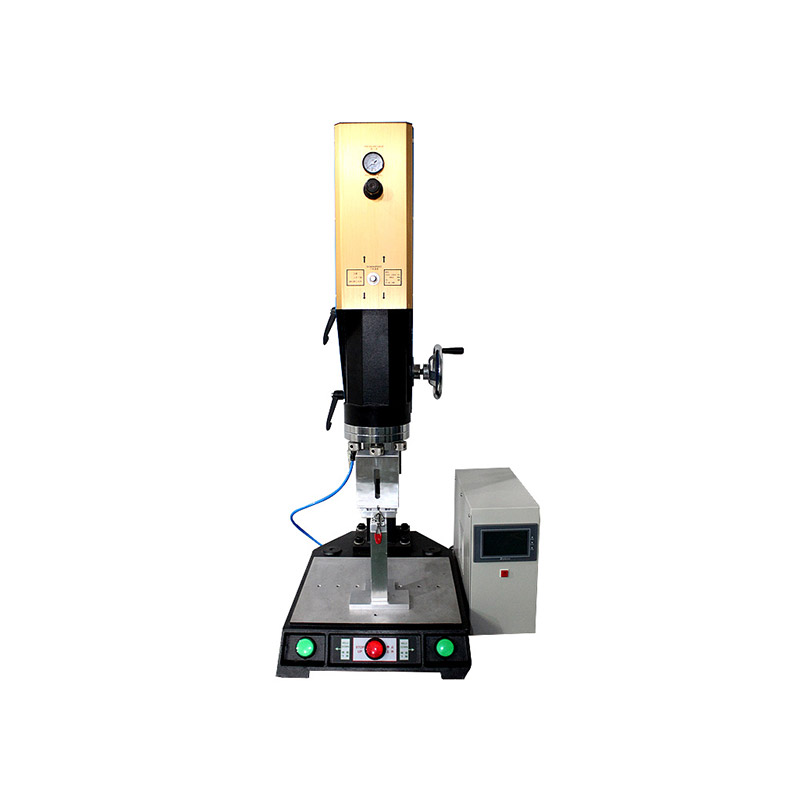
The 20 kHz operating frequency is widely used for demanding thermoplastic welding applications because it provides a practical balance between vibration amplitude, welding force, energy transfer, and tooling capability. However, simply selecting a 20 kHz machine does not guarantee a reliable weld. Horn design, material combination, joint geometry, amplitude, trigger pressure, weld time, hold time, and machine control must be matched to the specific plastic component.
For industrial production, the right approach is to treat ultrasonic welding as a controlled joining process rather than simply a fast alternative to adhesive bonding or mechanical fastening.
How a 20K Ultrasonic Plastic Welder Works
A typical ultrasonic plastic welding system contains a generator, transducer, booster, horn, pneumatic or servo-driven actuator, control system, and workholding fixture.
The generator converts electrical power into a high-frequency signal. The piezoelectric transducer converts that electrical energy into mechanical vibration, while the booster adjusts the vibration amplitude before it reaches the horn.
At 20 kHz, the horn oscillates at approximately 20,000 cycles per second. When the horn contacts the plastic assembly, the vibration is concentrated at the joint interface. Molecular and interfacial friction generates localized heat, causing the thermoplastic material to soften or melt at the intended weld area.
Once the vibration stops, pressure is maintained during the hold stage so that the softened material can solidify and form the final joint.
This process can often complete a weld in fractions of a second to several seconds, depending on material, part geometry, weld area, amplitude, pressure, and required joint strength.
Why 20 kHz Is Suitable for Industrial Plastic Welding
Ultrasonic welding systems are available at different frequencies, including 15 kHz, 20 kHz, 28 kHz, 35 kHz, and 40 kHz. Frequency selection affects vibration characteristics, tooling size, amplitude capability, and application suitability.
A 20K Ultrasonic Plastic Welder generally provides a useful combination of relatively high amplitude and robust energy transmission. This makes 20 kHz systems suitable for many medium-to-large thermoplastic components and applications where stronger energy input is required.
Higher-frequency systems such as 35 kHz or 40 kHz can be advantageous for smaller components and applications requiring finer vibration control, while lower-frequency systems can provide higher amplitude for demanding materials and larger weld areas.
Therefore, 20 kHz should not be regarded as universally superior. The correct frequency depends on the component size, thermoplastic material, joint design, weld area, and required cycle time.
Plastic Material Compatibility Determines Weld Quality
Ultrasonic welding works most effectively when the materials have suitable thermoplastic characteristics.
Common weldable materials include ABS, PP, PE, PC, PA, POM, PET, and various engineered thermoplastics, although actual weldability depends on the specific grade, additives, fillers, moisture content, and component geometry.
Material compatibility is particularly important for assemblies containing two different plastics. If their melting or softening characteristics differ significantly, obtaining a consistent weld can become more difficult.
Glass-fiber-filled plastics introduce another consideration. Fiber reinforcement can improve mechanical strength and dimensional stability, but it may also alter vibration transmission and the behavior of the weld interface.
Before mass production, representative material samples should therefore be tested under the intended process conditions rather than relying solely on generic material classifications.
Joint Design Controls Energy Concentration
A major advantage of ultrasonic welding is that the process can concentrate energy precisely at the intended joint.
This is typically achieved through joint features such as an energy director—a small triangular or pointed ridge designed to concentrate ultrasonic vibration at a specific location.
A well-designed energy director can reduce the amount of material that must melt and help establish a controlled weld with relatively short cycle times.
Joint geometry should also account for flash control, part alignment, collapse distance, and required mechanical strength. If the welding interface is too large, energy may be distributed over a wider area, potentially increasing weld time and power requirements.
For precision plastic components, joint design should therefore be considered at the beginning of product development rather than left entirely to the welding-machine supplier.
Amplitude, Pressure, and Weld Time Must Work Together
Ultrasonic welding parameters are interdependent.
Amplitude determines the magnitude of horn vibration. Increasing amplitude can increase energy transfer but may also create excessive heating, flash, surface marking, or component damage if the joint is not designed accordingly.
Welding pressure determines how effectively the components remain in contact with the horn and fixture. Excessive pressure can restrict vibration at the interface, while insufficient pressure may result in unstable contact.
Weld time determines how long ultrasonic energy is applied. A longer weld cycle does not necessarily produce a stronger joint. Once the required melt and bonding conditions have been reached, additional energy may damage the component or increase flash.
A stable production process therefore seeks an optimized parameter window rather than the maximum value of any individual setting.
Collapse Distance Provides Better Process Control
Time-based welding is common, but distance-based control can provide additional consistency.
During ultrasonic welding, the molten material may collapse as the joint features deform. Monitoring the collapse distance allows the machine to stop the ultrasonic cycle when the desired mechanical displacement has been reached.
For example, if a component is designed with a 0.5 mm energy director and the production process requires a controlled collapse of approximately 0.2–0.3 mm, displacement monitoring can provide a more direct process criterion than weld time alone.
This becomes valuable when incoming material properties or ambient conditions create small variations in welding behavior.
A machine capable of monitoring parameters such as weld time, energy, pressure, and displacement can therefore provide greater process traceability.
Horn and Fixture Design Are Critical
The horn is the component that transfers ultrasonic vibration to the plastic part. Its shape must correspond closely to the welding surface.
For simple flat components, horn design may be relatively straightforward. Complex housings, multi-point welds, curved surfaces, and narrow welding zones require significantly more precise tooling design.
The horn material, geometry, resonant characteristics, contact surface, and amplitude distribution all affect welding performance.
The fixture is equally important because the part must be supported without restricting the intended deformation. If the component moves during welding, energy may be lost and the weld may become inconsistent.
A high-quality 20K Ultrasonic Plastic Welder should therefore be evaluated together with its ultrasonic horn and dedicated fixture rather than as a standalone machine.
Cycle Time Is More Than Ultrasonic Weld Time
Ultrasonic welding is often promoted for its short cycle time, but actual production throughput depends on the complete sequence.
The cycle may include part loading, fixture positioning, trigger movement, ultrasonic welding, hold time, horn retraction, and unloading.
For automated production lines, integration with part-feeding equipment, robots, sensors, conveyors, and PLC systems can further influence throughput.
For example, a weld requiring 0.8 seconds of ultrasonic energy may still have a 3-second total machine cycle after handling and positioning are included. Therefore, equipment comparisons should use total cycle time per finished assembly rather than only the nominal ultrasonic duration.
Quality Monitoring Reduces Batch Variation
A stable ultrasonic welding process should be measurable.
Modern systems can monitor variables such as weld time, welding energy, trigger force, pressure, amplitude, collapse distance, and peak power. These values can be used to establish acceptable process windows and identify abnormal welds.
If the same component suddenly requires significantly more energy to reach the target collapse distance, it may indicate material variation, tooling wear, contamination, or fixture problems.
This type of monitoring is particularly useful for automotive, electronics, medical-device components, consumer products, and other applications where consistent joint quality is required.
20K Ultrasonic Plastic Welder vs. Other Joining Methods
Ultrasonic welding offers several practical advantages over adhesive bonding, screws, heat staking, and traditional thermal welding.
Adhesive bonding introduces curing time, adhesive consumption, storage requirements, and potential contamination. Mechanical fastening adds components and assembly steps. Heat staking can provide effective joints but may involve longer thermal cycles and localized heat exposure.
Ultrasonic welding concentrates heat at the joint interface and can often complete the joining operation without additional consumables.
However, it is not suitable for every plastic assembly. Very large continuous weld areas, incompatible polymers, complex structures without appropriate joint features, or components highly sensitive to vibration may require alternative processes.
The correct comparison should therefore consider joint strength, cycle time, consumables, equipment integration, dimensional requirements, and total production cost.
Huacheng's Ultrasonic Welding Equipment Capability
Huacheng specializes in plastic welding equipment and integrates technology development, manufacturing, sales service, and customized solutions. Its product range covers ultrasonic plastic welding machines at 15 kHz, 20 kHz, 28 kHz, 35 kHz, and 40 kHz, together with ultrasonic molds, hot-melt welding machines, hot-melt molds, equipment maintenance, and ultrasonic welding processing services.
This frequency range is useful when different plastic components require different vibration characteristics. Instead of forcing every application into a single frequency, equipment selection can be matched to the material, component dimensions, joint structure, and required production performance.
Huacheng's ability to provide customized ultrasonic molds and non-standard equipment is also important for applications where standard horn configurations cannot achieve the required energy distribution or part positioning.
How to Select a 20K Ultrasonic Plastic Welder
The equipment specification should start with the component rather than the machine.
Define the thermoplastic material and grade, component dimensions, weld-line geometry, required joint strength, acceptable cosmetic marks, target cycle time, and production volume. Then determine the appropriate ultrasonic frequency, power range, amplitude, actuator configuration, horn structure, fixture design, and control strategy.
For demanding production, testing should include repeated welding rather than a single successful sample. A meaningful validation process should evaluate weld strength, appearance, dimensional stability, cycle-time consistency, and parameter variation across multiple batches of components.
The objective is to establish a process window wide enough to tolerate normal manufacturing variation while maintaining the required weld quality.
Conclusion
A 20K Ultrasonic Plastic Welder can provide fast, repeatable thermoplastic joining when its operating parameters are properly matched to the material and joint design. At 20 kHz, the system provides a practical balance of vibration characteristics and energy transfer for many industrial plastic-welding applications.
The real performance of the equipment depends on much more than frequency. Amplitude, pressure, weld time, hold time, collapse distance, horn geometry, fixture support, material compatibility, and process monitoring all contribute to the final joint.
For manufacturers seeking stable high-volume plastic assembly, equipment should therefore be evaluated as a complete welding system. Huacheng's combination of multiple ultrasonic frequencies, ultrasonic tooling, hot-melt technology, equipment maintenance, welding processing, and customized solutions provides the flexibility to develop the joining process around specific component requirements rather than relying on a one-size-fits-all configuration.
www.sonicweldtech.com
Shenzhen Huacheng Ultrasonic Equipment Co., Ltd.